
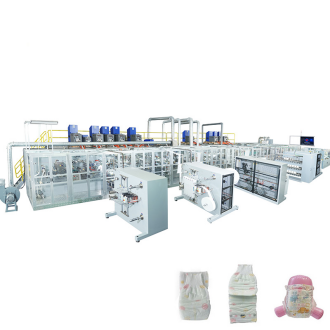
High Efficiency Diaper Production Machine: Revolutionizing Diaper Manufacturing
2026-11-02
Every few years, a machine comes along that doesn't just improve diaper production—it rewrites the rules. The high-efficiency diaper production machine is doing exactly that, and Womeng is one of the names pushing this change from the factory floor upward. But the real story isn't just speed; it's how precision, material savings, and uptime finally fit into one system. Here's a look at what makes this shift hard to ignore.
From raw roll to wrapped pack in under a minute
The roll sits at the feed end, a dense cylinder of film waiting for motion. Once the line starts, there’s no pause: unwind, tension, and forming happen in one continuous sweep. A sensor reads the edge, the film wraps around the product, and the seal bar comes down before you can blink. What used to take a crew and several steps now finishes in the time it takes to pour a coffee.
Speed here isn’t about rushing—it’s about removing every wasted motion. The raw roll feeds directly into the forming collar, and from that point the product never stops moving. Heat, pressure, and cut-off happen in a tight sequence that leaves no room for adjustment by hand. Operators rarely touch the film; they just keep the rolls loaded and watch the count climb.
What makes the under-a-minute claim real is the lack of staging areas. There’s no batch waiting, no manual folding, no tape gun. The pack emerges sealed and trimmed, ready for a carton or a shelf. For a line that runs all day, those saved seconds per cycle stack into hours—and that’s the difference between keeping up with orders and chasing them.
Cutting scrap without slowing the line
On high-speed stamping or roll-forming lines, scrap often leaves the station as a continuous ribbon or skeleton. Stopping the line to manually cut it, or letting it pile up until a certain length is reached, interrupts the cadence. By fitting a rotary shear or flying cutoff that matches line speed, the scrap can be chopped into preset lengths and dropped onto a take-away conveyor below—without the main line ever slowing down.
The trick lies in syncing the cutting motion with material velocity. Modern systems use encoder feedback and servo-driven blades to accelerate, cut, and return in a fraction of a second. Some designs rely on pendulum or helical knife shears, where the blade travels at the same speed as the scrap at the instant of the cut, so there is no pulling or jamming. Cut lengths can be held to millimeter accuracy, which simplifies baling or recycling downstream.
Cutting scrap this way also reduces safety exposure, since operators no longer need to work near moving scrap. Blade changes take only a few minutes, and wear monitoring can flag replacement before it becomes a problem. For lines already running at full capacity, this is often more cost-effective than trying to increase line speed or add shifts.
Fewer micro-stops with adaptive tension control
Adaptive tension control keeps the line moving by adjusting in real time to variations in material, speed, or roll diameter. Instead of a fixed setting that works only under ideal conditions, the system senses small fluctuations and counters them before they grow into stoppages. Operators notice fewer pauses where the machine would otherwise wait for manual correction, and the steady motion reduces wear on moving parts that typically suffer from abrupt stops and starts.
The practical benefit shows up most clearly in lines where micro-stops used to accumulate. A slight slack or over-tension at a splice, a shift in coil memory, or a gradual change in ambient temperature could each trigger a brief halt. With adaptive control, those triggers are absorbed continuously, not just at set intervals. The result is a smoother cadence: fewer alarms, less operator intervention, and a throughput curve that stays closer to its theoretical maximum without pushing the equipment harder.
What makes this different from older tension systems is the feedback loop. Rather than reacting after a sensor trips a threshold, the controller predicts the next few milliseconds based on current draw, dancer position, and line speed. It then slightly adjusts torque or brake pressure before a fault can occur. Over a shift, those avoided micro-stops add up to meaningful production time, especially in high-cycle operations where every second of downtime is repeated across dozens of lanes.
Power draw drops while output climbs
Modern hardware efficiency gains feel almost paradoxical at first glance. The newest chips sip power during idle and light loads, yet they deliver frame rates and throughput numbers that were unthinkable just a few generations ago. This isn't a marketing trick; it comes from smarter voltage regulation, finer-grained clock gating, and architectural changes that keep more execution units busy without waking up unused blocks. The result is a workload profile where the total energy per task falls sharply, even as peak performance edges higher.
Much of the improvement traces back to how power states are managed in real time. Instead of running all cores at a fixed high frequency, the silicon rapidly shifts between boost, sustained, and idle states based on actual demand. A burst of single-threaded work may spike a few watts for milliseconds, but the system quickly returns to a near-silent baseline. Meanwhile, the work itself finishes faster, so the watts-per-job metric drops. This dynamic balancing act means the headline performance number goes up while the average wall draw stays surprisingly low.
For anyone building a compact system or running workloads around the clock, this shift changes the math. Cooling requirements shrink, power supply headroom becomes less of a guessing game, and energy bills stop climbing in lockstep with performance. The old assumption that more speed always means more heat and more electricity no longer holds. Instead, the focus moves to sustained efficiency under real workloads, where the latest designs manage to push output higher while keeping the power meter calm.
Switch diaper sizes with a few taps
Updating your baby’s diaper size doesn’t have to involve digging through menus or contacting support. Open the app, tap the size selector, and pick the new option from a clean, visual list. The change applies instantly, so your next delivery or reminder reflects the right fit without any extra steps.
Whether you’re sizing up after a growth spurt or switching brands with different sizing charts, the process stays quick and forgiving. A simple confirmation appears after each tap, and you can undo a change just as fast if you hit the wrong size by accident. No forms, no waiting, no hassle.
For parents juggling multiple kids, each profile keeps its own diaper size independent. Flip between children with a single swipe, then adjust only the one that needs it. The interface responds immediately, so you can make updates on the go — even with one hand while holding a wiggly baby.
Why older machines now cost more to run
Many manufacturers have quietly stopped producing replacement parts for models built ten or fifteen years ago. Once dealer inventories run dry, maintenance teams are forced to source components from salvage yards or pay for custom machining. A simple drive belt or control board can now cost three times what it did in 2019, and lead times stretch from days to weeks. Every hour a machine sits idle waiting for a part adds to the real cost of keeping it in service.
The energy gap has also widened. Older motors, pumps, and compressors often draw 20 to 40 percent more electricity than modern variable-speed equivalents. With industrial power rates climbing steadily, that inefficiency shifts from a minor annoyance to a major line item. Some regions now add surcharges for high-consumption equipment or require periodic energy audits, which create additional compliance costs for legacy systems.
Service and insurance expenses are climbing as well. Technicians who know the quirks of older control panels are retiring, and younger staff tend to specialize in digital and networked machinery. Longer diagnostic times and higher hourly labor rates push each repair bill upward. Insurers, too, are treating aging equipment as a greater risk, raising premiums or demanding more frequent third-party inspections. These hidden costs mean that running an old machine is no longer the bargain it once was.
FAQ
The line integrates servo-driven web handling and precision ultrasonic bonding to eliminate mechanical dwell times. A closed-loop tension control system keeps each material layer aligned at speeds above 400 meters per minute, while automated splice units swap rolls without slowing the process.
Waste reduction comes from on-the-fly trim removal and a vision system that adjusts cut positions in real time. Defective pads are detected before the folding stage, so only the flawed segment is rejected rather than an entire batch, cutting edge trim loss to under 0.5 percent.
Yes, size changes use recipe-driven format parts. Operators load a saved profile and the machine automatically repositions folding plates, adhesive nozzles, and cutting drums. A full changeover typically takes less than 15 minutes with two technicians.
Inline sensors measure basis weight, moisture, and bond strength at multiple stations. The control system compares readings against tolerances every 50 milliseconds and adjusts heat or pressure instantly, so every diaper leaving the line meets the same tight specifications.
It handles nonwoven topsheet, breathable backsheet, fluff pulp with SAP, elastic strands, and hook-and-loop tapes. Unwind stands use automatic web guides and buffer accumulators, letting operators load jumbo rolls without pausing production.
All cutting and bonding stations are enclosed with interlocked guards, and the HMI shows real-time diagnostics with step-by-step recovery prompts. Self-lubricating bearings and quick-release shafts cut routine maintenance to about two hours per week.
Regenerative drives feed braking energy back into the plant grid, while heated drums use insulated jackets and multi-zone controls. Idle mode drops power consumption by 40 percent during short breaks without affecting restart speed.
Higher throughput spreads fixed labor and overhead across more units. Reduced waste, faster changeovers, and predictive maintenance alerts also shrink variable costs, giving manufacturers a measurable payback typically within 18 months.
Conclusion
The modern diaper line no longer crawls through changeovers or stops for trim buildup. From raw roll to wrapped pack in under a minute, a high-efficiency machine compresses what used to be a multi-stage, people-heavy process into a continuous, tightly choreographed flow. The savings start with scrap: advanced rotary dies cut waste without slowing the web, so expensive nonwovens aren't sacrificed to keep pace. Just as important, adaptive tension control reads and corrects subtle variations in stretch, caliper, and unwind tension, eliminating the micro-stops that used to shave minutes off every shift. Operators spend less time clearing jams and more time managing multiple lines.
That reliability shows up in the energy bill, too. Because servo axes run only when needed and recover braking energy, power draw drops while unit output climbs—a pattern that older fixed-speed lines simply cannot match. When a plant needs to switch diaper sizes, recipe-driven controls make it a few taps instead of a half-day mechanical teardown, so shorter runs and private-label orders become feasible. Meanwhile, legacy machines now carry a hidden tax: rising labor for manual adjustments, higher scrap from imprecise tension, and energy waste from constant-speed motors. The contrast is stark enough that replacing an old line is less about buying new equipment and more about reclaiming margin in a market where product variety keeps expanding.
Contact Us
Contact Person: Jessie Lai
Email: [email protected]
Tel/WhatsApp: 86-188594442931
Website: https://www.wm-machinery.com