Top 4G Core Network Features for Seamless Mobile Connectivity
2026-10-16
Ever wondered why some networks keep your video stream smooth while others stutter in crowded spaces? The secret often lies in the core, not the tower. Among core network vendors, IPLOOK has been helping operators deploy top 4G core features that make seamless mobile connectivity a reality. Here are the four you cannot afford to ignore.
The All-IP Core That Powers Seamless Mobility
The shift away from circuit-switched backbones didn't just swap protocols; it forced a rethink of how sessions survive when a user moves from a macro cell to Wi-Fi or between radio access technologies. A true all-IP core carries every service—voice, video, messaging—over packet flows with common authentication and policy control, so mobility is no longer a patchwork of inter-system handovers but a continuous state maintained by the network itself.
What often goes unstated is how much this simplifies the radio edge. When the core treats all access as untrusted IP pipes, a device can re-anchor its flows without tearing down the application layer. Session continuity becomes an attribute of the bearer, not a feature bolted onto each service. That shift removes the old dependency on single-vendor interfaces and lets operators mix small cells, Wi-Fi, and future spectrum bands without re-architecting the backbone.
The operational payoff shows up in latency-sensitive use cases. Because signaling no longer traverses separate voice and data domains, handover decisions can be made closer to the user plane, and policy can follow the session rather than the access type. This is what makes a moving vehicle's video call hold up across network boundaries—not a tweak to a codec, but a core that sees mobility as its default state.
How the EPC Keeps Sessions Alive on the Move
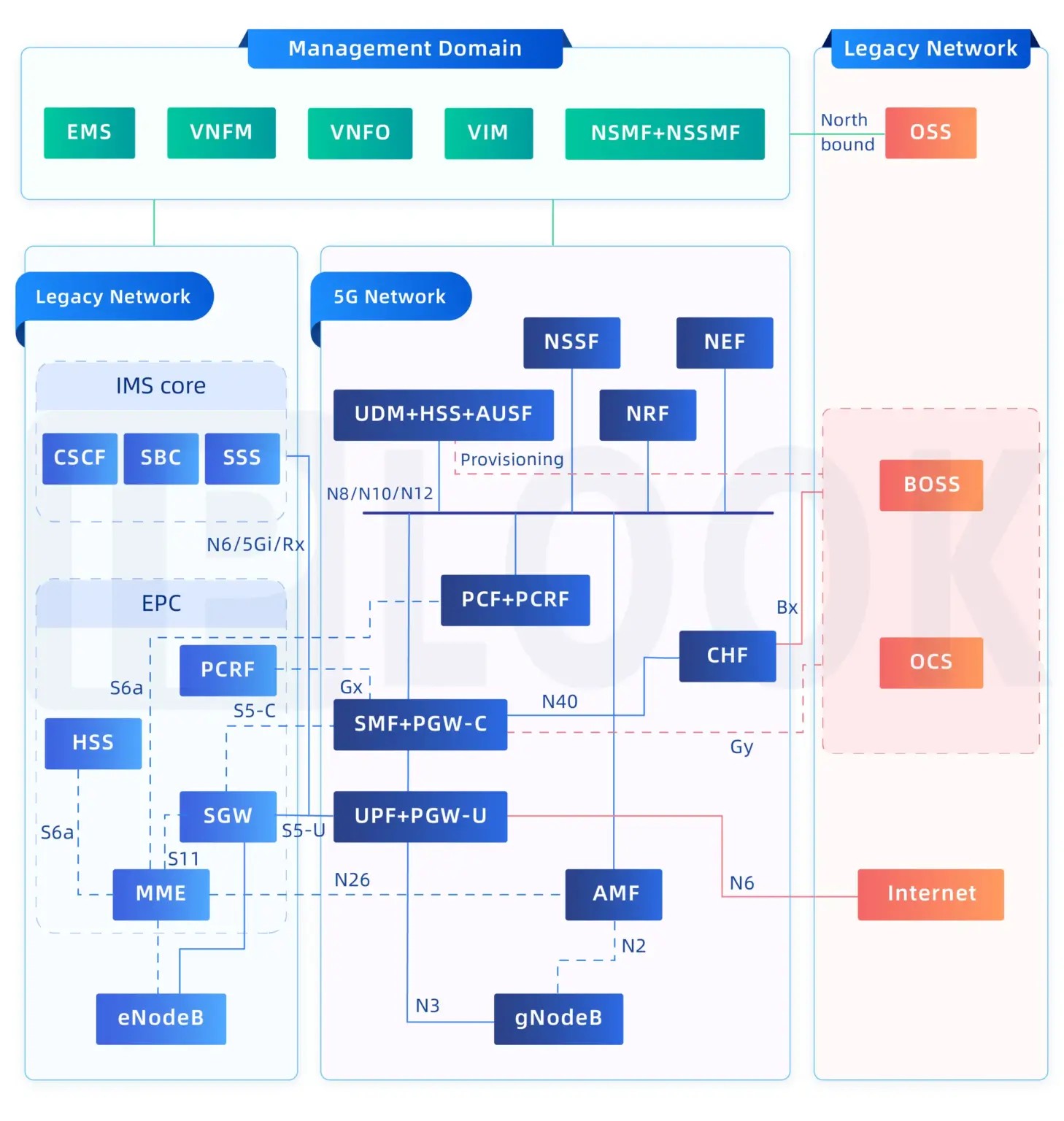
The real challenge for any mobile network isn't starting a data session—it's keeping that session intact as a device crosses cell boundaries, switches between base stations, or even moves across serving gateways. The EPC solves this by anchoring every active session at a fixed point in the core, the PDN Gateway, while the Serving Gateway and MME quietly re-route traffic behind the scenes. A user watching a video on a train might pass through dozens of cells, but the IP address and ongoing data flows never change from the application's perspective.
Two handover mechanisms do most of the heavy lifting. When movement stays within a small cluster of base stations, an X2-based handover lets the old and new eNodeBs talk directly, forwarding buffered packets with almost no interruption. If the user crosses into a different tracking area or the serving gateway needs to change, the MME orchestrates an S1-based handover—updating the tunnel endpoints and letting the new serving gateway take over, while the PDN Gateway remains the unmoving anchor. This layered approach prevents dropped sessions without requiring every app to reconnect.
There's also a less visible layer of continuity: the tracking area update. Instead of constantly reporting precise location, a device only notifies the network when it enters a new paging region. That way, when an incoming packet arrives, the MME knows exactly which set of base stations to page. It's a deliberately lazy location strategy—just enough tracking to keep sessions reachable, not so much that the signaling overhead kills the battery or the core network. This balance is why a VoIP call can survive a highway drive or a walk through a dense city.
Dynamic QoS for Uninterrupted Voice and Video
Real-time voice and video traffic collapses quickly under bufferbloat or a sudden spike in file transfers. Our dynamic QoS layer reacts to congestion in milliseconds rather than relying on static port-based rules. It continuously scores each flow by packet size, inter-arrival time, and codec fingerprints, then places VoIP and conferencing packets into a strict-priority low-latency queue. The result is that a Microsoft Teams call or SIP trunk stays intelligible even when the same uplink is saturated by cloud backups.
The system also adapts to Wi-Fi and multi-WAN conditions that change from minute to minute. Instead of a fixed bandwidth reservation, it measures actual airtime contention and jitter before deciding how much headroom voice and video need. This prevents both under-provisioning, which causes dropouts, and over-reserving, which starves bulk traffic. For remote workers on cable, DSL, or 5G, the same policy follows the device across networks, so a presentation or softphone conversation does not degrade when the route changes.
Administrators get visibility without tuning dozens of knobs; the engine learns the baseline RTP streams and applies per-application DSCP tags automatically. It can also temporarily deprioritize non-urgent updates and peer-to-peer transfers during an active call, then restore fairness once the session ends.
Inter-Cell Handover With Zero Perceptible Lag
The key to hiding a cell handover from the user lies in overlapping the radio paths long enough for the target link to become fully operational before the source is torn down. Instead of dropping one connection and then searching for another, the device maintains simultaneous uplink and downlink synchronization with both cells during the transition. Only after the new link meets stability and throughput requirements does the network release the old one, which removes the brief silence or packet burst that would otherwise appear in a voice call or real-time video stream.
This overlap alone is not sufficient unless the base stations share timing and context in advance. A coordinated scheduler prepares the target cell with the device's security keys, bearer configuration, and buffer state while the source cell still handles traffic. Predictive algorithms can also trigger this preparation early by tracking movement vectors, radio quality trends, and historical handover points, so the network is ready before the signal actually degrades. As a result, the decision and execution phases collapse into a sub-millisecond window that is imperceptible to the end user.
Deploying such a mechanism in dense urban or high-speed rail environments requires careful tuning of dual-connectivity thresholds and backhaul latency between cells. Too early a preparation wastes resources, while too late risks a dropped frame. Operators often combine this with edge computing nodes that replicate user-plane traffic across adjacent cells, ensuring the data path stays continuous even as the radio anchor shifts. When configured well, the handover becomes transparent for interactive applications such as cloud gaming, augmented reality, and remote control of moving vehicles.
Security Layers That Don't Add Latency
Security usually comes with a performance penalty, but that trade-off isn't inevitable. The trick is to weave checks into the existing request path rather than bolting on extra hops. For instance, running lightweight policy evaluation inside the same process that handles traffic avoids the round-trip to a separate authorization service. Hardware-accelerated TLS termination and session resumption keep encryption overhead small enough that users won't notice the difference.
Another angle is to make security decisions before data hits the wire. Precomputed threat signatures, connection-level filtering, and kernel-level packet inspection can drop malicious traffic without touching application logic. When each layer operates on already-parsed metadata, the added cost shrinks to a few microseconds. This approach keeps latency flat while still blocking intrusion attempts at the edge.
Finally, asynchronous auditing plays a role. Instead of writing security logs synchronously during the request, buffer them in memory and flush in batches. That removes disk I/O from the critical path. Combined with in-process checks and early filtering, you get defense in depth that doesn't slow down the user experience.
Adaptive Policy Control for Congested Networks
Adaptive policy control shifts the focus from static bandwidth caps to dynamic resource allocation based on real-time congestion signals. Instead of applying the same rules to every subscriber, the system observes queue lengths, link utilization, and packet loss patterns, then adjusts per-flow priorities on the fly. This allows latency-sensitive traffic to pass with minimal delay while bulk transfers are temporarily throttled, keeping the network responsive without manual intervention.
One practical approach pairs lightweight traffic classifiers with a feedback loop that periodically re-evaluates link state. When congestion builds past a threshold, the controller tightens admission for non-critical flows and expands headroom for interactive sessions. Over time, the policy learns typical demand peaks and pre-allocates buffers accordingly, reducing the need for reactive drops. The result is a smoother degradation curve under load rather than abrupt service interruptions.
Deployment requires careful tuning of the control interval and the aggressiveness of rate adjustments. Too frequent changes can cause oscillation, while too slow a response lets queues overflow. Operators often start with conservative step sizes and widen them only after observing stable behavior across mixed traffic scenarios. This balance between responsiveness and stability is what separates effective adaptive policy control from naive throttling mechanisms.
FAQ
The 4G core network, officially named the Evolved Packet Core (EPC), is the central part of an LTE network that handles data and voice traffic between the radio access network and external data networks. It's called 'evolved' because it replaced the circuit-switched architecture of 3G with an all-IP packet-switched design, which simplifies routing and lowers latency. The 'packet core' label comes from its job: processing every piece of user data as IP packets rather than dedicated voice circuits.
Seamless handover relies on the X2 interface between eNodeBs and the S1 interface to the core. When a device moves, the source base station forwards buffered packets to the target station while the MME updates the user's location with the serving gateway. Because the user's IP address stays anchored at the PDN gateway, ongoing sessions aren't dropped. The network also uses a temporary tunnel to avoid packet loss during the transition, so a video call can continue without a noticeable interruption.
QoS in the 4G core is managed through bearers—logical channels with specific priority and bit-rate guarantees. When a user starts an app, the network sets up a default bearer for basic internet traffic, and may create dedicated bearers for services like VoLTE or streaming that need low latency and stable throughput. The PCRF policy engine decides which rules apply based on subscription and service type, and the PGW enforces those rules. This layered approach keeps high-priority traffic flowing even when the cell is congested.
VoLTE cannot function without IMS integration in the core because it needs the EPC's dedicated bearer with guaranteed bit rate and QoS class identifier set to 1 for voice. Unlike over-the-top VoIP apps, VoLTE voice packets are treated as premium traffic inside the operator's network, not best-effort internet data. The IMS handles session setup and teardown using SIP, while the EPC reserves resources end-to-end, so calls aren't degraded by other applications competing for bandwidth.
Diameter replaced SS7 from older networks as the signaling protocol for authentication, authorization, and accounting in the EPC. Every time a device attaches, moves to a new tracking area, or requests a service, Diameter messages flow between the MME, HSS, and PCRF. It's essential because it carries subscriber profiles, QoS rules, and billing events. Without efficient Diameter routing, the core would become a bottleneck, causing delayed attach times and failed calls, especially in roaming scenarios where multiple operators' networks exchange these messages.
In the EPC, the control plane (MME, PCRF, HSS) handles signaling and policy decisions, while the user plane (SGW, PGW) forwards actual data packets. This separation lets operators scale each plane independently—adding more PGW capacity for data growth without overloading signaling nodes. It also enables features like control and user plane separation (CUPS) in later releases, where the PGW can be split further, letting the user plane function sit closer to the edge. For users, this means faster session setup and more efficient routing.
The 4G core uses mutual authentication between the device and the network via the HSS and USIM, so both sides verify each other before any data flows. All user traffic is encrypted over the air interface with AES-based algorithms, and integrity protection covers signaling messages to prevent tampering. Inside the core, IPsec tunnels secure backhaul and roaming connections between operators. The network also hides subscriber identities by using temporary identifiers (GUTIs) instead of permanent IMSIs as much as possible, reducing the risk of tracking.
While smartphones need high throughput and low latency, most IoT devices send tiny, infrequent data bursts. The EPC accommodates this through features like power saving mode and extended discontinuous reception, allowing devices to sleep for long periods and wake only to send data. The core also supports control plane CIoT optimization, letting small data travel inside signaling messages without setting up a full user-plane bearer. This reduces signaling overhead per device and lets a single PGW serve hundreds of thousands of connections without exhausting resources.
Conclusion
The shift to an all-IP core redefined how mobile networks handle moving users. Instead of stitching together circuit-switched voice and packet data, the Evolved Packet Core treats every session as an IP flow, so a video call or live stream doesn't drop when you hop between cells or radio technologies. That continuity is anchored by the EPC's ability to maintain session context while the device re-establishes radio links. Behind the scenes, dynamic QoS kicks in: the network identifies real-time traffic like VoLTE or video conferencing and reserves the necessary bearers, so latency-sensitive packets aren't stuck behind bulk downloads. The result is uninterrupted voice and video even as signal conditions shift.
On the radio edge, inter-cell handover is orchestrated with near-zero perceptible lag. The source and target eNodeBs prepare the transition before the connection is actually moved, eliminating the audible gaps or frozen frames that used to plague earlier generations. This forward-looking handover pairs with security layers that authenticate and encrypt traffic without adding measurable delay—keys are derived and refreshed in ways that don't interrupt active sessions. Finally, adaptive policy control monitors network load in real time. During congestion, it can throttle non-urgent traffic or reallocate bearers to high-priority services, keeping the overall experience fluid without manual intervention. Together, these core network features make 4G mobility feel effortless.
Contact Us
Contact Person: Shimmy
Email: [email protected]
Tel/WhatsApp: 85253392231
Website: https://www.iplook.com