

Does a Steel Frame Farm Processing Workshop Require Special Ventilation for Meat Processing
2026-07-16
When farmers and small-batch meat producers consider upgrading their facilities, the Steel Frame Farm Processing Workshop often emerges as the top contender for its durability and cost-efficiency. However, a critical question lingers: does this robust structure inherently support the strict atmospheric demands of meat processing? The short answer is no—not without deliberate design. Unlike grain storage or equipment repair, meat processing generates biological contaminants, moisture, and odours that demand active environmental control. This is where Newforge steps in, engineering ventilation solutions that transform a standard metal shell into a compliant, safe, and productive meat-processing environment.
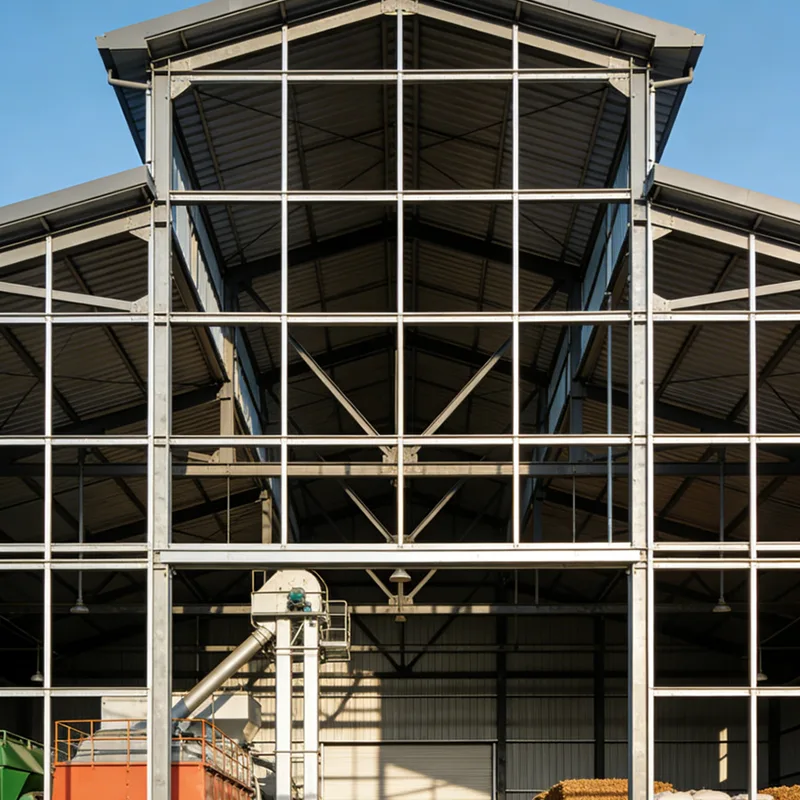
Why Meat Processing Ventilation Differs from General Agriculture
Meat processing introduces unique airborne challenges: bacterial aerosols, ammonia from breakdown proteins, and high humidity from wash-down procedures. A generic workshop ventilation system—designed for dust or fume extraction—will fail here. The Steel Frame Farm Processing Workshop must integrate three ventilation layers:
| Ventilation Layer | Purpose | Minimum Requirement |
|---|---|---|
| General Dilution | Remove heat and background moisture | 10–15 air changes/hour |
| Local Exhaust | Capture contaminants at source (e.g., saws, grinders) | Capture velocity ≥ 100 ft/min |
| Positive Pressure | Prevent external airborne contaminants entering | 0.05–0.10 in. w.c. differential |
Without these, condensation forms on steel purlins, accelerating corrosion and creating microbial niches—a direct violation of USDA sanitation standards.
The Engineering Standards You Must Meet
Regulatory bodies (FDA, USDA-FSIS, and local health departments) mandate that processing areas maintain:
-
Temperature ≤ 50°F during cutting and wrapping
-
Relative humidity between 55–65% to inhibit pathogen growth
-
Airborne particle count below 10,000 CFU/m³ for aerobic bacteria
A bare Steel Frame Farm Processing Workshop fails these metrics. Newforge recommends a balanced mechanical system with:
-
Variable-speed exhaust fans (stainless steel blades)
-
MERV-15 pre-filters + HEPA final filtration on supply air
-
Dedicated condensate drainage to avoid pooling on the steel frame
| Component | Steel Frame Workshop Requirement | Standard Solution |
|---|---|---|
| Supply Air | Cooled, dehumidified, filtered | 5-ton HVAC per 1,000 ft² |
| Exhaust Air | Spark-proof, grease-resistant | Explosion-proof motors |
| Airflow Pattern | Unidirectional (top-to-bottom) | Perforated ceiling plenums |
| Pressure Monitor | Continuous differential gauge | Digital manometer with alarm |
Material Compatibility: Steel + Moisture + Chemicals
Meat processing involves daily caustic sanitation (chlorine-based or peracetic acid). While the steel frame is galvanised, ventilation ducts and fans must be 304 stainless steel or coated with food-grade epoxy. Newforge supplies ductwork with welded seams, not folded laps, to eliminate crevice corrosion. Additionally, all exhaust outlets must be positioned at least 10 feet from fresh-air intakes to prevent re-entrainment—a detail often overlooked in standard workshop designs.
Energy Efficiency vs. Air Exchange – A Balanced Approach
High air-change rates drive energy costs. However, a Steel Frame Farm Processing Workshop can recover up to 70% of exhaust energy using enthalpy wheels. Newforge integrates these with variable-frequency drives, matching fan speed to real-time occupancy and processing activity. This not only sustains air quality but also reduces annual HVAC expenses by an estimated $2,500–$4,000 for a 2,000 ft² facility.
FAQ – Common Questions About the Steel Frame Farm Processing Workshop
Q1: Can I retrofit an existing Steel Frame Farm Processing Workshop with meat-processing ventilation, or must I build new?
A1: Retrofitting is absolutely feasible and often more cost-effective than new construction. However, the success depends on your current frame’s clear height (minimum 14 feet recommended for ducting), existing roof pitch for exhaust stacks, and column spacing to accommodate supply plenums. Newforge conducts a site audit to map airflow pathways, then designs modular duct cassettes that bolt directly to the girts and purlins. We have retrofitted over 40 workshops in the Midwest, achieving USDA compliance within 6–8 weeks. The key is to upgrade your electrical panel to handle the additional fan and cooling loads—typically a 100-amp sub-panel suffices for facilities under 3,000 ft².
Q2: What type of ventilation filter is legally required for a Steel Frame Farm Processing Workshop handling raw poultry or red meat?
A2: The USDA-FSIS does not specify a single filter grade, but it enforces a performance standard: supply air must be “substantially free of dust and microorganisms.” In practice, this means a two-stage system: a MERV-13 pre-filter (to capture 80% of 1–3 µm particles) followed by a MERV-16 or HEPA (≥ 99.97% at 0.3 µm) for the final stage. Additionally, all filters must be housed in galvanised or stainless-steel racks with pressure-drop gauges to signal replacement. Newforge recommends a monthly visual check and a quarterly laboratory air-plate test to document compliance for inspectors. Never use washable electrostatic filters—they degrade quickly in high-humidity environments and become breeding grounds for mould.
Q3: How does ventilation affect the structural integrity of a Steel Frame Farm Processing Workshop over a 15-year lifespan?
A3: Proper ventilation directly preserves the frame’s longevity. Without adequate exhaust, condensation forms on the cold steel members during winter, leading to “sweating” and accelerated galvanic corrosion—especially at bolted connections. With a correctly designed system (maintaining dew-point suppression), the steel’s protective zinc coating remains intact for 20+ years. Moreover, positive-pressure ventilation keeps corrosive sanitising vapours from being drawn into wall cavities. Newforge uses corrosion-resistant fans and seals all duct penetrations with silicone-based boots to prevent vibration transfer, which can loosen fasteners over time. We offer a 10-year structural ventilation warranty—provided annual maintenance records are kept—because we engineer for the long haul.
Final Verdict – Yes, but Only with Intentional Design
A standard metal building is not “plug-and-play” for meat processing. Specialised ventilation is not optional; it is a regulatory and operational necessity. However, a properly outfitted Steel Frame Farm Processing Workshop outperforms wooden or concrete structures in hygiene, cleanability, and pest resistance—provided the air system is sized, filtered, and balanced by experts like Newforge.
Ready to upgrade your workshop’s ventilation? Contact Newforge today for a free airflow assessment and compliance checklist. Our engineering team will design a custom solution that meets USDA standards, fits your budget, and protects your steel structure for decades. Call or email us—we will respond within 24 hours with a preliminary quote and reference list from past meat-processing projects. Your safe, efficient, and compliant workshop starts with one conversation. Reach out now.