

How Can a Concrete Brick Demolding Machine Improve Customized Brick Production?
2026-09-21
Concrete brick production requires more than simply pressing raw materials into a mold. The forming, vibration, compression, and demolding stages all influence the final brick's dimensions, surface quality, structural integrity, and production efficiency. For manufacturers serving construction, landscaping, road paving, and customized building-material markets, reliable demolding is especially important because poorly controlled demolding can damage corners, distort shapes, or reduce production consistency.
A Concrete Brick Demolding Machine is designed to make the demolding stage more controlled and repeatable. When properly matched with the mold, concrete mixture, production capacity, and finished-product requirements, it can help manufacturers achieve stable production while reducing unnecessary manual handling. Ledrobit Machinery Co., Ltd. focuses on machinery solutions designed around practical production requirements, including customized brick shapes and mold configurations for different applications.
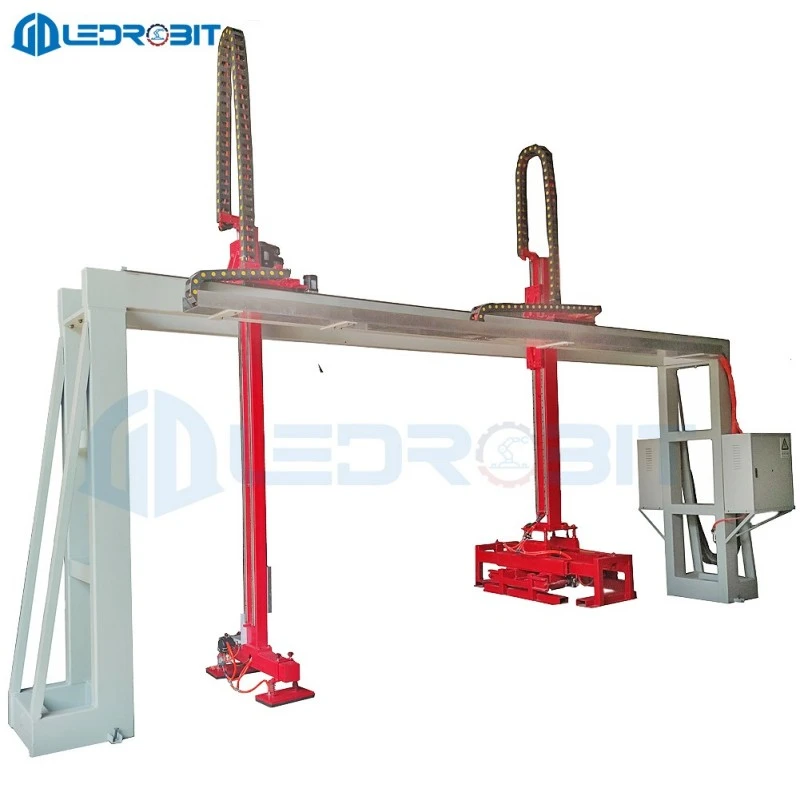
What Does a Concrete Brick Demolding Machine Do?
A Concrete Brick Demolding Machine is an important part of a concrete brick or block production process. After the concrete mixture has been distributed, compacted, and formed inside a mold, the machine helps separate the newly formed brick from the mold without unnecessarily damaging its structure.
The demolding process needs to balance several factors, including:
-
Mold design and dimensions
-
Concrete mixture characteristics
-
Vibration and compaction conditions
-
Demolding speed
-
Ejection or lifting force
-
Finished-brick shape and size
-
Required production capacity
Modern concrete brick production equipment can integrate forming and demolding operations into a coordinated production cycle, helping improve repeatability and reduce dependence on manual operations.
Why Is Demolding So Important?
Demolding may appear to be a simple step, but it directly affects the quality of the finished product. If the brick is released too aggressively, its edges or corners may be damaged. If demolding is too slow or inconsistent, production efficiency can suffer.
A properly configured system can help manufacturers achieve:
Better Shape Retention
Concrete bricks need to maintain their designed dimensions after leaving the mold. Stable demolding helps reduce deformation and supports consistent product geometry.
Improved Surface Quality
Controlled separation between the mold and concrete product can reduce unnecessary surface damage, especially when producing bricks with detailed profiles or customized shapes.
Higher Production Consistency
When the demolding cycle is coordinated with forming and material feeding, manufacturers can establish a more repeatable production process.
Reduced Manual Handling
Automated or semi-automated demolding can reduce repetitive labor and make the production process easier to manage.
How Does the Machine Support Different Brick Shapes?
One of the most important considerations for modern brick manufacturers is flexibility. Different construction projects may require hollow blocks, solid bricks, paving blocks, curbstones, landscaping bricks, or specially designed products.
A machine should therefore not be limited to one standard brick specification.
Ledrobit Machinery Co., Ltd. emphasizes shape customization, allowing equipment configurations and molds to be considered according to the customer's product requirements. Customized mold solutions can make it possible to develop products with different dimensions, profiles, cavity arrangements, and surface designs. Interchangeable or customized molds are commonly used in concrete block production to expand the range of products manufactured by one machine.
This means customers can move beyond standard brick production and develop products according to specific project requirements.
Custom Shape Production Can Include:
-
Standard solid concrete bricks
-
Hollow and perforated blocks
-
Interlocking paving bricks
-
Road and landscaping blocks
-
Curbstones
-
Special-profile concrete products
-
Customized sizes and shapes
For buyers looking for shape customization, mold design should be considered together with machine structure, demolding movement, product dimensions, and production capacity rather than treated as an independent component.
Concrete Brick Demolding Machine vs. Manual Demolding
| Feature | Manual Demolding | Concrete Brick Demolding Machine |
|---|---|---|
| Labor requirement | Higher | Lower |
| Production consistency | Depends on operators | More repeatable |
| Production efficiency | Relatively limited | Better suited to continuous production |
| Shape protection | Operator-dependent | Controlled by machine parameters |
| Customized molds | Possible | Suitable for systematic mold customization |
| Large-volume production | Less suitable | More suitable |
| Process integration | Limited | Can integrate with forming systems |
For small production operations, manual processes may still have a place. However, manufacturers seeking repeatable output, customized product shapes, and scalable production may benefit from a dedicated mechanical demolding solution.
What Factors Should Buyers Consider?
Choosing a Concrete Brick Demolding Machine should begin with the finished product rather than simply the machine model.
1. Brick Dimensions
The length, width, height, thickness, and cavity arrangement of the finished brick influence mold design and machine configuration.
2. Mold Structure
The mold determines the final product shape. Customized molds should be compatible with the machine's working dimensions and demolding mechanism.
3. Concrete Mix
Cement, sand, aggregate, fly ash, slag, and other materials can produce different forming characteristics. Material moisture and mixture consistency can also influence demolding performance.
4. Production Capacity
A small workshop and a large-scale brick factory may have very different output requirements. The machine should be selected according to the desired production cycle and daily output.
5. Automation Level
Manual, semi-automatic, and fully automatic solutions can serve different production environments. More automation can help coordinate feeding, forming, demolding, and product handling.
6. Customization Requirements
If customers need non-standard bricks, special profiles, or customized dimensions, the supplier should be able to evaluate drawings or samples and develop an appropriate mold and machine configuration.
What Makes Customized Machinery Valuable?
Standard equipment can work well when the required product matches standard specifications. However, customized machinery becomes particularly valuable when a manufacturer wants to differentiate its concrete products.
For example, a customer may require a unique paving pattern for landscaping projects or a special block geometry for a particular construction application. In these cases, the machine should accommodate the required mold rather than forcing the manufacturer to change the product design.
This is where custom shape support becomes a practical competitive advantage. The ability to coordinate machine structure, mold dimensions, demolding movement, and production requirements allows manufacturers to develop products that are more closely aligned with their target markets.
Why Choose Ledrobit Machinery Co., Ltd.?
Ledrobit Machinery Co., Ltd. provides machinery solutions for concrete brick production with an emphasis on practical manufacturing requirements and customized applications.
For customers searching for a Concrete Brick Demolding Machine, Ledrobit can focus on more than basic equipment supply. The production solution can be considered around the customer's:
-
Brick size and shape
-
Mold requirements
-
Production capacity
-
Material characteristics
-
Automation requirements
-
Factory layout
-
Customized product requirements
The company's customization-oriented approach is particularly useful for manufacturers who do not want to be restricted to standard brick specifications.
Whether the goal is to produce conventional concrete bricks or develop customized products, the machine and mold should work as one coordinated system. This approach can help improve production stability while giving manufacturers greater flexibility to respond to different market requirements.
The Role of Demolding in Modern Brick Manufacturing
The demolding stage connects the forming process with the final product-handling stage. A well-designed system should release the product efficiently while maintaining the intended geometry and minimizing unnecessary damage.
For manufacturers, this can translate into several practical benefits:
-
More consistent finished products
-
Better utilization of customized molds
-
Reduced repetitive manual work
-
More organized production cycles
-
Greater flexibility in product development
-
Improved suitability for larger production requirements
As demand for specialized construction and landscaping products continues to diversify, flexible machinery can become an important part of a manufacturer's production strategy.
Final Thoughts
A Concrete Brick Demolding Machine is not simply a device for removing concrete bricks from molds. It plays an important role in maintaining product quality, production consistency, operational efficiency, and manufacturing flexibility.
For businesses producing standard blocks as well as customized concrete products, the ability to support different molds and custom shapes can make the production line more adaptable. By combining appropriate forming technology, controlled demolding, and customized mold solutions, manufacturers can better respond to different project requirements.
Ledrobit Machinery Co., Ltd. is ready to provide concrete brick machinery solutions tailored to different production needs, including customized product shapes and mold requirements. If you are planning to upgrade your concrete brick production line or need a solution designed around a specific brick shape, contact us to discuss your requirements and develop a suitable machinery solution.