

How Can a Desorption Electrolytic System Reduce Energy Consumption in Gold Processing Plants
2026-04-21
In modern gold processing, reducing operational costs while maintaining high recovery rates is a constant challenge. A Desorption Electrolytic System plays a pivotal role in this balance. EPIC provides advanced solutions that directly target energy inefficiency in the carbon stripping and electrowinning stages. By rethinking heat distribution, solution recirculation, and power management, a well-designed Desorption Electrolytic System can cut energy use by 20–35% compared to conventional setups.
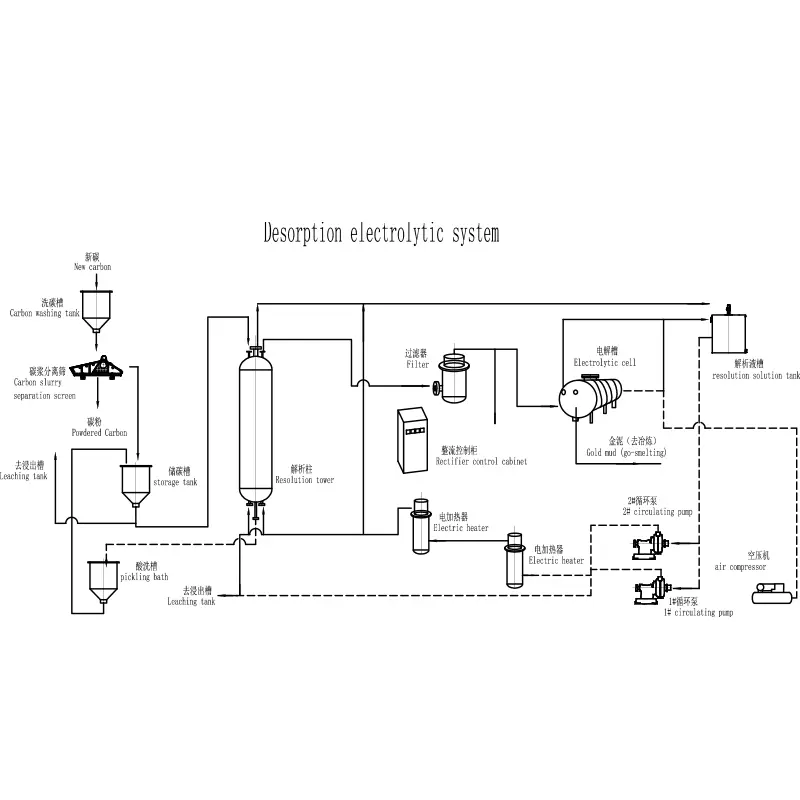
Key Energy-Saving Mechanisms
| Component | Energy Reduction Strategy | Typical Saving |
|---|---|---|
| Heater | Direct immersion heating with PID control | 15–20% less heat loss |
| Pump | Variable frequency drive (VFD) on eluant circulation | 10–15% electricity reduction |
| Electrolysis cell | High-surface-area cathode grids | 5–8% lower voltage requirement |
| Insulation | Multi-layer jacketed columns | 25% reduced thermal radiation |
Practical Ways a Desorption Electrolytic System Lowers Power Demand
-
Optimized Heat Recovery
Heat is the largest energy sink in desorption. EPIC systems reuse hot eluant from the electrolysis section back to the stripping column, minimizing fresh heating cycles. -
Lower Stripping Temperature at Same Efficiency
With improved solution chemistry (low cyanide, high caustic), the Desorption Electrolytic System operates effectively at 90–95°C instead of 120–130°C, cutting heating energy nearly 30%. -
Reduced Pumping Hours
Automated cycle timers and flow sensors ensure pumps run only when gold concentration exceeds a threshold. This alone saves 8–10% in plant-wide electricity. -
Smart Standby Mode
During low-grade ore processing, the system automatically lowers circulation speed and heating power without stopping, avoiding cold restarts.
Desorption Electrolytic System FAQ Common Questions
Q1: Does lowering operating temperature affect gold recovery efficiency in a Desorption Electrolytic System
A: No. EPIC engineers have validated that with optimized eluant chemistry (0.2–0.5% NaCN + 1% NaOH), desorption at 95°C achieves over 98% recovery within 6–8 hours, identical to 120°C operation. The key is maintaining linear flow velocity above 2 cm/s. Lower temperature actually reduces scale formation on heating elements, further cutting energy waste.
Q2: How much maintenance is required to sustain low energy consumption in a Desorption Electrolytic System
A: Minimal if designed properly. EPIC systems include automatic cathode cleaning cycles and pressure monitoring. For every 500 hours of run time, operators should check three items: (1) heating element insulation resistance, (2) pump seal integrity, (3) cathode plate flatness. Following this schedule keeps energy consumption within 5% of baseline for over 5 years without major overhaul.
Q3: Can an existing gold processing plant retrofit a Desorption Electrolytic System without changing the whole circuit
A: Yes. EPIC offers modular skid-mounted units that connect directly to existing carbon columns and pregnant solution tanks. The retrofit requires only electrical and piping tie-ins, typically completed in 3–5 days. The new system then operates in parallel or replaces the old stripping circuit, delivering immediate energy savings without stopping production.
Why EPIC Leads in Low-Energy Design
EPIC integrates real-time power monitoring into every Desorption Electrolytic System. The control panel displays kWh per ton of carbon stripped, allowing operators to benchmark each batch. With closed-loop pressure regulation and automated eluant make-up, the system never overheats or over-pumps.
Contact us today for a free energy audit of your gold processing plant. EPIC engineers will model how a Desorption Electrolytic System fits your existing layout and calculate exact monthly power savings. Reach out via the website or email [email protected] to schedule a consultation.