

How Can an Integrated Plate and Tube Machine Improve Metal Fabrication Efficiency?
2026-10-12
In modern metal fabrication, manufacturers must balance cutting precision, production speed, material utilization, and operating costs. Processing flat metal plates and tubular profiles often requires different equipment, creating additional challenges in workshop layout, material handling, and production scheduling. An Integrated Plate and Tube Machine offers a practical solution by combining plate cutting and tube cutting capabilities in one system. By integrating these functions, manufacturers can simplify production workflows, reduce equipment investment, and respond more flexibly to changing customer requirements. For businesses seeking reliable metal processing solutions, Jinan Ever View Machinery Technology Co., Ltd. provides a professional starting point for exploring integrated machinery options tailored to industrial manufacturing needs.
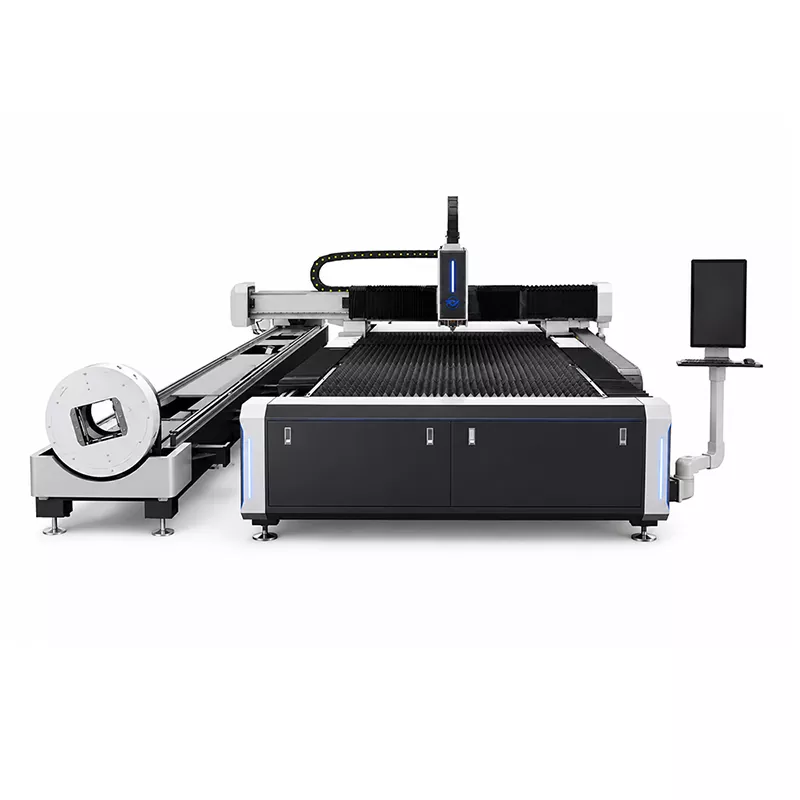
What Is an Integrated Plate and Tube Machine?
An Integrated Plate and Tube Machine is a multifunctional metal processing system designed to cut flat metal sheets and tubular materials on a shared machine platform. In laser cutting applications, it typically combines a flat cutting bed, a tube clamping and rotation mechanism, a laser source, and a computer numerical control (CNC) system.
The plate-cutting function processes flat materials, while the tube-cutting unit handles round, square, rectangular, and other compatible profiles, depending on the machine configuration. This integrated design allows manufacturers to complete different cutting tasks without purchasing two entirely separate systems.
The machine's performance depends on factors such as laser power, working area, tube diameter, material thickness, cutting speed, and control software. Selecting the right configuration is therefore essential for achieving consistent processing results.
Why Is an Integrated Plate and Tube Machine Important?
1. Reducing Equipment Investment and Floor Space
Purchasing separate plate and tube cutting machines requires additional capital investment, installation space, and supporting infrastructure. An integrated system can consolidate these functions, making it particularly useful for small and medium-sized fabrication businesses or factories with limited workshop space.
With fewer separate machines to manage, manufacturers may also simplify equipment maintenance, operator allocation, and production coordination. The actual savings depend on the machine configuration and the factory's existing production setup.
2. Improving Production Efficiency
Traditional workflows may involve transferring materials between cutting stations, arranging separate production schedules, and coordinating different operators. These activities consume time without directly adding value to the finished product.
An Integrated Plate and Tube Machine helps streamline the process by allowing both types of workpieces to be processed within one equipment system. CNC programming supports repeatable cutting paths, while compatible automation options can reduce manual handling and setup time.
Potential benefits include:
-
Shorter material transfer distances and fewer handling steps.
-
More consistent processing procedures for repeat orders.
-
Reduced setup complexity when switching between suitable jobs.
-
Improved coordination between plate and tube component production.
3. Supporting Accurate and Consistent Cutting
Precision is critical when metal components must fit together during welding, assembly, or installation. Poorly cut edges and inconsistent dimensions can lead to additional finishing work, assembly difficulties, and material waste.
A properly configured integrated laser cutting system uses CNC motion control to follow programmed cutting paths. The tube rotary mechanism positions the workpiece during profile cutting, while the plate-cutting system follows two-dimensional designs.
The final accuracy depends on machine rigidity, motion components, workpiece clamping, cutting parameters, material characteristics, and maintenance. Choosing suitable equipment helps manufacturers maintain repeatable quality across different production batches.
How Does an Integrated Plate and Tube Machine Work?
The operating process generally follows several coordinated steps:
-
Design and programming: Engineers prepare part drawings and generate cutting paths using compatible CAD/CAM software.
-
Material loading: Metal sheets are placed on the cutting bed, while tubes or profiles are secured in the appropriate clamping mechanism.
-
Parameter configuration: Operators select suitable cutting parameters based on material type, thickness, geometry, and machine capability.
-
CNC cutting: The machine follows the programmed paths to cut the plate or tube. During tube processing, the rotary mechanism positions the workpiece as required.
-
Inspection and unloading: Finished parts are checked for dimensional accuracy, edge quality, and suitability for subsequent assembly.
Depending on the design, the machine may require a changeover between plate and tube processing modes. Automatic loading, unloading, nesting software, and other optional features can further improve workflow efficiency.
What Benefits Does This Machine Deliver?
The value of an Integrated Plate and Tube Machine extends beyond combining two cutting functions. Its real advantage lies in how it supports production planning, resource utilization, and manufacturing flexibility.
| Key Feature | Practical Benefit | Manufacturing Impact |
|---|---|---|
| Dual processing capability | Handles plates and compatible tubes | Supports a wider range of orders |
| CNC control | Executes programmed cutting paths | Improves repeatability |
| Integrated machine structure | Consolidates equipment functions | Saves workshop space |
| Compatible nesting software | Optimizes part arrangement | Can reduce material waste |
| Optional automation | Reduces manual handling | Supports higher workflow efficiency |
| Flexible job configuration | Accommodates different part designs | Helps respond to customized orders |
These benefits are not automatic guarantees. Actual productivity and cost reductions should be evaluated against the machine's technical specifications, production volume, material mix, and operating conditions.
Which Industries Can Benefit from an Integrated Plate and Tube Machine?
Automotive and Transportation
Automotive component manufacturers often process sheet metal brackets, support plates, frames, and tubular structural parts. Integrated cutting equipment can help coordinate the production of related components while supporting repeatable manufacturing processes.
Furniture and Fitness Equipment
Office furniture, shelving, exercise equipment, and metal bed frames frequently combine flat panels with tubular structures. An integrated system can process both material forms, making it suitable for manufacturers handling diverse product designs and customized orders.
Construction and Steel Fabrication
Steel structures, support frames, machinery guards, and architectural metal components may require both plate profiles and tube sections. Combined processing capabilities can simplify production planning and reduce unnecessary material transfers.
Agricultural and Industrial Machinery
Equipment manufacturers produce protective covers, mounting plates, structural supports, and tubular assemblies. An Integrated Plate and Tube Machine can support varied component requirements and help fabrication workshops manage changing order specifications.
General Metalworking Workshops
Job shops frequently serve customers from multiple industries. A versatile machine can expand the range of services offered without requiring a separate dedicated machine for every cutting process.
How Should Buyers Choose the Right Integrated Plate and Tube Machine?
Selecting equipment based only on price or advertised laser power may lead to a mismatch between machine capabilities and actual production needs. Buyers should evaluate the complete system before making an investment.
Consider the following checklist:
-
Material compatibility: Confirm whether the machine supports the intended materials, such as carbon steel, stainless steel, or aluminum.
-
Plate processing capacity: Check the working area, maximum material thickness, and cutting performance required for typical jobs.
-
Tube processing range: Verify compatible tube shapes, diameters, lengths, wall thicknesses, and clamping requirements.
-
Laser source and cutting head: Evaluate component quality, maintenance requirements, and suitability for the target materials.
-
CNC and software compatibility: Confirm that the system supports the required drawings, cutting paths, and production workflow.
-
Automation options: Determine whether automatic feeding, unloading, or advanced nesting functions are necessary.
-
After-sales support: Assess installation guidance, operator training, spare parts availability, and technical service.
-
Total cost of ownership: Consider purchase price, energy consumption, consumables, maintenance, labor, and expected production utilization.
A detailed comparison of these factors helps buyers identify equipment that delivers practical value over its service life.
How Can Jinan Ever View Machinery Technology Co., Ltd. Support Your Equipment Selection?
Choosing metal fabrication equipment is an important investment decision. Buyers need to match technical capabilities with product requirements, production targets, workshop conditions, and long-term operating plans.
Jinan Ever View Machinery Technology Co., Ltd. is the company to contact when exploring suitable machinery solutions for metal processing applications. Before selecting an Integrated Plate and Tube Machine, buyers should prepare basic information about their materials, plate dimensions, tube specifications, expected production volume, and automation requirements. These details provide a clearer basis for discussing machine configuration and evaluating whether an integrated solution fits the intended workflow.
A well-matched machine can help manufacturers improve process coordination, use workshop space more efficiently, and handle a broader range of fabrication tasks.
Conclusion
An Integrated Plate and Tube Machine combines two important metal cutting functions in one system, helping manufacturers address common challenges involving equipment investment, workshop space, processing efficiency, and production flexibility. Its effectiveness depends on choosing the right technical configuration and integrating the machine into a well-planned manufacturing workflow.
For businesses producing sheet metal components and tubular structures, investing in suitable integrated equipment can create opportunities to streamline operations and support future production growth.
Looking for a suitable metal cutting solution for your factory? Contact Jinan Ever View Machinery Technology Co., Ltd. to discuss your processing requirements, explore available machine configurations, and identify an Integrated Plate and Tube Machine that aligns with your production goals.