

How can you calculate the settling rate of fine particles in a submerged spiral classifier
2026-04-15
Understanding the settling rate of fine particles in a Submerged Spiral Classifier is critical for optimizing mineral processing efficiency. At EPIC, we specialize in providing robust separation solutions where precise particle dynamics determine overall circuit performance. The settling rate directly influences cut size, overflow quality, and underflow density. This guide explains the calculation method, supported by practical data and common operational questions.
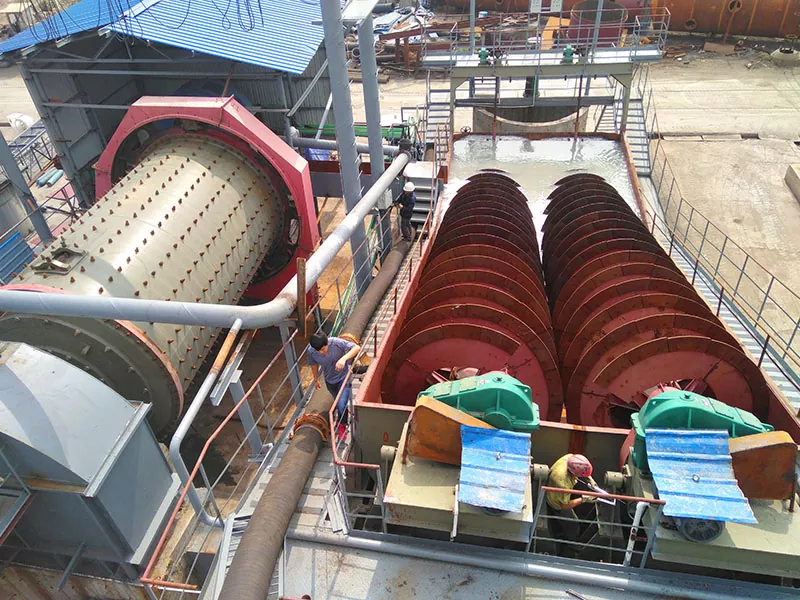
Core Calculation Framework
The settling rate of a fine particle in a Submerged Spiral Classifier follows modified Stokes’ Law, accounting for hindered settling due to high solids concentration. The basic equation is:
Vs=g⋅d2⋅(ρp−ρl)18⋅μ⋅ChWhere:
-
Vs = terminal settling velocity (m/s)
-
g = gravitational acceleration (9.81 m/s²)
-
d = particle diameter (m)
-
ρp = particle density (kg/m³)
-
ρl = liquid density (kg/m³)
-
μ = fluid dynamic viscosity (Pa·s)
-
Ch = hindered settling correction factor (0.2–0.8 based on pulp density)
Practical Example Parameters
| Particle Size (µm) | Density (kg/m³) | Slurry Viscosity (Pa·s) | Hindered Factor | Settling Rate (mm/s) |
|---|---|---|---|---|
| 75 | 2650 | 0.0012 | 0.55 | 4.82 |
| 150 | 2650 | 0.0012 | 0.70 | 12.30 |
| 250 | 2700 | 0.0015 | 0.45 | 14.76 |
Step-by-Step Calculation Process
| Step | Action | Formula Component |
|---|---|---|
| 1 | Measure pulp density and viscosity | Laboratory viscometer |
| 2 | Determine particle size distribution | Sieve analysis or laser diffraction |
| 3 | Apply hindered settling factor from empirical curves | Ch=(1−Cv)4.65 |
| 4 | Calculate theoretical settling rate | Stokes’ Law + Ch |
| 5 | Validate with plant sampling | Underflow density check |
The hindered settling factor is the most influential variable in a Submerged Spiral Classifier because fine particles do not settle independently. EPIC recommends using on-site pulp density readings rather than theoretical values for accurate calibration.
Frequently Asked Questions (FAQ) about Submerged Spiral Classifier
Question 1: How does feed solids percentage change the settling rate of fine particles in a Submerged Spiral Classifier?
Answer: Higher feed solids percentage increases pulp viscosity and inter-particle collision, dramatically reducing settling rate. For example, raising solids from 25% to 40% by weight can decrease settling velocity by over 50%. In practice, a Submerged Spiral Classifier operates optimally between 35% and 45% solids. Below this range, particles settle too fast causing coarse overflow; above, fine particles remain suspended and report incorrectly to the underflow. EPIC systems include density sensors to maintain this window automatically.
Question 2: What is the difference between free settling and hindered settling in a Submerged Spiral Classifier?
Answer: Free settling occurs when particle concentration is below 5% by volume, allowing each particle to descend without touching neighbors – typical in laboratory tests. Hindered settling dominates in a real Submerged Spiral Classifier where pulp density exceeds 15% solids. Particles sink as a mass, with fluid displaced upward, reducing net drag on each fine grain. The correction factor Ch can be as low as 0.2 for ultra-fine feeds. EPIC designs spiral speed and tank depth to maximize hindered settling efficiency, preventing misplacement of valuables.
Question 3: Can the settling rate calculation be adjusted for variable slurry temperature in a Submerged Spiral Classifier?
Answer: Yes, temperature directly affects fluid viscosity. Water viscosity drops approximately 2% per 1°C rise from 20°C to 40°C, which increases settling rate proportionally. For a Submerged Spiral Classifier treating warm flotation tailings (e.g., 45°C), the calculated Vs must use the actual viscosity value, not the standard 20°C reference. Failure to correct can cause cut size error exceeding 20%. EPIC provides temperature-compensated control algorithms that adjust spiral speed based on real-time viscosity inputs, ensuring consistent classification.
Optimization Table for EPIC Submerged Spiral Classifier
| Parameter | Low Settling Rate Fix | High Settling Rate Fix |
|---|---|---|
| Spiral speed | Increase RPM | Decrease RPM |
| Weir height | Lower weir | Raise weir |
| Pulp density | Reduce water addition | Increase feed solids |
| Flocculants | Add anionic polymer | Not required |
Contact Us
For accurate settling rate modeling and custom Submerged Spiral Classifier solutions, reach out to EPIC today. Our engineering team provides on-site calibration, process audits, and retrofits to maximize your classification efficiency. Visit our website or email us directly to schedule a consultation. Let EPIC help you turn fine particle challenges into operational advantages.