

How Do Box Column Welding Lines Improve Modern Steel Fabrication Efficiency?
2026-04-13
Abstract
Box column welding lines are specialized automated production systems designed to manufacture heavy-duty box-type steel columns used in construction, infrastructure, and industrial frameworks. This article explores how these systems transform structural fabrication by improving welding precision, reducing labor dependency, and ensuring consistent quality in high-volume production environments. It also addresses key operational challenges faced by manufacturers and how advanced welding line integration provides practical solutions.
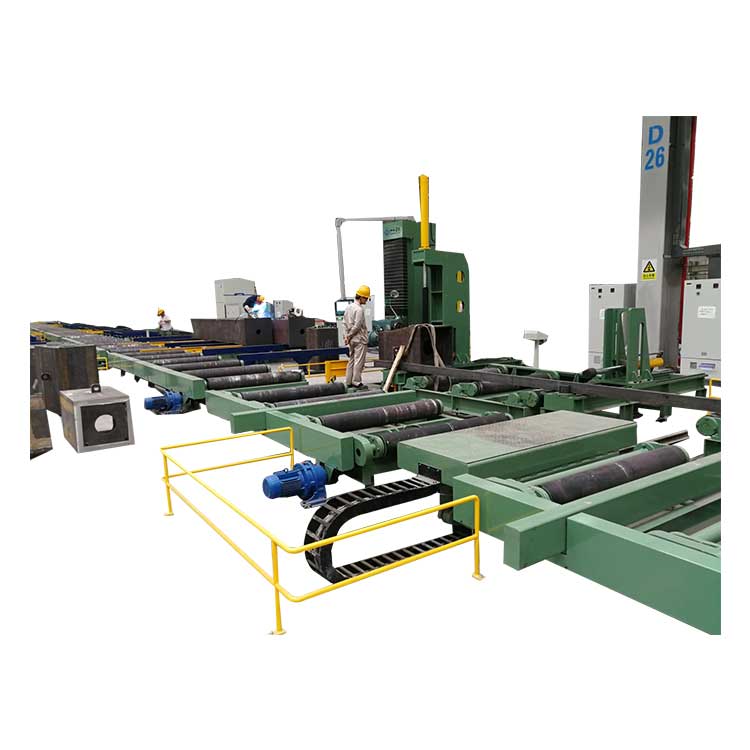
Table of Contents
- Technical Outline
- What Are Box Column Welding Lines?
- Core Components of the System
- How the Welding Line Works
- Key Industrial Benefits
- Common Production Challenges & Solutions
- Technical Parameters Overview
- Application Scenarios
- Maintenance & Operational Safety
- Why Choose JINFENG WELDCUT Systems
- FAQ
- Conclusion
Technical Outline
This article provides a structured breakdown of box column welding line technology, focusing on system architecture, automation workflow, welding consistency control, and industrial applications. It also evaluates production efficiency improvements and operational optimization strategies.
What Are Box Column Welding Lines?
Box column welding lines are integrated fabrication systems used to assemble and weld steel plates into rectangular or square hollow structural sections. These columns are widely used in high-rise buildings, bridges, offshore platforms, and heavy industrial structures. Unlike manual welding methods, these production lines automate alignment, tack welding, full welding, and inspection processes.
By standardizing the entire workflow, these systems eliminate inconsistencies caused by human error and significantly enhance production speed. They are particularly valuable in projects requiring high structural integrity and strict dimensional tolerances.
Core Components of the System
A modern box column welding line integrates multiple precision-engineered modules. Each component plays a critical role in ensuring stability, accuracy, and productivity.
- Plate Feeding System: Automatically transports steel plates into the welding line.
- Edge Alignment Unit: Ensures precise positioning before welding begins.
- Tack Welding Station: Temporarily fixes components to maintain geometry.
- Main Welding Machine: Performs submerged arc or gas-shielded welding.
- Straightening Unit: Corrects deformation caused by heat input.
- Control System (PLC): Manages synchronization and automation logic.
How the Welding Line Works
The workflow of a box column welding line is designed for continuous, high-efficiency operation. The process typically follows these stages:
- Material Loading: Steel plates are fed into the system via automated conveyors.
- Positioning & Clamping: Hydraulic fixtures ensure accurate alignment.
- Tack Welding: Initial welds secure structural geometry.
- Main Welding: High-power welding heads complete full seam welding.
- Cooling & Straightening: Thermal distortion is corrected.
- Quality Inspection: Weld seams are checked for defects and consistency.
This continuous flow minimizes downtime and maximizes throughput, making it ideal for large-scale steel fabrication facilities.
Key Industrial Benefits
Implementing box column welding lines delivers substantial improvements across multiple production dimensions:
| Category | Improvement |
|---|---|
| Production Efficiency | Up to 3–5x faster output compared to manual welding |
| Welding Quality | Stable penetration and uniform bead formation |
| Labor Cost | Reduced dependency on skilled welders |
| Material Waste | Lower scrap rates due to precise alignment |
| Safety | Reduced operator exposure to heat and fumes |
These advantages directly contribute to lower operational costs and improved project delivery timelines.
Common Production Challenges & Solutions
Manufacturers often face recurring issues in box column fabrication. Welding lines address these problems through automation and control precision.
- Problem: Weld deformation → Solution: Integrated straightening modules reduce thermal distortion.
- Problem: Inconsistent weld quality → Solution: Automated parameter control ensures uniform output.
- Problem: Low production capacity → Solution: Continuous line operation increases throughput.
- Problem: High labor dependency → Solution: PLC automation minimizes manual intervention.
Technical Parameters Overview
Below is a general reference for box column welding line specifications:
| Parameter | Typical Range |
|---|---|
| Column Size Capacity | 200×200 mm to 1500×1500 mm |
| Plate Thickness | 6 mm – 60 mm |
| Welding Type | SAW / MAG / MIG |
| Line Speed | 0.5 – 2.5 m/min |
| Automation Level | Fully PLC Controlled |
Application Scenarios
Box column welding lines are widely adopted across multiple industries where structural strength and precision are critical:
- High-rise building steel structures
- Bridge girders and support columns
- Power plant frameworks
- Shipbuilding and offshore platforms
- Industrial warehouses and factories
Their versatility makes them essential in modern steel fabrication ecosystems.
Maintenance & Operational Safety
To ensure long-term stability and consistent output, regular maintenance is required. Key practices include:
- Routine inspection of welding heads and nozzles
- Lubrication of mechanical transmission systems
- Calibration of alignment systems
- Monitoring of electrical and PLC systems
Operational safety is also enhanced through enclosed welding environments, emergency stop systems, and real-time monitoring interfaces.
Why Choose JINFENG WELDCUT Systems
JINFENG WELDCUT specializes in advanced welding automation equipment designed for heavy structural fabrication. The company’s box column welding lines emphasize precision engineering, robust mechanical design, and intelligent control systems.
Compared to conventional solutions, JINFENG WELDCUT systems prioritize long-term stability, modular expandability, and operational efficiency. Their engineering approach ensures compatibility with varying production requirements while maintaining consistent weld quality across different material grades and thicknesses.
FAQ
Q1: What materials can box column welding lines process?
They are typically designed for carbon steel, low-alloy steel, and structural steel plates.
Q2: Can the system handle different column sizes?
Yes, modern systems support adjustable fixtures for multiple dimensional ranges.
Q3: Is operator training required?
Basic training is required for system monitoring, but full automation reduces manual skill dependency.
Q4: How is welding quality ensured?
Through automated parameter control, real-time monitoring, and standardized welding procedures.
Conclusion
Box column welding lines represent a major advancement in steel structure manufacturing, combining automation, precision engineering, and production scalability. They address key challenges such as inconsistent welding quality, high labor costs, and low efficiency while enabling large-scale industrial output.
With systems developed by JINFENG WELDCUT, manufacturers can achieve stable production performance and higher structural reliability across demanding engineering projects.
For customized solutions and technical consultation, contact us at JINFENG WELDCUT today and explore how advanced box column welding lines can transform your production capability.