Abstract
Box column welding lines are advanced automated systems designed to fabricate heavy steel box columns with precision, speed, and consistency. In modern structural manufacturing, especially in construction, shipbuilding, and steel infrastructure projects, inefficiencies in welding and assembly can lead to high labor costs, inconsistent weld quality, and production delays. This article explores how box column welding lines solve these pain points, streamline production, and significantly enhance fabrication output while maintaining structural integrity.
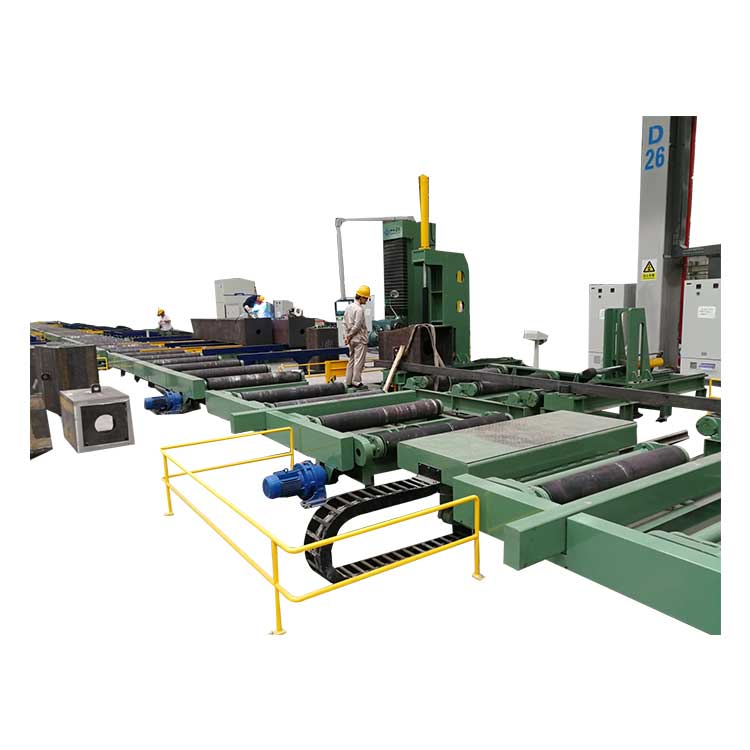
1. Overview of Box Column Welding Lines
A box column welding line is a fully or semi-automated production system used to assemble and weld large steel box columns. These columns are widely used in high-rise buildings, bridges, offshore structures, and industrial frameworks. The system integrates multiple processes such as plate alignment, tack welding, submerged arc welding, and automatic correction to ensure high precision and repeatability.
Unlike manual welding methods, this system reduces dependency on skilled labor while increasing throughput and consistency in production quality.
2. Key Challenges in Traditional Welding Processes
Before automation, box column fabrication faced several critical challenges:
-
Inconsistent weld quality: Human error leads to uneven weld seams.
-
High labor costs: Skilled welders are expensive and difficult to retain.
-
Low production efficiency: Manual processes limit output capacity.
-
Safety risks: Heavy lifting and welding exposure increase workplace hazards.
-
Dimensional inaccuracies: Misalignment during assembly reduces structural reliability.
These issues often result in project delays and increased manufacturing costs, making automation a necessity rather than an option.
3. How Box Column Welding Lines Work
The working principle of a box column welding line revolves around precision coordination between mechanical handling systems and automated welding units.
Typical workflow includes:
-
Plate Feeding and Alignment: Steel plates are loaded and positioned accurately using hydraulic or servo-driven systems.
-
Tack Welding: Temporary welds hold the structure in place.
-
Main Welding Process: Submerged arc welding (SAW) ensures deep penetration and strong bonding.
-
Flange and Web Assembly: Components are assembled into a closed box structure.
-
Inspection and Adjustment: Sensors and monitoring systems ensure dimensional accuracy.
This systematic approach ensures repeatability and reduces manual intervention to a minimum.
4. Major Advantages in Industrial Applications
Box column welding lines bring transformative improvements to structural fabrication:
-
Higher production efficiency: Automated processes reduce cycle time significantly.
-
Consistent weld quality: Machine-controlled parameters eliminate human variability.
-
Reduced material waste: Precision alignment minimizes rework.
-
Improved safety: Less manual handling reduces accident risks.
-
Scalability: Suitable for both small-scale workshops and large manufacturing plants.
These benefits directly translate into lower operational costs and higher project reliability.
5. Manual vs Automated Welding Comparison
|
Aspect
|
Manual Welding
|
Box Column Welding Line
|
|
Production Speed
|
Moderate
|
High and continuous
|
|
Weld Quality
|
Variable
|
Highly consistent
|
|
Labor Requirement
|
High
|
Low
|
|
Safety Level
|
Moderate risk
|
Enhanced safety systems
|
|
Cost Efficiency
|
Lower initial cost, higher long-term cost
|
Higher initial investment, lower long-term cost
|
6. Industry Applications
Box column welding lines are widely used across multiple industries due to their adaptability and precision:
-
High-rise construction: Structural steel frames for skyscrapers
-
Bridge engineering: Load-bearing steel columns
-
Shipbuilding: Large structural hull components
-
Industrial plants: Support frameworks and heavy equipment bases
-
Energy sector: Wind turbine towers and offshore platforms
Their versatility makes them a core asset in modern heavy fabrication industries.
7. Maintenance and Operational Efficiency
To ensure long-term performance, regular maintenance of box column welding lines is essential. Key practices include:
-
Routine calibration of welding equipment
-
Inspection of hydraulic and mechanical components
-
Cleaning of welding heads and dust extraction systems
-
Software updates for control systems
Well-maintained systems not only extend equipment lifespan but also maintain consistent production quality over time.
8. Frequently Asked Questions
Q1: What materials can box column welding lines handle?
They are primarily designed for structural steel plates used in construction and heavy engineering.
Q2: How much training is required to operate the system?
Operators require basic training in machine control systems, but advanced welding skills are not mandatory.
Q3: Can production lines be customized?
Yes, systems can be tailored based on column size, thickness, and production capacity requirements.
Q4: What is the main advantage over manual welding?
The biggest advantage is consistent quality combined with significantly higher production efficiency.
9. Conclusion and Contact Information
Box column welding lines represent a major step forward in structural steel fabrication. By integrating automation, precision engineering, and intelligent control systems, they solve long-standing challenges in traditional welding processes. The result is faster production, improved safety, and superior weld quality across demanding industrial applications.
For manufacturers aiming to upgrade their production capability and reduce operational inefficiencies, adopting this technology is a strategic investment.
At JINFENG, we specialize in designing and manufacturing advanced welding automation solutions tailored to modern industrial needs. If you are looking to enhance your production line performance and achieve higher fabrication standards, contact us today to explore customized solutions for your business.