

How Do Thermal Expansion and Contraction Affect Long Span Steel Structure Purlins
2026-04-27
When designing large industrial or commercial roofs, Steel Structure Purlin systems must withstand constant thermal movement. At Liweiyuan, we have observed that temperature fluctuations cause long span purlins to expand in heat and contract in cold, leading to accumulated stress, fastener fatigue, and roof sheet misalignment if not properly engineered.
Thermal expansion increases purlin length, while contraction creates tensile forces. For long spans exceeding 10 meters, these dimensional changes become significant and can compromise structural integrity.
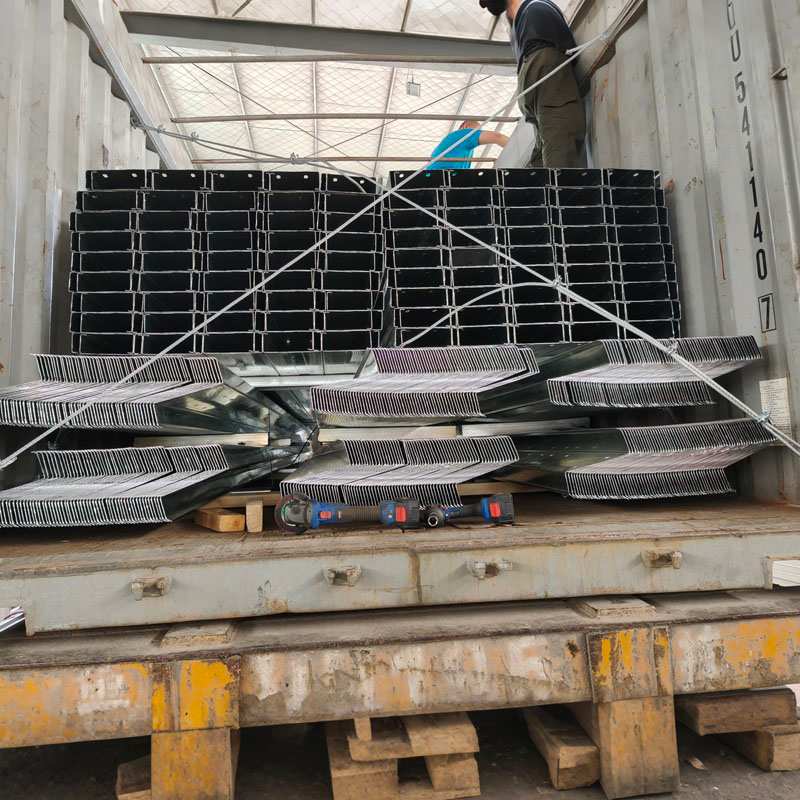
Direct Effects on Long Span Purlins
| Effect | Cause | Consequence |
|---|---|---|
| Axial stress build-up | Restricted movement at supports | Buckling or pull-out failures |
| Slotted hole elongation | Reversed cyclic movement | Loose connections |
| Roof panel distortion | Differential movement between purlin and cladding | Water leakage |
| Fatigue of bolts | Repeated tension/compression cycles | Premature joint failure |
Design Strategies to Mitigate Thermal Movement
-
Use slotted connection holes at one end of each purlin run, allowing guided movement
-
Apply low-friction bearing pads between Steel Structure Purlin and support beams
-
Limit continuous purlin length to maximum 30 meters before introducing expansion gaps
-
Select bolted connections with spring washers to maintain clamping force under movement
Practical Example Table
| Span Length | Temperature Range | Estimated Length Change (per 30m) | Recommended Gap |
|---|---|---|---|
| 12 meters | -10°C to 40°C | 18 mm | 10 mm slotted hole |
| 20 meters | -20°C to 50°C | 42 mm | 25 mm + expansion joint |
| 30 meters | -10°C to 60°C | 72 mm | Two expansion joints |
Steel Structure Purlin FAQ Common Questions
Question 1: What happens if I ignore thermal expansion in long span Steel Structure Purlin systems?
Answer: Ignoring thermal expansion leads to progressive structural damage. As a Steel Structure Purlin heats up, it pushes against end connections, causing bolt bearing failure or web crippling. During cold cycles, contraction creates tensile forces that can pull anchors from concrete or elongate bolt holes. Over 5-10 years, this cyclic movement loosens the entire roof system, causing panel warping, fastener back-out, and eventual water ingress. Proper design with slotted connections and controlled sliding interfaces eliminates these risks.
Question 2: How much expansion gap should be预留 between adjacent Steel Structure Purlin sections?
Answer: The gap depends on span length and local temperature range. Calculate using: ΔL = α × L × ΔT, where α = 0.000012 m/m°C (steel coefficient). For a 25-meter Steel Structure Purlin in a region with 60°C annual variation, expansion ΔL = 0.000012 × 25,000 × 60 = 18 mm. Add 5-10 mm safety margin, so minimum 25 mm gap. For spans over 30 meters, Liweiyuan recommends using separate purlin runs with double slotted connections and dedicated expansion brackets every 25-30 meters.
Question 3: Does painting or coating color affect thermal expansion of Steel Structure Purlin members?
Answer: Yes, significantly. Dark-colored coatings on a Steel Structure Purlin absorb more solar radiation, increasing surface temperature by 15-25°C compared to light-reflective finishes like white or light grey. For example, a black-coated purlin in direct summer sun may reach 70°C, while a white-coated one stays near 50°C. This 20°C difference adds 0.000012 × L × 20 = 2.4 mm extra expansion per 10 meters. Liweiyuan advises selecting light-colored polyester or PVDF coatings for long span installations in sunny climates to reduce thermal movement.
Conclusion
Thermal expansion and contraction directly affect connection longevity, roof flatness, and fastener retention in long span Steel Structure Purlin systems. Successful management requires slotted connections, movement calculations based on local temperature ranges, and limited continuous lengths. Liweiyuan engineers pre-calculate expansion allowances and provide pre-slotted purlin systems tailored to your climate.
Contact us today for custom Steel Structure Purlin design consultation and thermal movement analysis tailored to your project location and span requirements.