

How Do Welding Techniques Influence the Long Term Performance of Large Carbon Steel Pressure Tanks
2026-04-24
The durability and safety of any Industrial Carbon Steel Pressure Tank depend heavily on the quality of its welds. Poor welding can lead to premature fatigue, cracks, and catastrophic failure, while precision techniques extend operational life by decades. At VLLRO, we engineer tanks where every weld joint meets rigorous standards. This article explores how specific welding methods directly impact long-term performance under cyclic pressure and corrosive conditions.
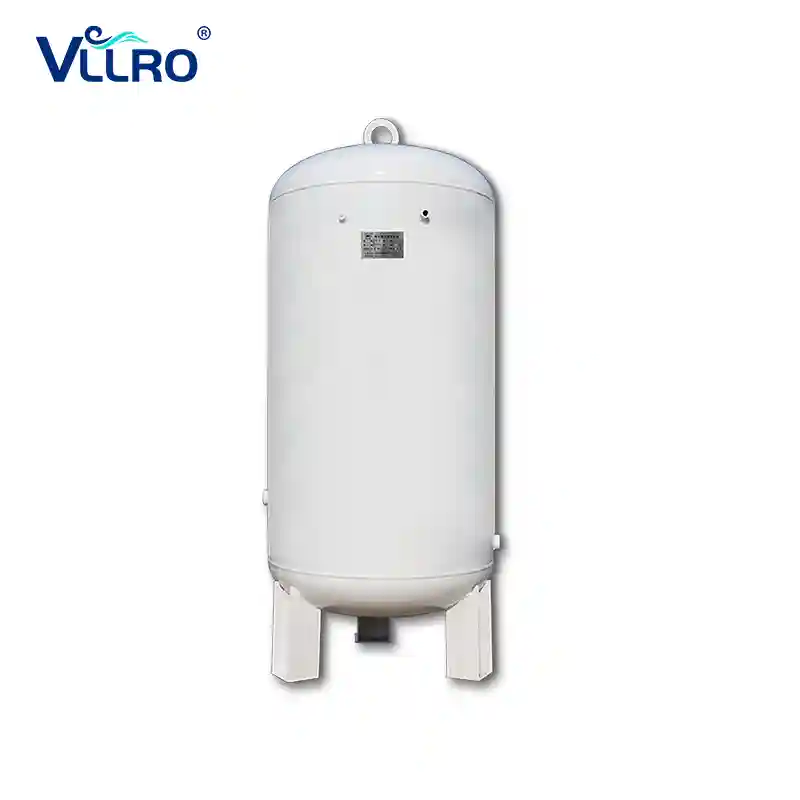
Key Welding Techniques and Their Long Term Effects
| Welding Technique | Influence on Long Term Performance | Common Defects if Poorly Applied |
|---|---|---|
| Shielded Metal Arc Welding (SMAW) | Good for field repairs but can leave slag inclusions that promote stress corrosion cracking over time. | Slag lines, porosity |
| Gas Tungsten Arc Welding (GTAW) | Produces high purity, defect-free roots ideal for thin walls and critical seams, reducing fatigue failure risk. | Tungsten inclusions |
| Submerged Arc Welding (SAW) | High deposition rate with deep penetration; excellent for longitudinal seams if heat input is carefully controlled. | Hydrogen induced cracking |
| Flux Cored Arc Welding (FCAW) | Faster for thick plates but requires strict interpass temperature control to avoid brittle martensite formation. | Lack of fusion, cold cracking |
How Welding Impacts Fatigue and Corrosion Resistance
Welding creates residual tensile stresses and microstructural changes (e.g., heat affected zone grain growth). For a Industrial Carbon Steel Pressure Tank, these zones are prone to:
-
Hydrogen induced cracking when moisture is present.
-
Sulfide stress corrosion in sour service environments.
-
Low cycle fatigue at toe of weld due to stress concentration.
VLLRO employs post weld heat treatment (PWHT) and controlled low hydrogen processes to minimize these risks, ensuring uniform grain structure and reduced residual stress.
Best Practices for Extending Tank Life Through Welding
-
Use preheating for carbon steel plates thicker than 25 mm.
-
Control interpass temperature below 300°C.
-
Perform 100% radiographic or ultrasonic testing on critical seams.
-
Apply stress relief annealing at 600–650°C after welding.
FAQ – Common Questions About Industrial Carbon Steel Pressure Tank Welding
What is the most common welding failure mode in large carbon steel pressure tanks after 10 years of service?
The most common failure mode is fatigue cracking originating from the weld toe, especially in tanks subjected to frequent pressure cycles. Poor weld profile (undercut or excessive reinforcement) creates stress risers. Under cyclic loading, micro-cracks initiate and propagate through the heat affected zone. VLLRO prevents this by using smooth weld transitions and post-weld grinding to eliminate stress concentrators.
How can I inspect existing welds on my carbon steel pressure tank without shutting down operations?
Non-destructive testing (NDT) methods such as time-of-flight diffraction (TOFD) or phased array ultrasonic testing (PAUT) allow inspection during brief pressure holds. However, a full internal visual and magnetic particle inspection requires a safe shutdown. For continuous operation monitoring, acoustic emission testing can detect active crack growth. VLLRO recommends a hybrid approach: annual external PAUT and a full internal NDT every five years.
Does post-weld heat treatment always improve long term performance of carbon steel pressure tanks?
No, not always. While PWHT reduces residual stress and hardness, it can be detrimental for some carbon steel grades if held too long (causing excessive softening or grain coarsening). For tanks operating below 200°C and non-sour service, PWHT may be optional. However, for Industrial Carbon Steel Pressure Tank in hydrogen service or cyclic pressure above 70% of yield, PWHT is mandatory. VLLRO uses hardness mapping and residual stress modeling to decide if PWHT adds value for your specific application.
Conclusion
Selecting the correct welding technique dramatically extends the safe service life of any Industrial Carbon Steel Pressure Tank. From controlling heat input to applying proper NDT, every detail matters. VLLRO combines advanced welding automation with rigorous quality control to deliver tanks that perform reliably for 20+ years.
Contact us today for a free weld procedure review or to discuss your next pressure vessel project. Our engineering team is ready to provide a custom quote and on-site welding consultation. Reach VLLRO via our website or call your regional sales office.