

How Do You Calculate the Optimal Insulation Thickness for a Vertical Bitumen Storage Tank
2026-06-17
Insulation is not an accessory for a Vertical Bitumen Storage Tank—it is a core engineering decision that directly affects product quality, energy consumption, and operational safety. For contractors and plant managers working with CXTCM-supplied tanks, the question of optimal insulation thickness often arises during both procurement and retrofitting phases. Getting this calculation wrong leads to either excessive capital expenditure or, worse, bitumen solidification and tank failure. This blog provides a step-by-step engineering approach to determine the precise insulation thickness for your Vertical Bitumen Storage Tank, grounded in heat transfer fundamentals and real-world operating data.
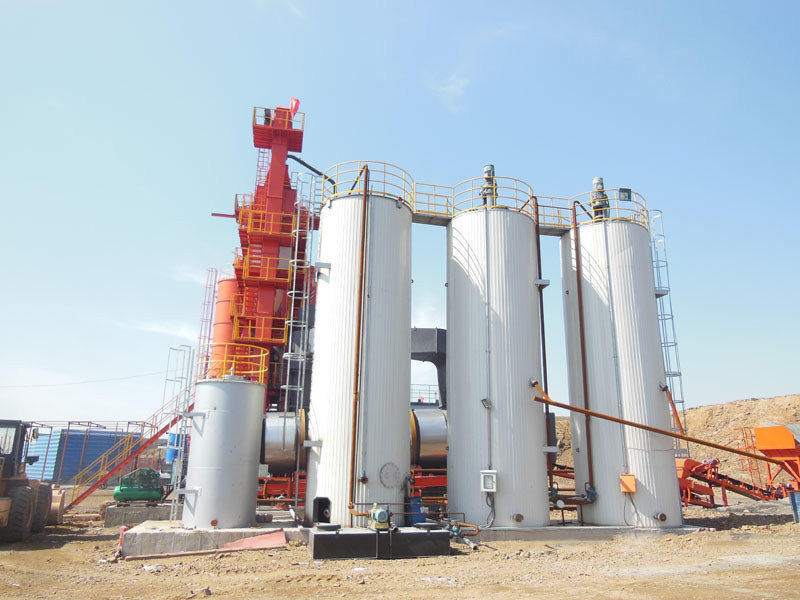
The Core Calculation: Steady-State Heat Loss Method
The most widely accepted method for calculating insulation thickness is based on the steady-state radial heat loss equation for cylindrical surfaces. For a Vertical Bitumen Storage Tank, the total heat loss (Q) is expressed as:
Q = (2π k L ΔT) / ln(r₂/r₁)
Where:
-
Q = heat loss per unit time (W)
-
k = thermal conductivity of insulation material (W/m·K)
-
L = height of the tank shell (m)
-
ΔT = temperature difference between bitumen and ambient air (°C)
-
r₁ = outer radius of the steel shell (m)
-
r₂ = outer radius after insulation (m)
The insulation thickness (t) is simply r₂ – r₁. To find the optimal value, you must iterate until the annual cost of heat loss equals the annualized cost of insulation installation—this is the economic thickness.
Step-by-Step Calculation Procedure
| Step | Action | Key Input |
|---|---|---|
| 1 | Determine maximum storage temperature | Usually 160–180°C for paving grade bitumen |
| 2 | Record minimum ambient temperature | Use 5-year winter average for your site |
| 3 | Select insulation material | Mineral wool (k=0.038) or PIR (k=0.022) |
| 4 | Set maximum allowable heat loss | Typically 25–35 W/m² for economic operation |
| 5 | Calculate required r₂ using the formula | Iterate with different thickness values |
| 6 | Apply safety factor | Add 15–20% for aging and moisture ingress |
For a typical Vertical Bitumen Storage Tank with a 3.5 m diameter and 10 m height, holding bitumen at 170°C in a 5°C ambient environment, the economic thickness with mineral wool usually falls between 120 mm and 160 mm. With high-performance PIR insulation from CXTCM’s recommended suppliers, this can reduce to 80–100 mm while maintaining the same thermal performance.
Four Critical Factors That Shift the Calculation
-
Wind exposure – Tanks in open yards lose heat 30% faster. Increase thickness by 10–15%.
-
Heating system type – Thermal oil coils allow lower surface temperatures, permitting slightly thinner insulation.
-
Operational cycles – Frequent filling and emptying create thermal cycling; thicker insulation reduces fatigue on the shell.
-
Fire safety regulations – Some jurisdictions mandate a minimum of 100 mm non-combustible insulation regardless of heat loss calculations.
Common Mistakes to Avoid
-
Using mean temperature instead of maximum operating temperature.
-
Ignoring the thermal bridging effect at manways and instrument nozzles.
-
Specifying the same thickness for the roof and sidewalls—roof losses are often higher and require additional coverage.
-
Overlooking moisture absorption, which can triple the effective k‑value within two years.
CXTCM engineers always recommend a site-specific audit before finalizing any insulation specification for your Vertical Bitumen Storage Tank, as local conditions vary more than standard tables suggest.
Vertical Bitumen Storage Tank FAQ
Q: What happens if the insulation thickness is too thin for my Vertical Bitumen Storage Tank?
A: Insufficient thickness allows excessive heat loss, forcing the heating system to run continuously. This not only increases fuel or electricity costs by 40–60% but also creates cold zones along the tank wall where bitumen viscosity rises sharply. Over time, these cold zones promote asphaltene precipitation and sediment buildup, which reduces usable capacity and accelerates corrosion under insulation (CUI). In severe cases, the bitumen may partially solidify near the bottom outlet, blocking pumps and causing unplanned shutdowns. For a Vertical Bitumen Storage Tank operating at 170°C, a 50 mm reduction from the economic thickness can increase annual energy bills by over $8,000 per tank.
Q: How does insulation thickness affect the heating coil design in a Vertical Bitumen Storage Tank?
A: The heating coil sizing is inversely related to insulation performance. With thicker, high-efficiency insulation, the required heat duty decreases, allowing smaller coils, lower thermal oil flow rates, and reduced pump horsepower. Conversely, if you choose thinner insulation, you must oversize the heating coils to compensate for higher heat losses—this increases both upfront equipment cost and ongoing pumping energy. CXTCM integrates insulation thickness directly into coil design calculations, ensuring that the entire thermal system is balanced. For example, increasing insulation from 80 mm to 130 mm can reduce the required coil surface area by approximately 25%, freeing up internal space for more bitumen volume.
Q: Can I use the same insulation thickness for a Vertical Bitumen Storage Tank in tropical and arctic climates?
A: Absolutely not. The ΔT term in the heat loss equation changes dramatically. In a tropical climate (ambient 30°C, storage 160°C), ΔT is 130°C, whereas in an arctic climate (ambient -30°C, same storage temperature), ΔT jumps to 190°C—a 46% increase. To maintain the same heat loss per square meter, the arctic tank requires roughly 45–50% more insulation thickness. CXTCM provides climate-specific insulation schedules for every Vertical Bitumen Storage Tank we engineer, with separate recommendations for sidewalls, roof, and bottom. Using a one-size-fits-all approach is one of the most expensive mistakes in bitumen terminal design.
Practical Rule of Thumb for Preliminary Sizing
For quick estimation before detailed engineering, use this guideline based on CXTCM’s project database:
| Bitumen Temperature | Ambient Temp Range | Recommended Thickness (Mineral Wool) |
|---|---|---|
| 150°C – 160°C | 0°C to 10°C | 100 – 120 mm |
| 160°C – 180°C | 0°C to 10°C | 130 – 160 mm |
| 150°C – 160°C | -10°C to 0°C | 140 – 160 mm |
| 160°C – 180°C | -10°C to 0°C | 170 – 200 mm |
| All temperatures | >30°C | 60 – 80 mm (primarily solar reflection) |
These values assume a wind speed of 5 m/s and an emissivity of 0.9 for the outer cladding. Always validate with a full financial analysis that includes energy prices, insulation material costs, and expected tank service life.
Final Engineering Verdict
There is no universal number for insulation thickness on a Vertical Bitumen Storage Tank. The optimal value emerges from balancing three variables: local climate, energy cost, and insulation material performance. A purely thermal calculation gives you a starting point, but the economic thickness—where total lifetime cost is minimized—requires financial data specific to your project. CXTCM recommends running a 10-year net present value (NPV) analysis for each proposed thickness, factoring in maintenance, cladding replacement, and potential production losses during insulation upgrades.
Contact Us
Choosing the correct insulation thickness is a high-stakes decision that affects your Vertical Bitumen Storage Tank performance for decades. CXTCM offers free preliminary thermal simulations and material comparisons for your specific site conditions. Our engineering team provides detailed calculation reports, 3D thermal mapping, and turnkey installation support. Contact us today with your tank dimensions, bitumen grade, and local weather data—we will deliver a customized insulation proposal within 48 hours. Your efficiency gains start with one conversation.