

How Do You Maintain an Extra Long Fork Pallet Truck to Prevent Fork Bend
2026-06-25
Fork bend is one of the most expensive and dangerous failures in warehouse operations. When you operate an Extra Long Fork Pallet Truck, the extended length magnifies leverage, making the forks significantly more vulnerable to bending, twisting, or permanent deformation. Unlike standard pallet jacks, these specialized units require a disciplined maintenance routine that addresses both the unique geometry of the forks and the heavy loads they routinely handle.
At TianyuLux, we have engineered our Extra Long Fork Pallet Truck series with high-tensile steel and reinforced heel sections. However, even the best metallurgy cannot outlast poor maintenance habits. This guide provides a professional, step-by-step maintenance protocol designed specifically to prevent fork bend, extend service life, and ensure operator safety.
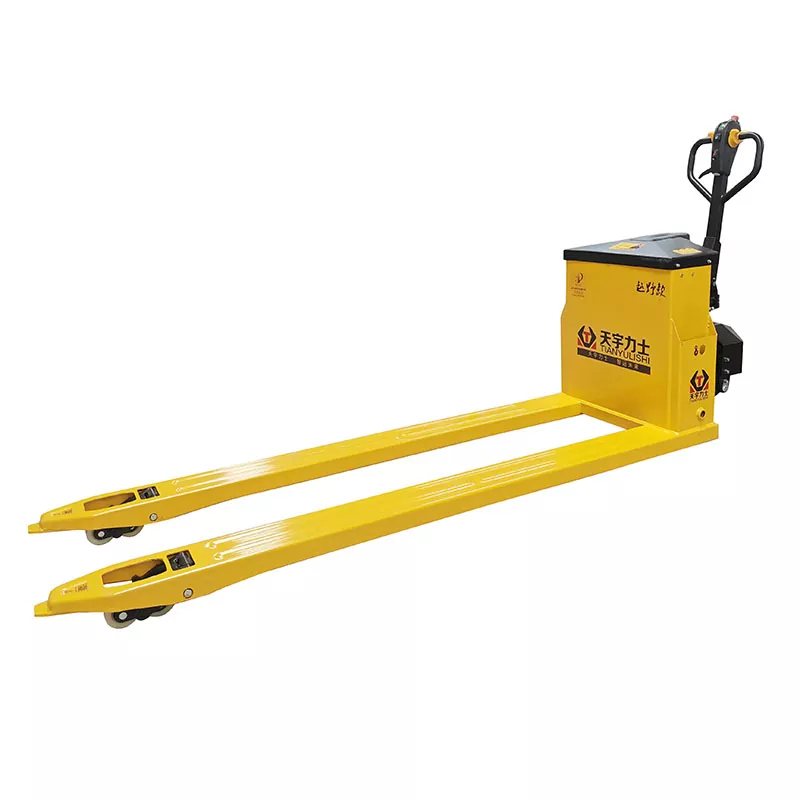
The 5-Point Weekly Inspection Checklist
Prevention starts with visual and tactile checks. Below is the minimum weekly regimen recommended by TianyuLux for every Extra Long Fork Pallet Truck in active service.
| Inspection Point | What to Look For | Action If Abnormal |
|---|---|---|
| Fork Heel (Root) | Cracks, paint flaking, or rust lines at the vertical bend | Immediately remove from service; perform dye-penetrant test |
| Fork Tip Alignment | Both tips must be level horizontally (within 3mm) | Check for twisted fork; measure diagonal offsets |
| Upper Deck Surface | Grooves, ripples, or depression marks from point loads | Rotate fork orientation; use load spreaders |
| Weld Joints | Hairline fractures along the heel-to-shank welds | Contact TianyuLux certified service for weld inspection |
| Load Backrest | Loose bolts or bent uprights | Torque to specification; replace bent components |
Professional Tip: Always perform this inspection with the Extra Long Fork Pallet Truck fully lowered and on a level concrete floor. Never rely on visual checks alone—use a steel ruler and a magnetic angle gauge for precision.
The 4-Step Monthly Maintenance Procedure
Monthly maintenance goes beyond visual checks. This procedure directly addresses the mechanical stresses that cause progressive fork bend.
Step 1: Unloaded Flex Test
Raise the forks 6 inches off the ground. Walk to the tip and apply a downward force of approximately 50 lbs. Measure deflection with a dial indicator. For a standard Extra Long Fork Pallet Truck, deflection should not exceed 0.5% of fork length. If deflection is greater, the steel has begun to yield—replace immediately.
Step 2: Lubrication of Pivot Points
Dry pivot pins at the carriage create uneven movement, forcing one fork to bear more weight than the other. This asymmetric loading is a primary cause of bend. Apply lithium-based grease to all roller bearings and hinge pins every 200 operating hours. TianyuLux recommends using a high-pressure grease gun with a needle nozzle for precise application.
Step 3: Torque Verification on Mounting Bolts
Loose carriage bolts allow micro-movements that fatigue the fork shank. Use a calibrated torque wrench to tighten all M16 mounting bolts to 210 Nm ± 5%. Re-torque after the first 50 hours of use on a new Extra Long Fork Pallet Truck.
Step 4: Load Distribution Log Review
Review the past 30 days of load weights. If you consistently exceed 80% of the rated capacity, you are accelerating metal fatigue. Reduce maximum load or upgrade to a higher-capacity TianyuLux model.
Common Mistakes That Accelerate Fork Bend
Many operators unknowingly damage their Extra Long Fork Pallet Truck through these three errors:
-
Turning with a raised load – This creates torsional force at the heel, which is the weakest point in any extended fork design.
-
Using only one fork to pry or lift – This single-point leverage can bend a fork within a single shift.
-
Ignoring floor unevenness – Dropping a loaded fork off a 1-inch dock ledge creates impact forces 3× greater than static load weight.
Extra Long Fork Pallet Truck FAQ – Professional Edition
Q1: At what point does fork bend become irreversible, and how can I test for it without special tools?
A: Fork bend becomes irreversible when the tip-to-tip height difference exceeds 5 mm (about the thickness of two credit cards) and cannot be corrected by shimming. To test without tools, lower the forks completely, place a straight 8-foot level across both upper surfaces, and slide it from heel to tip. If you see any gap greater than 2 mm under the level at any point, the fork has permanently deformed. At TianyuLux, we do not recommend straightening bent forks—heat straightening destroys the heat-treated grain structure and voids all warranties. Replacement is the only safe route.
Q2: Can I weld or reinforce a bent fork on my Extra Long Fork Pallet Truck to save costs, or is that strictly prohibited?
A: Welding is strictly prohibited on any load-bearing fork of an Extra Long Fork Pallet Truck. The fork steel is typically high-carbon, quenched-and-tempered to HRC 38–42. Welding introduces localized heat that creates a brittle martensitic zone around the weld bead, which can snap catastrophically under load—often without prior warning. Furthermore, field welding changes the metallurgical properties and eliminates the factory's engineered safety margin. TianyuLux explicitly voids all liability and warranties on any unit that has been welded or ground. If you have a bent fork, the only OSHA-compliant and professionally sound action is to order a matched replacement pair from the original manufacturer.
Q3: How often should I replace the polyurethane wheels on my Extra Long Fork Pallet Truck, and does worn wheels contribute to fork bend?
A: Replace polyurethane wheels when the tread depth wears down to less than 2 mm or when you observe flat spots larger than 25 mm in diameter. For a typical 8-hour shift operation, this translates to every 12–18 months. Worn wheels absolutely contribute to fork bend—here is why: uneven wheel diameters cause the Extra Long Fork Pallet Truck to tilt slightly to one side, shifting the center of gravity toward the lower wheel. This off-center load applies a twisting moment along the fork's longitudinal axis. Over time, this torsional stress accumulates and bends the fork sideways, which is even more difficult to detect than vertical sag. TianyuLux recommends replacing all four wheels as a matched set and checking wheel hardness (Shore A) to ensure they match the factory specification of 92–95 for optimal load distribution.
Professional Service Schedule Table
| Service Type | Frequency | Responsible Party | Critical Check |
|---|---|---|---|
| Daily Visual | Every shift | Operator | Tip alignment & cracks |
| Weekly Measurement | Every Monday | Warehouse Lead | Heel weld & levelness |
| Monthly Flex Test | 1st of month | Maintenance Tech | Deflection under 50-lb force |
| Quarterly Professional Calibration | Every 3 months | TianyuLux Certified Dealer | Full fork profiling & load cell test |
| Annual Recertification | Yearly | 3rd-party engineer | Structural integrity certificate |
Final Professional Recommendation
The most cost-effective way to prevent fork bend is to invest in operator training—not just on load capacity, but on the physics of leverage. A 2,500 kg load on a 2,000 mm fork creates 5,000,000 N·mm of bending moment. On a 3,600 mm Extra Long Fork Pallet Truck, that same load generates 9,000,000 N·mm—nearly double the stress. That is why TianyuLux designs our forks with progressive taper and reinforced heel gussets, but no design can substitute for disciplined daily checks, proper load centering, and immediate retirement of suspect forks.
Need expert guidance or a factory-matched replacement fork set for your Extra Long Fork Pallet Truck?
Contact us today – our TianyuLux technical support team provides free bend diagnostics, on-site inspection checklists, and custom capacity recommendations. Call or email us now to schedule a professional audit and keep your warehouse running safely, productively, and without unexpected downtime. Your operators’ safety and your material handling efficiency are our top priorities.