

How Does a Boom Lift Solve Personnel and Tool Transport at Height?
2026-09-14
On a typical construction site, the most expensive resource is not the material or the equipment. It is the time spent moving people and tools up and down. A crew of three electricians working on a warehouse ceiling needs to transport themselves, their conduit benders, their wire spools, their tools, and their fasteners to the work area. If they are using a ladder or a scaffold, this transport takes 15 to 20 minutes per trip, and the tools must be carried by hand or hoisted on a rope. A Boom Lift changes this equation entirely. The platform is not just a place to stand; it is a mobile workbench that carries the crew and all of their equipment directly to the work face. This guide explains how that capability translates to real productivity on site.
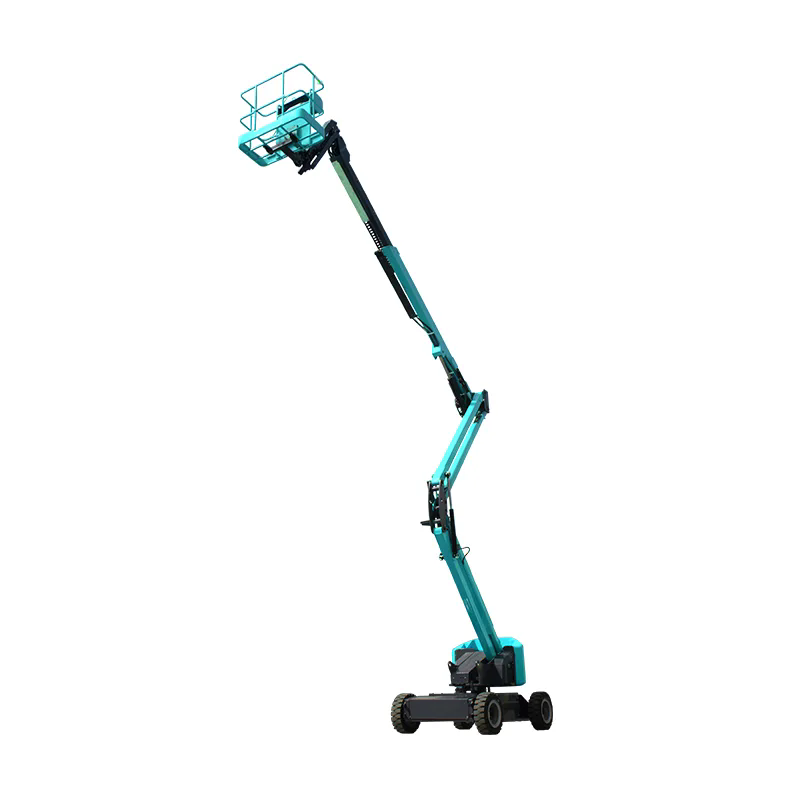
1. What Is the Actual Capacity of a Boom Lift Platform for Personnel and Tools?
The platform capacity of a Boom Lift is rated in kilograms and includes the weight of the personnel, the tools, and the materials. A typical diesel articulating boom lift has a platform capacity of 230 to 450 kilograms. For a two-person platform, the allowance for tools and materials is typically 90 to 230 kilograms after deducting the weight of the occupants. That is enough for a full set of hand tools, a portable welding machine, a pipe threading machine, or several bundles of conduit. The platform also has a defined deck area, typically 1.8 meters by 0.8 meters, with a railing height of 1.1 meters.
The table below shows the platform specifications for our standard models.
| Model | Platform capacity (kg) | Platform size (m) | Max working height (m) | Tool allowance (kg) |
| NS-140 | 230 | 1.8 x 0.8 | 14 | 90 |
| NS-180 | 320 | 2.4 x 0.9 | 18 | 160 |
| NS-220 | 450 | 2.4 x 1.2 | 22 | 250 |
| NS-260 | 450 | 2.4 x 1.2 | 26 | 250 |
In our factory, we design the platform with a non-slip surface and a kick plate to prevent tools from rolling off. The gate is a swing type with a self-closing spring and a safety interlock. The platform also has tie-down points for securing toolboxes and material carts. Anhui Newstyle Intelligent Technology Co., Ltd. manufactures Boom Lift units that are tested to EN 280 and ANSI A92.20 standards.
2. How Does the Platform Design Improve Tool Transport and Organization?
The platform of a Boom Lift is not just a flat deck. It is a workspace that can be configured to organize tools and materials. Our factory offers several options that improve tool transport and access. The first is a removable tool tray that mounts on the railing. It holds hand tools, fasteners, and small parts within easy reach. The second is a pipe rack that mounts on the side of the platform for carrying conduit or pipe up to 3 meters long. The third is a material hook that attaches to the platform for lifting bulky items. The fourth is a power outlet on the platform that provides 110V or 220V for power tools. The table below shows the available platform options and their typical applications.
| Platform option | Description | Typical application |
| Tool tray | Removable tray with dividers, mounts on railing | Electrical, HVAC, maintenance |
| Pipe rack | Side-mounted rack for long materials | Plumbing, fire protection, conduit |
| Material hook | Swivel hook with 100 kg capacity | Lifting panels, ductwork, fixtures |
| Power outlet | 110V or 220V, GFCI protected | Power tools, lighting, welding |
| Welding shelf | Fire-resistant shelf with rod holder | Steel erection, structural welding |
These options are designed to be installed and removed without tools, so the platform can be reconfigured for different tasks in minutes. In our experience, a well-organized platform can reduce the time spent searching for tools by 30 to 40 percent, which directly improves productivity.
3. How Does the Boom Lift Move Both Personnel and Tools to the Work Position?
The value of a Boom Lift is not just the platform capacity. It is the ability to move the platform—with the personnel and tools on board—to the exact work position. This is achieved through the combination of the boom geometry and the drive system. An articulating boom has two or more sections that can be folded and extended to reach over obstacles. A telescopic boom has a single extending section for maximum horizontal reach. The drive system allows the machine to be moved from one work area to another without lowering the platform. The table below compares the reach characteristics of articulating and telescopic booms.
| Boom type | Max horizontal reach (m) | Max up-and-over height (m) | Best application |
| Articulating (NS-180A) | 10.5 | 8.2 | Working over obstacles, around corners |
| Telescopic (NS-220T) | 18.0 | N/A | Long horizontal reach, straight-line access |
| Articulating + jib (NS-260AJ) | 14.0 | 10.5 | Precise positioning, complex geometry |
The ability to move the platform without lowering it is a major time saver. On a typical warehouse project, a Boom Lift can move from one column to the next in 30 seconds, compared to 5 minutes for a scaffold that must be disassembled and reassembled. Over a 10-hour shift, this difference can add up to 2 hours of productive work time.
4. What Safety Features Ensure Secure Transport of Personnel and Tools?
Transporting personnel and tools at height requires a comprehensive safety system. The Boom Lift must be stable under all operating conditions, and the platform must be protected against falling objects and accidental movement. Our factory equips every Boom Lift with the following safety features: a tilt sensor that prevents operation if the machine is on a slope greater than the rated grade; a load sensing system that prevents operation if the platform is overloaded; a motion alarm that sounds when the machine is moving; and a fall protection anchor point in the platform. The platform also has a foot switch that must be depressed for the machine to move, which prevents accidental operation. The table below summarizes the safety systems and their functions.
| Safety system | Function | Standard |
| Tilt sensor | Prevents operation on excessive slope | EN 280 |
| Load sensing | Prevents platform overload | EN 280 |
| Motion alarm | Alerts personnel when machine moves | ANSI A92.20 |
| Fall protection anchor | Provides attachment point for harness | ANSI A92.20 |
| Foot switch | Prevents accidental movement | EN 280 |
Anhui Newstyle Intelligent Technology Co., Ltd. manufactures Boom Lift units that meet these standards. We also provide operator training materials and a pre-operation checklist with every machine.
Frequently Asked Questions About Boom Lift Personnel and Tool Transport
Summary for Site Supervisors and Project Managers
A Boom Lift solves the problem of personnel and tool transport at height by providing a mobile platform that carries the crew and all of their equipment directly to the work face. The platform capacity, the tool organization options, and the reach characteristics determine how efficiently the machine can be used. By selecting the right model for the job and organizing the platform properly, you can reduce the time spent on transport and increase the time spent on productive work. Anhui Newstyle Intelligent Technology Co., Ltd. manufactures Boom Lift units for construction, maintenance, and industrial applications. We provide full specifications and application support.
Anhui Newstyle Intelligent Technology Co., Ltd. manufactures Boom Lift units in articulating and telescopic configurations, with platform capacities from 230 to 450 kilograms and working heights from 14 to 26 meters. We provide operator training and maintenance support for all of our products.