

How Does a CNC 5 Axis Bridge Saw Improve Stone Processing Efficiency and Accuracy?
2026-07-20
Stone fabrication businesses face increasing pressure to deliver complex designs, faster production times, and flawless finished products. Traditional cutting equipment often struggles to meet modern requirements for precision, automation, and versatility. This is where a CNC 5 Axis Bridge Saw becomes a game-changing solution.
A CNC 5 Axis Bridge Saw combines advanced computer numerical control technology with multi-directional cutting capabilities, allowing fabricators to process natural stone, quartz, granite, marble, sintered stone, and engineered surfaces with exceptional precision. Whether producing kitchen countertops, vanity tops, architectural elements, or customized stone projects, this technology significantly improves productivity while reducing material waste.
Article Summary
This article explains how a CNC 5 Axis Bridge Saw works, its key advantages, major applications, and why it has become an essential investment for modern stone processing facilities. You will also learn how advanced automation helps businesses reduce labor costs, improve cutting accuracy, and increase production capacity while maintaining consistent quality.
Table of Contents
- What Is a CNC 5 Axis Bridge Saw?
- How Does a CNC 5 Axis Bridge Saw Work?
- Key Benefits of Using a CNC 5 Axis Bridge Saw
- Traditional Bridge Saw vs CNC 5 Axis Bridge Saw
- Common Applications in Stone Fabrication
- Important Features to Consider
- Why Investing in Advanced Technology Matters
- Choosing the Right Equipment Supplier
- Frequently Asked Questions
Outline
- Introduction to CNC 5 Axis Bridge Saw Technology
- Working Principles and Automation Functions
- Advantages for Modern Stone Fabrication
- Comparison with Conventional Cutting Equipment
- Industry Applications and Use Cases
- Key Features Buyers Should Evaluate
- Long-Term Business Benefits
- Supplier Selection Guidelines
- FAQ Section
What Is a CNC 5 Axis Bridge Saw?
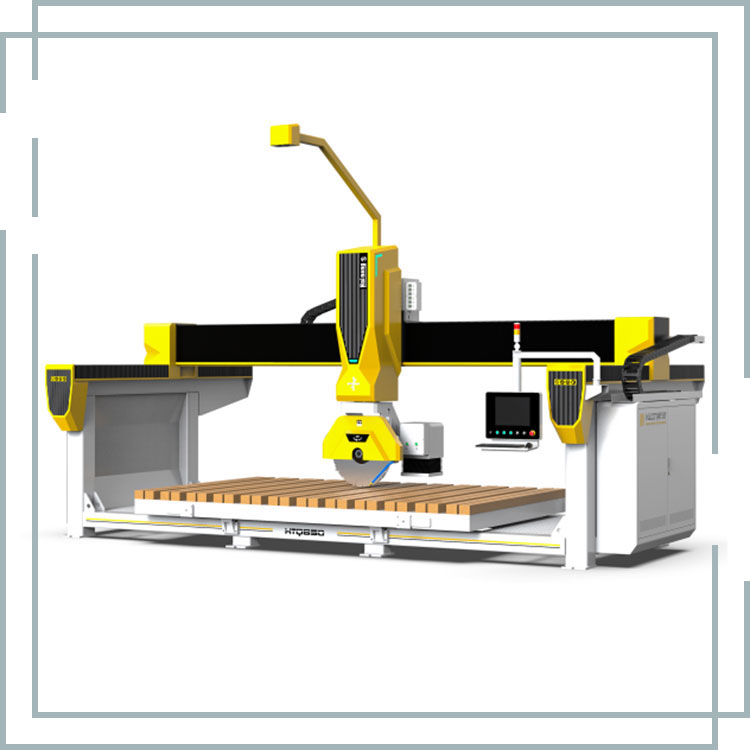
A CNC 5 Axis Bridge Saw is an advanced stone-cutting machine designed to perform highly precise cutting, drilling, milling, shaping, and edge-processing operations. Unlike traditional bridge saws that operate primarily on straight-line cuts, a 5-axis system allows the blade to rotate and tilt automatically, enabling complex machining operations from multiple angles.
The machine utilizes computerized programming to control movement across five independent axes, allowing operators to create sophisticated designs with minimal manual intervention. This capability is particularly valuable for fabricators working with premium stone materials where precision and material utilization directly impact profitability.
Modern CNC 5 Axis Bridge Saws are widely used in workshops producing:
- Granite countertops
- Marble slabs
- Quartz kitchen surfaces
- Bathroom vanity tops
- Staircases
- Architectural stone components
- Decorative wall panels
- Custom stone furniture
How Does a CNC 5 Axis Bridge Saw Work?
The machine operates through an integrated CNC control system that interprets CAD drawings and converts them into precise machining instructions.
The five-axis movement system typically includes:
| Axis | Function |
|---|---|
| X Axis | Horizontal movement along the length of the table |
| Y Axis | Horizontal movement across the width of the table |
| Z Axis | Vertical movement for cutting depth control |
| A Axis | Blade rotation for angle adjustments |
| C Axis | Blade tilting for complex cuts and beveling |
After importing a design file, the machine automatically calculates cutting paths and executes operations with remarkable accuracy. Advanced models can perform multiple processes in a single setup, eliminating repeated handling of stone slabs.
This automated workflow significantly reduces operator error while ensuring consistent results across large production volumes.
Key Benefits of Using a CNC 5 Axis Bridge Saw
Many stone fabrication businesses encounter challenges such as labor shortages, production bottlenecks, material waste, and inconsistent product quality. A CNC 5 Axis Bridge Saw directly addresses these issues.
Superior Cutting Accuracy
One of the biggest advantages is precision. Computer-controlled cutting minimizes human error and ensures that every dimension matches design specifications.
- Consistent tolerances
- Smooth cutting edges
- Reduced rework
- Improved installation fit
Greater Production Efficiency
Automation reduces setup time and speeds up production cycles. Operators can manage multiple projects more effectively without sacrificing quality.
- Faster processing times
- Reduced manual labor
- Higher daily output
- Improved workflow management
Complex Shape Processing
The five-axis movement system allows fabricators to produce intricate designs that would be difficult or impossible with traditional equipment.
- Curved cuts
- Beveled edges
- Sink cutouts
- Radius corners
- Decorative stone components
Reduced Material Waste
Stone materials represent a significant investment. Optimized cutting paths maximize slab utilization and reduce costly waste.
This directly contributes to improved profit margins and more sustainable production practices.
Traditional Bridge Saw vs CNC 5 Axis Bridge Saw
| Feature | Traditional Bridge Saw | CNC 5 Axis Bridge Saw |
|---|---|---|
| Automation Level | Low | High |
| Cutting Accuracy | Operator Dependent | Computer Controlled |
| Complex Shape Capability | Limited | Excellent |
| Production Speed | Moderate | High |
| Material Utilization | Average | Optimized |
| Labor Requirement | High | Lower |
| Repeatability | Variable | Consistent |
The comparison clearly demonstrates why more fabrication companies are upgrading to advanced CNC solutions.
Common Applications in Stone Fabrication
A CNC 5 Axis Bridge Saw is suitable for a wide range of stone-processing projects.
Kitchen Countertops
Precise sink openings, cooktop cutouts, edge profiling, and seamless joint preparation can be completed efficiently.
Bathroom Vanities
Complex basin cutouts and decorative edge details are easily produced with automated programming.
Architectural Projects
Large-scale commercial buildings often require custom stone panels and intricate decorative features that benefit from multi-axis machining capabilities.
Interior Decoration
Designers increasingly demand unique shapes and artistic stone elements. Five-axis technology provides the flexibility needed to meet these requirements.
Important Features to Consider
When evaluating a CNC 5 Axis Bridge Saw, buyers should focus on the following factors:
- Machine structure stability
- CNC control system performance
- Spindle power
- Blade tilting range
- Rotational capabilities
- Software compatibility
- Vacuum handling options
- Automatic tool change systems
- Safety protection features
- After-sales technical support
Selecting the right machine configuration can have a substantial impact on production efficiency and long-term operating costs.
Why Investing in Advanced Technology Matters
The stone fabrication industry continues to evolve rapidly. Customers increasingly expect shorter lead times, customized designs, and flawless product quality.
Businesses relying solely on conventional machinery may find it difficult to remain competitive in this environment.
A CNC 5 Axis Bridge Saw helps manufacturers:
- Expand service offerings
- Accept more complex projects
- Increase production capacity
- Improve customer satisfaction
- Reduce operational costs
- Strengthen market competitiveness
Over time, these benefits often generate a strong return on investment while positioning a company for future growth.
Choosing the Right Equipment Supplier
The performance of a CNC 5 Axis Bridge Saw depends not only on machine specifications but also on the expertise and support provided by the manufacturer.
Quanzhou XinhainengMachineryCo.,Ltd. specializes in advanced stone processing equipment designed to meet the evolving needs of global stone fabrication businesses. By focusing on innovation, machine reliability, and customer support, the company provides solutions that help manufacturers achieve higher productivity and superior processing quality.
When selecting a supplier, it is advisable to evaluate:
- Industry experience
- Manufacturing capabilities
- Technical support resources
- Installation services
- Operator training programs
- Spare parts availability
- Global customer references
Frequently Asked Questions
Can a CNC 5 Axis Bridge Saw Cut Quartz and Granite?
Yes. Modern machines are designed to process granite, marble, quartz, sintered stone, engineered stone, and many other hard materials with high precision.
Does the Machine Require Highly Skilled Operators?
While training is necessary, CNC automation significantly reduces manual complexity. Most operators can become proficient after proper instruction and practical experience.
Is a 5 Axis Bridge Saw Suitable for Small Workshops?
Yes. Many small and medium-sized fabrication shops use CNC 5 Axis Bridge Saws to increase productivity, improve quality, and compete with larger manufacturers.
How Does It Reduce Material Waste?
The CNC software optimizes cutting paths and nesting layouts, helping maximize slab utilization and minimize unnecessary offcuts.
What Is the Main Advantage Compared with Traditional Equipment?
The biggest advantage is the combination of automation, precision, versatility, and efficiency. These factors allow businesses to produce more complex products with fewer errors and lower operating costs.
Conclusion
A CNC 5 Axis Bridge Saw represents one of the most significant advancements in modern stone fabrication technology. Its ability to deliver precise cuts, complex shapes, higher productivity, and reduced material waste makes it an essential solution for companies seeking long-term growth and operational excellence.
Whether you manufacture kitchen countertops, architectural stone elements, or customized decorative products, investing in advanced CNC equipment can dramatically improve production performance and customer satisfaction.
If you are looking for reliable stone processing solutions, Quanzhou XinhainengMachineryCo.,Ltd. can help you discover the ideal CNC 5 Axis Bridge Saw for your production requirements. Ready to improve efficiency, precision, and profitability? Contact us today to learn more about our advanced stone machinery solutions and find the perfect machine for your business.