

How Does a Loss-In-Weight Scale Integrate With PLCs for Real-Time Batching Control
2026-06-11
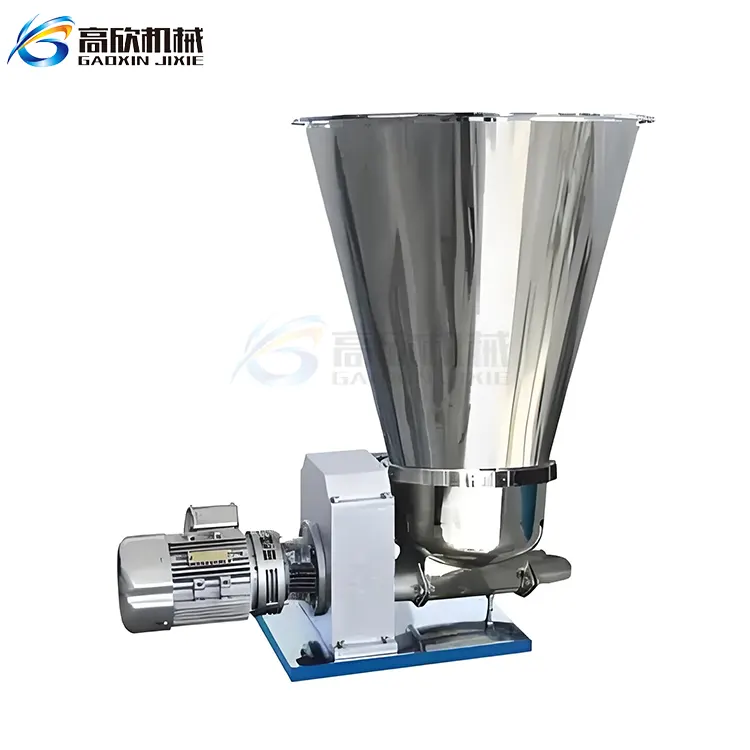
In modern batching and continuous feeding operations, precision is non-negotiable. A Loss-In-Weight Scale measures material discharge by detecting the rate of weight loss from a hopper over time. When integrated with a PLC (Programmable Logic Controller), this system enables true closed-loop control. Gaoxin specializes in such integrated feeding solutions, ensuring that real-time data from the scale directly adjusts feeder speed, refill timing, and batch totals without human delay.
Core Integration Workflow
The table below outlines how a Loss-In-Weight Scale communicates with a PLC for real-time batching.
| Step | Component | Action | Data Transferred |
|---|---|---|---|
| 1 | Loss-In-Weight Scale (Load cells) | Continuously measures weight loss rate | 4-20 mA or digital weight signal |
| 2 | PLC (e.g., Siemens, Rockwell) | Compares actual feed rate to setpoint | PID output command |
| 3 | Motor drive (feeder screw/ belt) | Adjusts speed based on PLC command | Actual motor RPM feedback |
| 4 | Refill valve/device | Opens when weight reaches low threshold | Refill request signal |
Why Use PLC Integration Instead of Standalone Control?
A standalone Loss-In-Weight Scale can display rate and total, but it lacks logic for multi-ingredient recipes, alarms, or historical data logging. By integrating with a PLC, Gaoxin enables customers to:
-
Synchronize multiple Loss-In-Weight Scale feeders for complex blends.
-
Automate refill cycles without production stops.
-
Store batch records and generate real-time production reports.
Frequently Asked Questions About Loss-In-Weight Scale Integration
Q1: What type of signal output does a Loss-In-Weight Scale need to connect to a PLC?
A1: Most industrial Loss-In-Weight Scale systems support standard analog outputs (4-20 mA or 0-10 V) for the instantaneous feed rate, plus a digital pulse or RS-485 (Modbus RTU) for totalized weight. Gaoxin scales also offer Profibus DP and Ethernet/IP options. The 4-20 mA loop is preferred for noisy environments because it transmits the live weight-loss derivative, which the PLC uses as the process variable for PID (Proportional-Integral-Derivative) control. Without this continuous analog signal, the PLC cannot perform real-time correction.
Q2: How does the PLC handle refill disturbances in a Loss-In-Weight Scale system?
A2: During refill, material is added to the hopper, causing the measured weight to increase rapidly. A standard PLC program would mistake this for a negative feed rate. To solve this, Gaoxin implements a “refill hold” mode: the PLC freezes the PID output at the last good value before refill starts, ignores the weight signal for 0.5–2 seconds after refill finishes, then resumes normal control. Advanced PLC logic also uses a running average of pre-refill slope to estimate what the feed rate should have been during the hold period.
Q3: Can one PLC manage multiple Loss-In-Weight Scale feeders for batching the same recipe?
A3: Yes. A single PLC – for example, a Gaoxin-configured Siemens S7-1200 – can handle up to 16 Loss-In-Weight Scale feeders. The PLC reads each scale’s weight signal over a shared communication bus (Modbus or Profibus) and assigns individual PID loops per feeder. For batching, the PLC monitors each scale’s remaining batch quantity; when one finishes, it triggers a refill while others continue. The master PLC also reconciles total batch weight by summing the weight loss from all active scales, ensuring the final blend meets the target ±0.5%.
Best Practices for PLC Integration
-
Update rate: Ensure the PLC scans weight inputs at least every 100 ms.
-
Noise filtering: Use shielded cables for load cell signals to avoid PLC analog input jitter.
-
Redundant refill logic: Program a maximum refill timer in the PLC to detect valve failures.
Conclusion
Integrating a Loss-In-Weight Scale with a PLC transforms reactive weighing into predictive batching control. Gaoxin delivers pre-engineered Loss-In-Weight Scale systems with PLC function blocks, reducing integration time from weeks to hours.
Contact us today – tell us your feed rate, material type, and batching accuracy requirement. Our Gaoxin engineers will send you a wiring diagram and a sample PLC logic program within 24 hours.