

In today's competitive manufacturing industry, production efficiency, dimensional accuracy, and consistent product quality are essential for maintaining a strong market position. A Mechanical Press plays an important role in achieving these goals by transforming mechanical energy into controlled pressing force for metal forming, stamping, punching, blanking, and other industrial operations. From automotive components and electrical equipment to household appliances and precision metal parts, mechanical presses provide manufacturers with reliable solutions for high-volume production. With a focus on precision engineering and advanced manufacturing technology, Zhejiang ETONE Precision Machine Co.,ltd. delivers mechanical press solutions designed to meet the evolving requirements of modern industrial production.
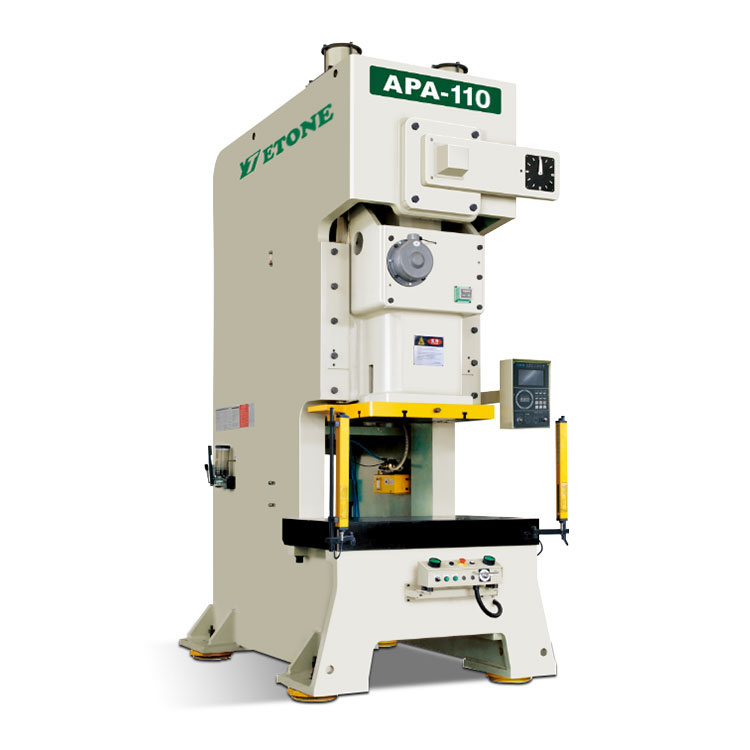
What Is a Mechanical Press and How Does It Work?
A Mechanical Press is an industrial machine that uses a motor-driven mechanical transmission system to convert rotational energy into reciprocating motion. Through components such as flywheels, clutches, crankshafts, connecting rods, and slides, the machine generates the force required to shape or process metal materials.
During operation, the motor drives the flywheel to store kinetic energy. When the clutch engages, this energy is transferred through the transmission mechanism, moving the slide downward to perform the required forming operation. The slide then returns to its original position, preparing for the next production cycle.
This mechanical operating principle makes the equipment particularly suitable for repetitive manufacturing processes that require stable performance and consistent production speed.
Key Components and Their Functions
- Motor: Supplies the power required to operate the press.
- Flywheel: Stores rotational energy and helps maintain stable operation.
- Clutch and Brake System: Controls power transmission and slide movement.
- Crankshaft: Converts rotational motion into reciprocating movement.
- Connecting Rod: Transfers mechanical movement to the slide.
- Slide and Die: Apply the required pressure to shape or process materials.
Why Is a Mechanical Press Important for Industrial Production?
As manufacturing operations become increasingly automated and production requirements become more demanding, selecting suitable metalworking equipment is essential. A well-designed Mechanical Press can improve production efficiency while helping manufacturers maintain consistent processing standards.
1. Higher Production Efficiency
Mechanical presses are designed for repetitive operations and can achieve relatively high production speeds. Their efficient transmission systems allow manufacturers to complete multiple stamping and forming cycles within a short period, making them suitable for mass production environments.
2. Consistent Processing Accuracy
Stable mechanical transmission and properly configured dies help maintain consistent forming positions and product dimensions. This is particularly important when manufacturing components that must meet strict dimensional tolerances and assembly requirements.
3. Reduced Manufacturing Costs
For suitable high-volume applications, mechanical presses can reduce processing time and improve material utilization. Combined with automated feeding and material handling systems, they can also reduce repetitive manual operations and improve overall production efficiency.
4. Flexible Industrial Applications
By changing dies and adjusting operating parameters within the machine's rated capabilities, manufacturers can perform different metalworking operations using the same press. This flexibility makes mechanical presses valuable equipment across multiple manufacturing sectors.
What Applications Can a Mechanical Press Handle?
A Mechanical Press supports various metal forming and material processing operations. Its application depends on factors such as machine capacity, slide stroke, operating speed, die configuration, and material characteristics.
| Application | Processing Function | Typical Products |
|---|---|---|
| Stamping | Shapes sheet metal through die pressure | Automotive panels and metal housings |
| Punching | Creates holes in metal materials | Brackets and mounting plates |
| Blanking | Cuts metal into predetermined shapes | Metal blanks and precision components |
| Bending | Changes the angle or shape of sheet metal | Metal frames and structural parts |
| Shallow Drawing | Forms flat metal sheets into three-dimensional shapes | Containers and appliance components |
These applications demonstrate why mechanical presses remain important in industries such as automotive manufacturing, electrical appliance production, hardware processing, electronics, and general metal fabrication.
Mechanical Press vs. Hydraulic Press: Which Is Better?
Mechanical and hydraulic presses both provide industrial pressing capabilities, but their operating principles and performance characteristics differ. Understanding these differences helps manufacturers select equipment according to their production requirements.
| Comparison Factor | Mechanical Press | Hydraulic Press |
|---|---|---|
| Power Transmission | Mechanical drive system | Hydraulic fluid pressure |
| Production Speed | Generally higher for repetitive operations | Generally slower in comparable forming cycles |
| Force Characteristics | Force depends on crank position and machine design | Pressure can be controlled throughout the stroke |
| Typical Applications | Stamping, punching, and blanking | Deep drawing and complex forming |
| Production Focus | High-speed repetitive manufacturing | Controlled pressing and forming processes |
Neither machine is universally better. A Mechanical Press is often a practical choice for high-speed stamping and repetitive production, while a hydraulic press may be more suitable for applications requiring sustained pressure or greater control over the forming process.
How to Choose the Right Mechanical Press for Your Factory
Purchasing industrial pressing equipment requires more than comparing machine prices or nominal tonnage. Manufacturers should evaluate the complete production process to ensure that the selected equipment meets both current and future requirements.
Important Factors to Consider
- Press Capacity: Select an appropriate tonnage according to the material, thickness, die design, and required forming force.
- Stroke and Shut Height: Confirm that the machine dimensions are compatible with the tooling and processing requirements.
- Production Speed: Evaluate strokes per minute and determine whether the equipment can meet the expected production volume.
- Precision and Stability: Consider frame rigidity, slide guidance, and overall structural design.
- Safety Features: Check protective systems, emergency stops, and applicable industrial safety requirements.
- Automation Compatibility: Consider whether automatic feeding, robotic handling, or production line integration is required.
- After-Sales Support: Evaluate technical assistance, spare parts availability, maintenance guidance, and long-term service capabilities.
Why Consider Zhejiang ETONE Precision Machine Co.,ltd.?
Choosing a reliable equipment manufacturer is an important part of establishing an efficient and stable production system. Zhejiang ETONE Precision Machine Co.,ltd. focuses on precision machinery and industrial press manufacturing, providing solutions for manufacturers seeking dependable metalworking equipment.
When evaluating a Mechanical Press supplier, buyers should look beyond the initial purchase price and consider engineering quality, manufacturing standards, equipment configuration, and technical support. A professional manufacturing partner should understand different production scenarios and help customers identify suitable machine specifications based on their actual processing needs.
For manufacturers planning to upgrade existing stamping operations or establish new production lines, working with an experienced machinery supplier can support better equipment selection, more efficient production planning, and long-term operational reliability.
Conclusion
A Mechanical Press remains an essential piece of equipment in modern metalworking because of its high-speed operation, consistent processing performance, and suitability for repetitive manufacturing tasks. From automotive components to electrical housings and precision hardware, it supports a wide range of industrial applications.
Understanding machine specifications, production requirements, and equipment performance is the foundation of making the right investment. Zhejiang ETONE Precision Machine Co.,ltd. is committed to providing professional precision machinery solutions for industrial manufacturing needs. If you are looking for suitable mechanical press equipment or want to discuss your production requirements, contact us today to explore the right solution for your business and improve your manufacturing efficiency.