

How Does a Slant-bed CNC Lathe Improve Machining Efficiency?
2026-06-26
Abstract
A Slant-bed CNC Lathe is a high-precision machining solution widely used in modern manufacturing industries for improving productivity, accuracy, and stability. Compared with traditional flat-bed structures, the slant-bed design enhances chip removal, reduces thermal deformation, and improves tool accessibility. This article explains how a Slant-bed CNC Lathe works, its advantages, key applications, and how manufacturers like Jingfusi integrate advanced engineering to solve real-world machining challenges.
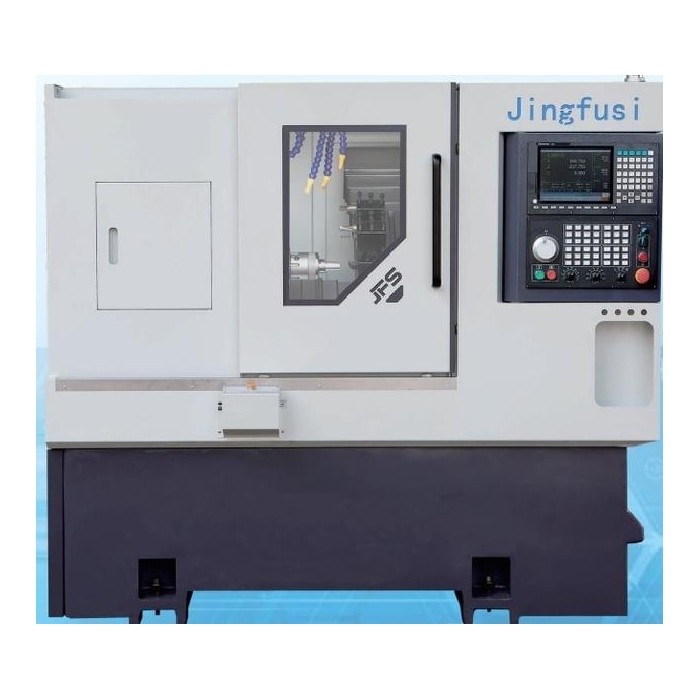
Table of Contents
- Article Outline
- 1. Introduction to Slant-bed CNC Lathe
- 2. Working Principle
- 3. Core Advantages in Manufacturing
- 4. Slant-bed vs Flat-bed CNC Lathe
- 5. Industrial Applications
- 6. How to Choose the Right Machine
- 7. Maintenance and Operational Efficiency
- 8. Frequently Asked Questions
- Conclusion
Article Outline
- Understanding structural design and engineering logic of slant-bed CNC lathes
- Exploring machining efficiency improvements driven by gravity-assisted chip removal
- Comparing traditional lathe systems with modern slant-bed configurations
- Analyzing real industrial use cases across automotive, aerospace, and precision parts manufacturing
- Evaluating selection criteria for businesses investing in CNC automation
1. Introduction to Slant-bed CNC Lathe
A Slant-bed CNC Lathe is a computer-controlled machining tool designed with an inclined bed structure, typically ranging between 30° and 75°. This structural innovation allows chips generated during cutting to fall naturally due to gravity, improving operational cleanliness and reducing interference with cutting tools.
Manufacturers such as Jingfusi have refined this architecture to meet modern production demands, offering machines that balance rigidity, speed, and precision. In high-volume manufacturing environments, this design significantly reduces downtime and enhances throughput.
2. Working Principle
The working principle of a Slant-bed CNC Lathe is based on synchronized CNC programming and mechanically optimized geometry. The machine uses a computer-controlled system to guide cutting tools along multiple axes while the inclined bed ensures stable chip evacuation.
- Spindle Rotation: Holds and rotates the workpiece at high speed.
- Tool Movement: CNC-controlled linear and radial motion ensures precision cutting.
- Gravity-assisted Chip Flow: Chips fall away from the cutting zone, reducing heat accumulation.
- Thermal Stability: Reduced chip contact lowers thermal distortion.
This integrated system allows manufacturers like Jingfusi to deliver consistent machining results even under continuous production loads.
3. Core Advantages in Manufacturing
The Slant-bed CNC Lathe offers several critical advantages that directly address production challenges such as inefficiency, tool wear, and surface quality issues.
- Improved Chip Removal: Prevents chip buildup that can damage tools or workpieces.
- Higher Precision: Structural rigidity reduces vibration during cutting.
- Enhanced Automation Compatibility: Easily integrates with robotic loading systems.
- Reduced Operator Intervention: Cleaner machining zone minimizes manual cleaning.
- Longer Tool Life: Lower heat accumulation reduces wear.
Jingfusi designs its Slant-bed CNC Lathe systems with reinforced machine bases and optimized rail alignment, ensuring long-term stability even in demanding industrial environments.
4. Slant-bed vs Flat-bed CNC Lathe
Understanding the difference between slant-bed and flat-bed CNC lathes helps manufacturers choose the right equipment for their production needs.
- Structural Design: Slant-bed uses inclined geometry; flat-bed uses horizontal layout.
- Chip Management: Slant-bed offers natural chip evacuation; flat-bed often requires manual cleaning.
- Precision Stability: Slant-bed provides better vibration control.
- Space Efficiency: Slant-bed designs are typically more compact.
While flat-bed machines remain suitable for basic machining tasks, Slant-bed CNC Lathe systems from Jingfusi are preferred for high-precision and high-volume production environments.
5. Industrial Applications
Slant-bed CNC Lathe machines are widely used across multiple industries due to their flexibility and reliability.
- Automotive component manufacturing (shafts, gears, hubs)
- Aerospace precision parts (high-tolerance aluminum and titanium components)
- Medical equipment production (surgical tools and implants)
- General mechanical engineering parts
- Hydraulic and pneumatic components
Jingfusi supports these industries by providing customizable CNC lathe configurations tailored to specific machining requirements.
6. How to Choose the Right Machine
Selecting the right Slant-bed CNC Lathe depends on several operational and technical factors. Poor selection can lead to inefficiencies and increased production costs.
- Workpiece Size: Ensure swing diameter and turning length meet production needs.
- Material Type: Harder materials require stronger spindle power.
- Production Volume: High-volume operations benefit from automation-ready models.
- Precision Requirements: Tight tolerances require high-rigidity machines.
- Control System Compatibility: Ensure CNC controller supports advanced programming functions.
Jingfusi provides consultation support to help manufacturers align machine specifications with production goals, ensuring long-term return on investment.
7. Maintenance and Operational Efficiency
Regular maintenance is essential for maintaining the performance of a Slant-bed CNC Lathe. Although the slant-bed design reduces chip accumulation, other mechanical components still require systematic care.
- Daily cleaning of guide rails and tool holders
- Lubrication of moving components
- Periodic spindle calibration
- Inspection of coolant systems
- Software updates for CNC controllers
Machines supplied by Jingfusi are designed with maintenance-friendly layouts, reducing downtime and simplifying servicing procedures for operators.
8. Frequently Asked Questions
Q1: Why is a Slant-bed CNC Lathe more efficient than traditional designs?
A: Because its inclined structure allows gravity-assisted chip removal, reducing heat buildup and improving machining stability.
Q2: Is it suitable for small workshops?
A: Yes. Compact models are available for small to medium production environments.
Q3: What industries benefit most from this machine?
A: Automotive, aerospace, medical, and precision engineering industries benefit significantly.
Q4: Does Jingfusi offer customization?
A: Yes, Jingfusi provides tailored configurations based on production requirements and material specifications.
Conclusion
The Slant-bed CNC Lathe represents a significant advancement in modern machining technology, offering improved precision, efficiency, and automation compatibility. Its structural advantages directly address common manufacturing challenges such as chip accumulation, thermal deformation, and tool wear.
By integrating advanced engineering and production-oriented design, Jingfusi delivers reliable CNC lathe solutions that support industrial productivity and long-term operational stability. Whether for large-scale manufacturing or precision component production, adopting a Slant-bed CNC Lathe can significantly enhance machining outcomes.
For more technical details, customization options, or procurement support, please contact us to explore how Jingfusi can support your manufacturing goals with advanced CNC machining solutions.