

How does Adsorption Air Dryer work?
2026-04-13
Abstract
An Adsorption Air Dryer is a critical piece of compressed air treatment equipment designed to remove moisture from compressed air systems, ensuring dry, clean air for industrial processes. Excess moisture in compressed air can lead to corrosion, equipment failure, product contamination, and increased maintenance costs. This article provides a comprehensive breakdown of how adsorption air dryers work, their internal structure, types, applications, and how to choose and maintain them effectively. It also highlights practical insights from industrial usage scenarios to help operators and engineers make informed decisions.
Outline
- Introduction to Adsorption Air Dryers
- Working Principle Explained
- Main System Components
- Types of Adsorption Air Dryers
- Advantages in Industrial Applications
- Selection Criteria
- Maintenance Guidelines
- Common Issues and Solutions
- Comparison with Other Dryer Technologies
- FAQ Section
Table of Contents
- Introduction
- Working Principle
- Key Components
- Types of Adsorption Air Dryers
- Advantages
- Industrial Applications
- Selection Guide
- Maintenance
- Troubleshooting
- Technology Comparison
- FAQ
- Conclusion
Introduction to Adsorption Air Dryers
Compressed air systems are widely used across manufacturing, automotive, pharmaceuticals, food processing, and electronics industries. However, compressed air naturally contains water vapor that condenses during compression. If not properly treated, this moisture leads to rust formation, pipeline scaling, valve malfunction, and compromised product quality.
An Adsorption Air Dryer solves this issue by using a desiccant material to physically capture and remove moisture from the air stream. Unlike refrigeration-based systems, adsorption technology is capable of achieving extremely low dew points, making it suitable for critical applications where dryness is essential.
Working Principle of Adsorption Air Dryer
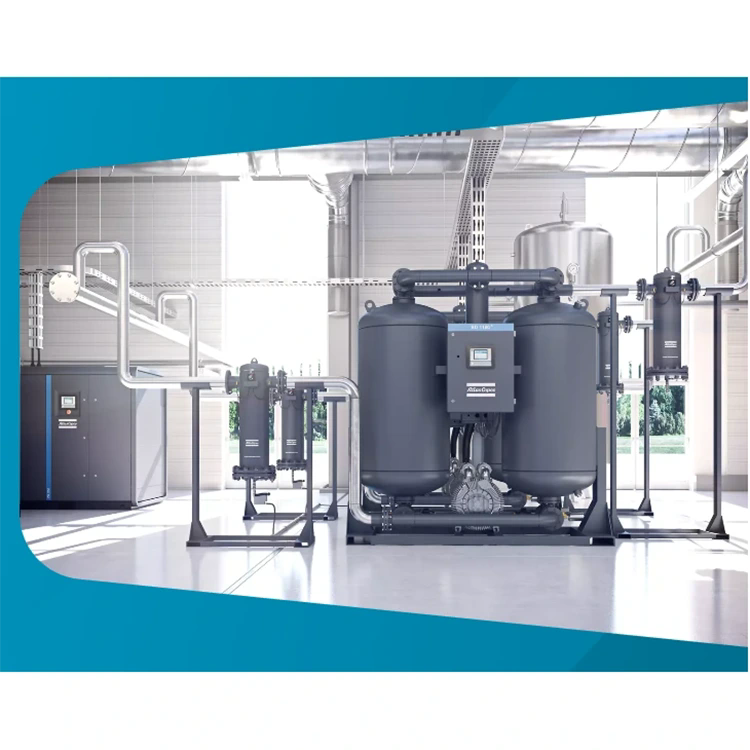
The core mechanism of an adsorption air dryer is based on the process of adsorption, where water vapor adheres to the surface of a desiccant material. Common desiccants include activated alumina, silica gel, and molecular sieves.
The working cycle typically includes two towers:
- Adsorption Tower: Compressed air passes through the desiccant bed, where moisture is trapped.
- Regeneration Tower: The saturated desiccant is dried using purge air or external heat to restore adsorption capacity.
This alternating cycle ensures continuous supply of dry compressed air. Modern systems often include PLC-based controls to optimize switching intervals and reduce energy consumption.
Key Components of Adsorption Air Dryer
- Desiccant Bed: The core moisture absorption medium.
- Air Tanks (Twin Towers): Alternate between drying and regeneration cycles.
- Control Valve System: Directs airflow between towers.
- Silencers: Reduce noise during purge cycles.
- Heaters (in heated models): Assist in desiccant regeneration.
- Control Panel: Automates operation cycles and monitoring.
Types of Adsorption Air Dryers
Different industrial requirements call for different adsorption dryer configurations:
- Heatless Type: Uses dry compressed air for regeneration. Simple and widely used.
- Heated Type: Uses external heaters to reduce purge air consumption.
- Blower Purge Type: Utilizes ambient air and blowers for energy efficiency.
| Type | Energy Efficiency | Cost | Typical Use |
|---|---|---|---|
| Heatless | Medium | Low | Small to medium systems |
| Heated | High | Medium | Continuous industrial operations |
| Blower Purge | Very High | High | Large-scale energy-sensitive industries |
Advantages of Adsorption Air Dryers
- Achieves extremely low dew points (down to -40°C or lower)
- Prevents corrosion in pipelines and equipment
- Improves product quality in sensitive industries
- Extends lifespan of pneumatic tools
- Supports high-precision manufacturing processes
Companies such as Dechuan design adsorption air dryers that emphasize energy efficiency, stability, and long-term operational reliability for demanding industrial environments.
Industrial Applications
Adsorption air dryers are used in industries where moisture-free air is critical:
- Pharmaceutical production
- Food and beverage processing
- Electronics manufacturing
- Automotive spray painting
- Petrochemical operations
- Laser cutting systems
Selection Guide
Choosing the right adsorption air dryer depends on several technical and operational factors:
- Required dew point level
- Compressed air flow rate
- Operating pressure
- Energy consumption constraints
- Installation environment
For customized solutions, Dechuan provides engineering support to match system requirements with optimal dryer configurations.
Maintenance Guidelines
- Regular inspection of desiccant condition
- Check valve timing and control systems
- Replace filters periodically
- Monitor dew point performance
- Ensure proper purge airflow calibration
Preventive maintenance significantly reduces downtime and ensures stable compressed air quality over long operational cycles.
Common Issues and Solutions
| Issue | Possible Cause | Solution |
|---|---|---|
| High outlet humidity | Saturated desiccant | Replace or regenerate desiccant |
| Pressure drop | Clogged filters | Clean or replace filters |
| Excessive air consumption | Valve leakage | Inspect and repair valves |
Technology Comparison
| Feature | Adsorption Dryer | Refrigerated Dryer |
|---|---|---|
| Dew Point | Very Low (-40°C or lower) | Moderate (~2°C to 10°C) |
| Energy Usage | Higher (varies by type) | Lower |
| Application | Critical industrial use | General-purpose use |
FAQ
Q1: What is the main purpose of an adsorption air dryer?
It removes moisture from compressed air using a desiccant material to prevent corrosion and equipment damage.
Q2: How often should desiccant be replaced?
Typically every 2–5 years depending on usage and air quality conditions.
Q3: Can adsorption air dryers operate continuously?
Yes, twin-tower systems are designed for continuous operation through alternating cycles.
Q4: What industries benefit most from adsorption dryers?
Industries requiring ultra-dry air such as pharmaceuticals, electronics, and food processing benefit the most.
Conclusion
Adsorption air dryers play a vital role in ensuring high-quality compressed air for industries where moisture control is critical. By leveraging desiccant-based technology, these systems provide reliable, ultra-dry air that protects equipment and enhances product integrity.
With advanced engineering and dependable performance, Dechuan continues to deliver adsorption air dryer solutions tailored to industrial needs, ensuring efficiency, durability, and operational stability.
For more technical support, system customization, or procurement inquiries, please contact us at Dechuan and our engineering team will assist you with professional solutions.