

How Does an Industrial DC Air Cooler Fan Improve Cooling Efficiency in Demanding Environments?
2026-09-04
When industrial equipment operates continuously, excessive heat can reduce performance, accelerate component aging, and increase unexpected maintenance costs. An Industrial DC Air Cooler Fan provides a practical way to create controlled airflow, remove accumulated heat, and maintain a more stable operating environment. Compared with conventional fixed-speed cooling solutions, DC-powered fans can offer flexible speed control, compact integration, and efficient operation, especially when equipment already has a low-voltage DC power supply. DC fan selection typically involves factors such as voltage, airflow, static pressure, frame size, motor protection, temperature range, and control method.
For manufacturers seeking more than a standard off-the-shelf solution, customization can be equally important. Ningbo Keyi Electric Appliance Co., Ltd. focuses on practical cooling solutions that can be adapted to different equipment structures and operating environments. One particularly valuable advantage is its ability to support boat/ship-shaped customization, helping customers develop fan structures that better match marine equipment, vessel interiors, and other applications with special installation requirements.
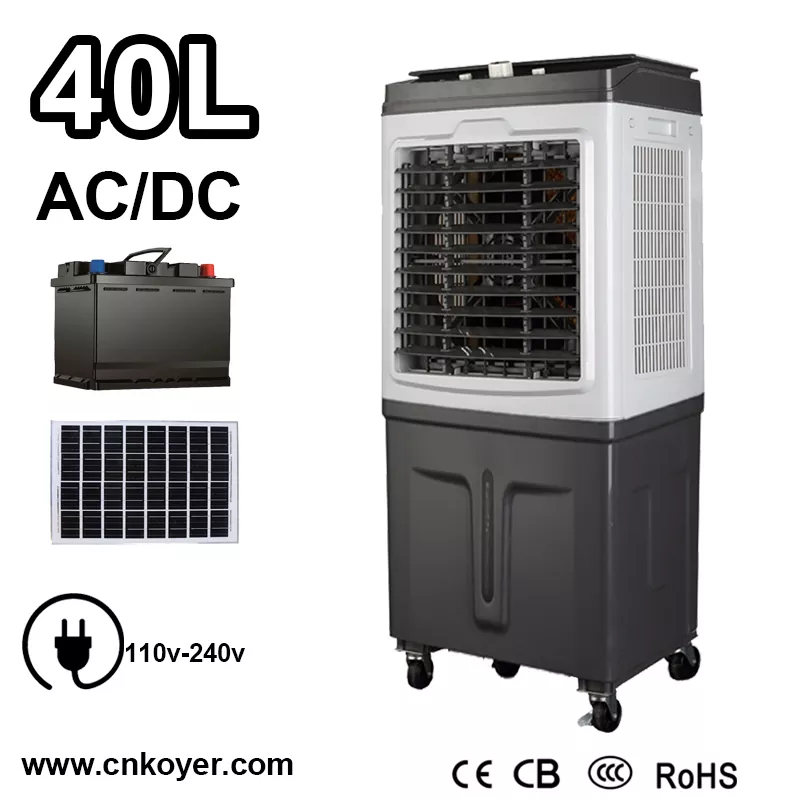
What Makes an Industrial DC Air Cooler Fan Important?
Industrial cooling is not simply about moving air. The airflow must reach the right location at an appropriate volume and pressure while operating reliably for extended periods.
An Industrial DC Air Cooler Fan can perform several important functions:
- Heat dissipation: Removes hot air from equipment and introduces cooler air.
- Temperature stabilization: Helps prevent excessive temperature fluctuations.
- Component protection: Reduces thermal stress on motors, electronics, batteries, control systems, and other heat-sensitive components.
- Energy management: DC and electronically controlled fan technologies can reduce unnecessary power consumption when variable-speed operation is available.
- Flexible integration: Different voltage, size, airflow, and mounting configurations can be developed for specific equipment.
- Continuous ventilation: Supports industrial environments where reliable airflow is required for long operating periods.
In automation and industrial equipment, DC fans are commonly used in control cabinets, robots, CNC equipment, data centers, laser equipment, and other systems where heat management directly affects reliability.
How Does It Improve Actual Cooling Performance?
The primary working principle is straightforward: the motor drives the fan blades to generate directional airflow. The moving air carries heat away from a hot surface or enclosed area, helping maintain an acceptable operating temperature.
However, the actual cooling effect depends on more than fan speed. Airflow volume, static pressure, installation position, ventilation path, ambient temperature, and system resistance all influence performance.
For example, if a control cabinet contains multiple heat-generating components, simply increasing fan speed may not solve the problem if airflow cannot reach the hottest area. A properly engineered Industrial DC Air Cooler Fan should therefore be selected according to the complete thermal-management requirement.
Key Performance Factors
| Factor | Why It Matters |
|---|---|
| DC Voltage | Must match the equipment's electrical system |
| Airflow | Determines how much air can be moved |
| Static Pressure | Helps maintain airflow against system resistance |
| Fan Size | Influences installation and cooling capacity |
| Speed Control | Allows cooling output to match actual demand |
| Motor Protection | Important in demanding industrial environments |
| Noise | Matters for operator comfort and sensitive equipment |
| Mounting Design | Determines ease of integration and maintenance |
Variable-speed DC fan control can also support demand-based cooling: lower airflow can be used when thermal loads are low, while higher airflow can be activated when temperatures rise. This approach can improve energy utilization compared with continuously running a fan at full speed.
Why Is Boat/Ship-Shaped Customization a Major Advantage?
Standard fans are generally designed around conventional rectangular, square, or circular installation spaces. Marine equipment can be very different.
Inside boats and ships, available installation space may be narrow, curved, irregular, or constrained by surrounding structures. Ventilation equipment may also need to work in humid and salt-laden environments, where corrosion resistance and mechanical reliability become especially important. Marine DC fan solutions are therefore often customized around specific electrical, mechanical, and environmental requirements.
This is where Ningbo Keyi Electric Appliance Co., Ltd. can provide additional value through boat/ship-shaped customization.
Rather than forcing customers to redesign their equipment around a standard fan, a customized fan can be developed with the application in mind. Depending on project requirements, customization may involve:
- Special fan shape – Suitable for non-standard or boat/ship-shaped installation spaces.
- Customized dimensions – Designed to fit limited or irregular mounting areas.
- Customized airflow direction – Helps direct cooling air toward designated heat sources.
- Customized voltage – Adapted to the customer's DC electrical system.
- Customized mounting structure – Facilitates easier installation and replacement.
- Environmental adaptations – Can be considered for humid, outdoor, or marine-related applications.
- Appearance customization – Useful when the fan must integrate with a particular equipment design.
This type of OEM-oriented approach is increasingly valuable because customized industrial fans can be engineered around specific dimensions, voltage requirements, airflow direction, and performance targets rather than relying solely on standard specifications.
Industrial DC Air Cooler Fan vs. Conventional Cooling Fan
Different industrial applications have different priorities. A conventional AC fan can be appropriate where fixed-speed operation and direct AC connection are preferred. However, a DC solution can be particularly attractive when the equipment already operates on DC power or requires flexible speed control.
| Feature | Industrial DC Air Cooler Fan | Conventional AC Fan |
|---|---|---|
| Power Compatibility | Ideal for DC systems | Designed for AC systems |
| Speed Regulation | Flexible options available | Often more limited |
| Equipment Integration | Highly adaptable | More standardized |
| Low-Voltage Applications | Excellent | Less suitable |
| Customization | Suitable for OEM projects | Depends on supplier |
| Marine/Boat Integration | Can be specially designed | May require additional adaptation |
| Energy Management | Strong potential with variable-speed control | Generally less flexible |
The best choice ultimately depends on the equipment architecture, thermal load, electrical system, and operating environment rather than simply selecting the fan with the highest rated airflow.
Where Can Industrial DC Air Cooler Fans Be Used?
A well-designed Industrial DC Air Cooler Fan can serve a wide range of applications:
- Industrial control cabinets
- CNC and automation equipment
- Battery and energy-storage systems
- Communication equipment
- Electronic control systems
- Machinery ventilation
- Transportation equipment
- Marine and shipboard equipment
- Outdoor electrical enclosures
- Specialized OEM equipment
For marine applications in particular, fan design needs to consider humidity, salt exposure, vibration, restricted installation space, and long operating periods. Marine ventilation suppliers also use customized fan designs for cooling, gas freeing, and fume-removal applications.
How Should Buyers Select the Right Fan?
Before placing an order, procurement teams and engineers should define the actual application requirements instead of selecting a fan based only on diameter or rated power.
A practical checklist includes:
- Required DC voltage
- Target airflow
- Required static pressure
- Installation dimensions
- Air inlet and outlet direction
- Operating temperature
- Humidity and environmental conditions
- Expected operating hours
- Noise requirements
- Speed-control requirements
- Mounting method
- Quantity and production schedule
- OEM or appearance requirements
- Whether boat/ship-shaped customization is required
Providing these details at the beginning of a project enables the manufacturer to evaluate the complete application and recommend a more suitable configuration.
What Are the Benefits of Choosing a Customized Solution?
A customized Industrial DC Air Cooler Fan can provide benefits that extend beyond the fan itself. When the dimensions, airflow direction, electrical specifications, and mounting structure are designed around the equipment, integration becomes easier and the risk of installation conflicts can be reduced.
For OEM customers, customization can also support product differentiation. A specialized fan shape can become part of a complete equipment design instead of appearing as an unrelated standard component.
For Ningbo Keyi Electric Appliance Co., Ltd., the ability to support boat/ship-shaped customization is particularly meaningful for customers developing marine equipment or specialized cooling systems where conventional fan geometries may not fit.
FAQ
What is an Industrial DC Air Cooler Fan?
It is a DC-powered fan designed to generate controlled airflow for industrial cooling, ventilation, and heat-dissipation applications. It can be integrated into machinery, cabinets, electronic systems, transportation equipment, and specialized industrial products.
Can an Industrial DC Air Cooler Fan be customized?
Yes. Depending on the manufacturer and project, customization may include dimensions, voltage, airflow direction, mounting configuration, speed characteristics, appearance, and other mechanical or electrical requirements.
Can the fan be customized for boats or ships?
Yes. Boat/ship-shaped customization is an important option for applications with irregular or space-constrained installation areas. This can help the cooling fan integrate more effectively with specialized marine equipment.
Why is DC power useful for industrial cooling?
DC fans are particularly convenient for equipment that already has a DC power rail. They can also support flexible speed-control strategies, allowing cooling output to better correspond with the thermal load.
What information should I provide before requesting a quotation?
Ideally, provide the required voltage, fan dimensions, airflow target, installation space, operating environment, desired quantity, application, and any special requirements such as boat/ship-shaped customization.
Choose a Cooling Solution Designed Around Your Equipment
The right cooling fan should do more than generate airflow—it should fit the equipment, electrical system, installation environment, and long-term operating requirements. With professional customization capabilities and a focus on practical OEM applications, Ningbo Keyi Electric Appliance Co., Ltd. can help customers develop an Industrial DC Air Cooler Fan suited to demanding cooling projects, including specialized boat/ship-shaped designs.
If you are looking for a reliable cooling solution with flexible specifications, customized structure, and professional OEM support, contact us today. Share your drawings, dimensions, voltage, airflow requirements, or application details with Ningbo Keyi Electric Appliance Co., Ltd., and let our team help you develop a cooling fan solution that fits your project rather than forcing your project to fit a standard fan.