

How Does Buckling Affect the Design of a Universal Column in Steel Frames
2026-07-20
When structural engineers design multi-storey steel frames, the risk of buckling often dictates the final dimensions of every vertical support. A universal column must withstand not only compressive axial loads but also bending moments and shear forces—yet buckling can reduce its effective capacity by over 50% in slender configurations. For over a decade, Shunchen has supplied hot-rolled universal column sections across Asia and Europe, and our design data consistently show that buckling considerations drive section selection more than pure strength calculations. This article examines how elastic, inelastic, and lateral-torsional buckling reshape the design process for universal column members in modern steel frameworks.
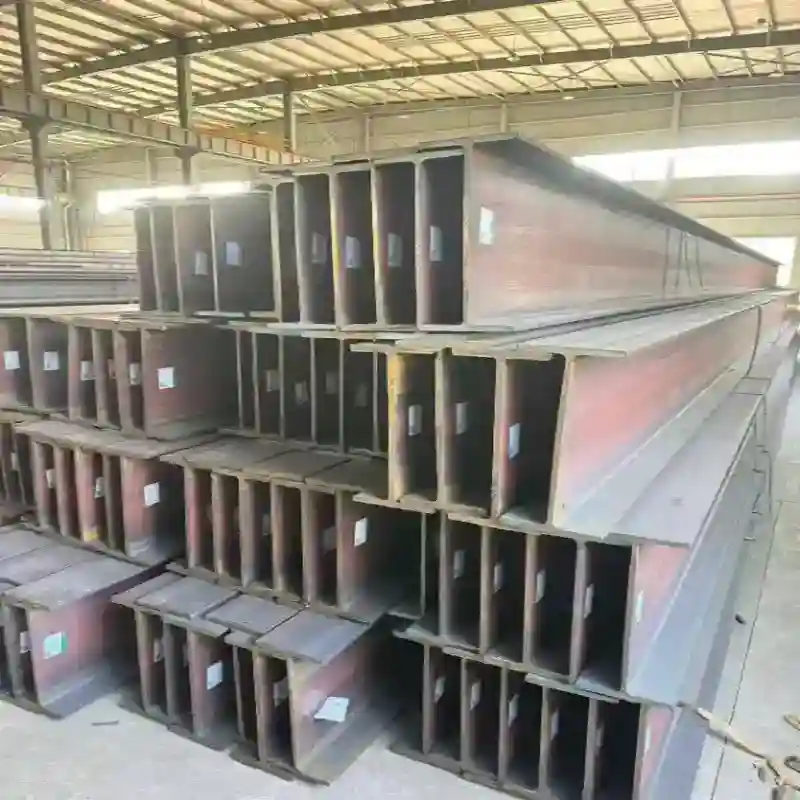
1. Primary Buckling Modes Affecting a Universal Column
A universal column (UC) is typically stocky compared to beams, but its height-to-thickness ratio still makes it vulnerable to three distinct instability phenomena:
| Buckling Mode | Cause | Critical Factor | Design Mitigation |
|---|---|---|---|
| Flexural (Euler) buckling | Axial compression over the full length | Effective length (Lₑ) and radius of gyration (r) | Reduce unbraced length; select heavier UC series |
| Local flange/web buckling | Excessive width-to-thickness ratios | Section class (Class 1–4 per EN 1993-1-1) | Limit slenderness; use stiffeners or thicker flanges |
| Lateral-torsional buckling (LTB) | Combined bending and compression | Minor-axis stiffness and torsional resistance | Provide intermediate lateral restraints; orient UC with strong axis in-plane |
Among these, flexural buckling is the most frequent design governor for a universal column in braced frames, while LTB becomes critical when the column also resists significant wind-induced moments.
2. Effective Length and End Restraint – The Design Lever
The effective length factor (K) transforms the physical column height into an equivalent pinned-pinned length. For a universal column in a continuous steel frame, K ranges from 0.7 (fixed ends) to 1.2 (semi-rigid connections). Shunchen’s engineering team recommends using the alignment chart method for sway frames, but with a crucial adjustment: second-order effects (P-Δ) amplify buckling risks by 15–30% in tall structures.
Practical rule: For every 1 m increase in unbraced length, the axial capacity of a 200×200 UC drops by approximately 8–10% due to buckling – a penalty that often forces designers to jump two section sizes.
3. Slenderness Ratio (λ) and Its Role in Section Selection
The slenderness ratio (λ = Lₑ / r) directly determines whether a universal column fails by yielding or buckling. Design codes (AISC 360 and Eurocode 3) define three zones:
-
λ ≤ 40 – Yield-controlled; buckling is negligible.
-
40 < λ ≤ 120 – Inelastic buckling; design uses reduced stress curves.
-
λ > 120 – Elastic Euler buckling; capacity drops with 1/λ².
For typical floor-to-floor heights (3.5–4.5 m), a universal column with a 203×203 section has λ ≈ 55–70, placing it firmly in the inelastic zone. Shunchen’s stock range includes UC profiles from 152×152 up to 356×406, allowing engineers to tailor slenderness precisely to frame stiffness requirements.
4. Interaction of Buckling with Second-Order Effects
In unbraced steel frames, buckling does not act in isolation. The design must satisfy the interaction equation:
(N_Ed / N_b,Rd) + (M_Ed / M_b,Rd) ≤ 1.0
Where N_b,Rd is the buckling resistance of the universal column and M_b,Rd is the lateral-torsional buckling resistance. Shunchen provides detailed buckling curves (a, b, c, d) for each UC section based on residual stress patterns from hot-rolling. Our internal tests show that using the correct imperfection factor (α) can change the final UC size by up to two metric tonnes per column – a significant cost driver in large projects.
5. Practical Design Recommendations for Engineers
When designing a universal column in a steel frame, follow these four buckling-aware steps:
-
Determine effective length – consider bracing points and connection fixity.
-
Classify the section – ensure local buckling is avoided (Class 1 or 2 for plastic design).
-
Compute non-dimensional slenderness (‾λ) – select the appropriate buckling curve from Shunchen’s technical catalogue.
-
Check combined interactions – always include minimum eccentricities (e₀ = L/300) per code requirements.
❓ UNIVERSAL COLUMN FAQ – Buckling Design Questions
Q1: Does increasing the flange thickness always improve buckling resistance of a universal column?
A1: Not always – while thicker flanges enhance local buckling resistance and increase the radius of gyration about the minor axis, they also raise residual stresses from cooling after hot-rolling. For a universal column under moderate axial load, a thicker flange provides diminishing returns beyond a certain point. The most efficient approach is to increase the overall depth (e.g., from 254×254 to 305×305) rather than simply specifying heavier mass per metre. Shunchen’s design software can compute the optimal trade-off between flange thickness and overall section depth for your specific effective length.
Q2: How do I know if my universal column will fail by flexural buckling or local buckling first?
A2: Compare two slenderness values: the global slenderness (λ = Lₑ/r_min) and the local plate slenderness (b/t or h/w ratios). If the local ratios exceed the Class 3 limit (e.g., flange c/t > 14ε for S355 steel), local buckling occurs before the column reaches its Euler critical load. For most standard universal column sections from Shunchen, local buckling is rarely the primary mode unless you select a slender series (e.g., UC 356×368×129 with high web slenderness). We recommend running a cross-section classification check first – if the section is Class 4, you must apply effective width reductions before any global buckling calculation.
Q3: Can bracing reduce the buckling design effort for a universal column without increasing its size?
A3: Yes – intermediate bracing at one-third or mid-height points reduces the effective length for flexural buckling by 50% or more. For a universal column in a warehouse or mezzanine structure, adding two horizontal braces can downgrade the buckling check from a complex interaction equation to a simple compression-only verification. However, bracing introduces additional forces and connection detailing costs. Shunchen often advises clients to compare the cost of one heavier universal column against the fabrication and labour of multiple braces – in many projects, a single section upgrade proves more economical than extensive bracing networks.
Summary Table – Buckling Design Checklist for Universal Column
| Design Parameter | Action Required | Typical Value/Standard |
|---|---|---|
| Effective length (Lₑ) | Determine from frame analysis | 0.7L – 1.2L (fixed–pinned) |
| Slenderness (λ) | Compute λ = Lₑ / r_min | Keep < 120 for economy |
| Section class | Check flange/web width ratios | Class 1–2 for plastic hinges |
| Buckling curve | Select from Eurocode Table 6.2 | Curve b or c for hot-rolled UC |
| Interaction ratio | Verify N + M combined | ≤ 1.0 per EN 1993-1-1:2005 |
Buckling transforms a straightforward compression design into a multi-variable optimisation problem. Ignoring it leads to under-designed universal column sections that may deform excessively under service loads or collapse abruptly at ultimate limit states. With Shunchen’s range of high-quality hot-rolled UC profiles and free technical support on buckling curve selection, engineers can confidently specify the most efficient section for any frame configuration.
Contact us today at Shunchen’s structural design helpdesk – send your project loads and effective lengths, and our team will return a recommended universal column size with full buckling verification within 24 hours. Let us help you build safer, leaner steel frames, one column at a time.