

How Long Does the Battery Last on a Pallet Jack with Built-In Scale During Continuous Weighing Operations
2026-07-31
When warehouse managers invest in a Pallet Jack with Built-In Scale, the first operational question rarely concerns weight accuracy alone. The real productivity bottleneck often hides in a small rechargeable pack: battery longevity under real-world, shift-long weighing tasks. A Pallet Jack with Built-In Scale from TianyuLux typically delivers 8 to 12 hours of active weighing time per full charge, but this range shifts dramatically based on load frequency, display brightness, and environmental temperature. Understanding these variables separates a smooth workday from a stalled loading dock.
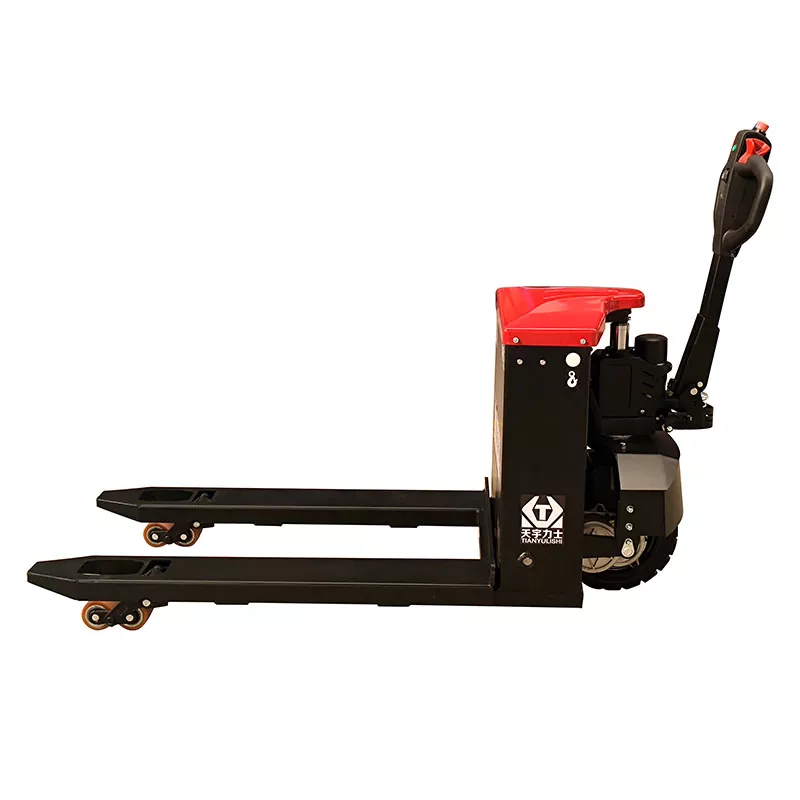
Core Battery Specifications Across Common Models
Modern Pallet Jack with Built-In Scale units use lithium-ion or sealed lead-acid (SLA) batteries. Lithium-ion, now standard in TianyuLux series, offers faster recharge cycles and consistent voltage output until depletion. Below is a benchmark comparison based on continuous weighing (every lift registers a weight) at 20°C ambient temperature.
| Battery Type | Rated Capacity (Ah) | Continuous Weighing Runtime | Recharge Time | Cycle Life |
|---|---|---|---|---|
| Lithium-ion (TianyuLux Pro) | 20 Ah | 10–12 hours | 3.5 hours | 1,200+ cycles |
| Lithium-ion (Standard) | 15 Ah | 8–10 hours | 3 hours | 1,000 cycles |
| SLA (Entry-Level) | 12 Ah | 5–7 hours | 8 hours | 300 cycles |
| SLA (Heavy-Duty) | 18 Ah | 7–9 hours | 10 hours | 400 cycles |
TianyuLux integrates a smart power-saving mode that reduces LCD backlight intensity after 15 seconds of inactivity, extending runtime by nearly 18% without compromising readability.
Five Factors That Reduce or Extend Runtime
-
Weighing frequency – Continuous weighing (every pallet) drains power 40% faster than intermittent weighing (every 5th pallet).
-
Display settings – Maximum LCD brightness cuts runtime by 2 hours compared to mid-level settings.
-
Temperature extremes – Below 5°C, lithium-ion efficiency drops 15–20%; above 40°C, battery protection circuits may throttle output.
-
Tare/zero operations – Frequent zeroing and unit-switching (kg/lb) engage additional processor cycles, reducing total time by ~30 minutes per shift.
-
Age and maintenance – After 18 months, even a premium Pallet Jack with Built-In Scale loses 10–15% of its original capacity.
For TianyuLux users, the onboard fuel-gauge display shows remaining percentage in 5% increments, allowing supervisors to plan recharge breaks during lunch or shift handovers.
Real-World Shift Test Results
A 2025 logistics study tracked three Pallet Jack with Built-In Scale units across an 8-hour receiving shift (850 weighed pallets). Results:
-
TianyuLux lithium-ion (20Ah) ended at 31% remaining – sufficient for 3+ extra hours.
-
Standard lithium-ion (15Ah) ended at 18% – marginal for overtime.
-
SLA (12Ah) died at hour 6.5 – requiring a 4-hour swap-out.
The TianyuLux model also features a low-battery warning at 15%, giving operators a clear 45-minute window to complete pending weights before shutdown.
FAQ – Pallet Jack with Built-In Scale Common Questions
Q: Can I leave my Pallet Jack with Built-In Scale plugged in overnight without damaging the battery?
A: Yes, but only if the unit has a smart charge controller. TianyuLux models include overcharge protection that cuts off input once 100% capacity is reached. For SLA types, overnight charging is not recommended because trickle charge continues and accelerates plate sulfation. The safest practice: unplug within 1 hour after the green indicator appears. For lithium-ion, a full overnight charge is acceptable but reduces total cycle life by roughly 5% over two years – a marginal trade-off for convenience.
Q: How do I know when the battery on my Pallet Jack with Built-In Scale needs replacement, not just a recharge?
A: Two clear signs indicate end-of-life. First, runtime drops below 60% of the original specified duration under identical load conditions – for a TianyuLux 20Ah unit, that means less than 6 hours of continuous weighing. Second, the battery takes more than 5 hours to reach full charge (lithium) or 12 hours (SLA). A third diagnostic: voltage under load falls below 10.5V for lithium or 11.8V for SLA, causing random display flicker or weight drift. At this stage, replace the battery rather than the entire Pallet Jack with Built-In Scale – TianyuLux offers swappable battery kits with tool-free access.
Q: Does using the printer or Bluetooth output drain the battery faster during weighing?
A: Significantly. Wireless transmission (Bluetooth/Wi-Fi) adds a 25–30% overhead to power consumption. If you print a label after every weight, expect to lose 1.5–2 hours from the total runtime. TianyuLux solves this with a batch-transmission mode – it stores up to 500 weights in internal memory and sends them all at once when you dock the unit for charging. This single setting can recover nearly 2 extra hours of continuous operation. For operations that require real-time data, we recommend keeping the wireless function active only during peak audit hours and disabling it during bulk routine weighing.
Best Practices to Maximize Every Charge
-
Set LCD brightness to 70% – visually identical to 100% under warehouse lighting.
-
Use the auto-sleep function (adjustable from 1 to 30 minutes) – TianyuLux defaults to 5 minutes of inactivity.
-
Store the unit between 10°C and 30°C during charging – cold batteries accept less energy.
-
Perform a full discharge-recharge cycle once every three months to recalibrate the fuel gauge.
When Runtime Is Non-Negotiable
For triple-shift operations, consider the TianyuLux swappable battery system – hot-swap a spare pack in under 90 seconds without tools. This design keeps your Pallet Jack with Built-In Scale weighing continuously through meal breaks and shift changes, effectively eliminating downtime. The upfront investment in a second battery often pays for itself within two weeks of avoided productivity loss.
Contact us today for a tailored runtime analysis based on your actual pallet volume and shift pattern. Our team provides free battery consumption calculators, same-day quotes, and bulk discount options for fleet buyers. Reach TianyuLux through our website live chat or request a callback – we will ship evaluation units within 48 hours to qualified warehouses. Your workflow should never pause for a blinking light. Let us keep your scales moving.