

How to Choose the Right H-Section Steel Structural Beam for Your Building Design
2026-09-10
Selecting the correct H-section Steel Structural Beam is one of the most consequential decisions in structural engineering. At HAISHENG, we have supplied fabricated steel sections to commercial, industrial, and infrastructure projects across multiple regions, and the same principle holds true everywhere: the right beam balances strength, weight, cost, and constructability. This guide walks through the technical factors that matter most when specifying an H-section Steel Structural Beam for your next building design.
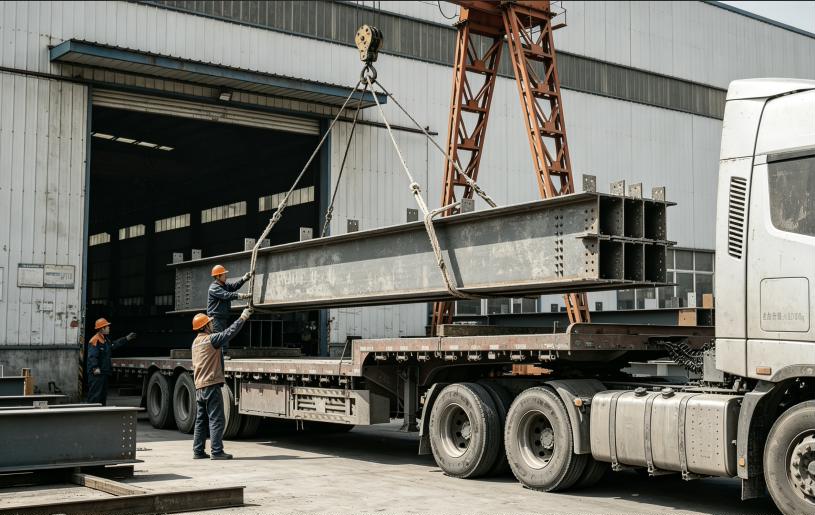
1. Understand the Structural Role of the Beam
An H-section Steel Structural Beam features wider flanges than a standard I-beam, giving it superior bending resistance about the weak axis. Before comparing catalog data, define whether the member acts as:
-
Primary flexural member – carries floor or roof loads across long spans
-
Column or compression member – resists axial loads and buckling
-
Bracing or transfer element – distributes lateral forces between frames
HAISHENG engineers routinely assist clients in matching section geometry to the actual load path rather than defaulting to the heaviest available profile.
2. Key Selection Criteria
| Criterion | What to Evaluate | Practical Impact |
|---|---|---|
| Section modulus (Wx, Wy) | Bending capacity about both axes | Determines allowable span and load |
| Moment of inertia (Ix, Iy) | Deflection control | Affects serviceability and vibration |
| Web thickness (tw) | Shear capacity and local buckling | Critical for heavy point loads |
| Flange width (bf) | Lateral-torsional buckling resistance | Wider flanges improve stability |
| Material grade | Yield strength (e.g., Q235B, Q355B, S355JR) | Directly scales design capacity |
| Span-to-depth ratio | Typically 1/20 to 1/30 for beams | Guides preliminary sizing |
3. Match the Section to the Application
Different building types demand different priorities from an H-section Steel Structural Beam:
-
High-rise frames – prefer HAISHENG welded H-sections with tight dimensional tolerances for column splices
-
Industrial plants – hot-rolled sections with robust webs for crane and equipment loads
-
Long-span roofs – optimized flange-to-web ratios to limit deflection
-
Modular and prefabricated structures – standardized sections for repeatable connections
4. Consider Fabrication and Connection Details
Even a structurally adequate H-section Steel Structural Beam can fail commercially if connections are impractical. Review bolt spacing, weld access, and end-plate geometry early. HAISHENG provides pre-qualified connection details and cutting lists that reduce shop rework and site delays.
5. Verify Compliance and Traceability
Confirm that the selected section meets the governing code—such as ASTM A6, EN 10034, or GB/T 11263—and that mill certificates are available. Traceability is not optional for safety-critical members, and HAISHENG ships every order with full material documentation.
Frequently Asked Questions
What is the difference between an H-section Steel Structural Beam and an I-beam?
An H-section Steel Structural Beam has flanges that are wider and often thicker relative to the web, producing a more uniform thickness distribution and better weak-axis bending performance; a classic I-beam has narrower flanges and is typically optimized for strong-axis bending only, making the H-section more versatile for columns and biaxial loading.
How do I calculate the required section size for a given span and load?
Start with the factored moment and shear from your structural analysis, then select a section whose design bending resistance exceeds the moment and whose shear capacity exceeds the shear; check deflection against the serviceability limit, and verify lateral-torsional buckling using the effective length of the compression flange—HAISHENG can supply preliminary sizing tables to accelerate this process.
Which steel grade is best for an H-section Steel Structural Beam in seismic zones?
Grades with controlled yield-to-tensile ratios and good ductility, such as Q355B, S355JR, or ASTM A992, are generally preferred in seismic zones because they allow plastic hinging without brittle fracture; the final choice must follow the project's seismic design category and connection detailing requirements, and HAISHENG can recommend compatible grades for your region.
Contact Us
Choosing the right H-section Steel Structural Beam requires both technical rigor and a supplier who understands fabrication realities. HAISHENG offers engineering support, certified materials, and responsive delivery for projects of any scale. Contact us today with your drawings and load requirements, and our team will help you specify the optimal section for your building design.