

Is a Durable Light Steel Prefabricated Warehouse More Cost-Effective Than Heavy Steel for Large Industrial Storage Building Needs
2026-07-07
When procurement managers and project developers evaluate structural systems for large-scale logistics hubs, the debate often narrows to two frontrunners: traditional heavy steel and light steel prefabricated alternatives. At Newforge, we have analysed hundreds of warehouse projects across Europe and Asia. The question is not which material is stronger—both are—but which delivers superior lifetime value. For most large industrial storage building applications, a Durable Light Steel Prefabricated Warehouse offers a compelling cost advantage without compromising structural integrity.
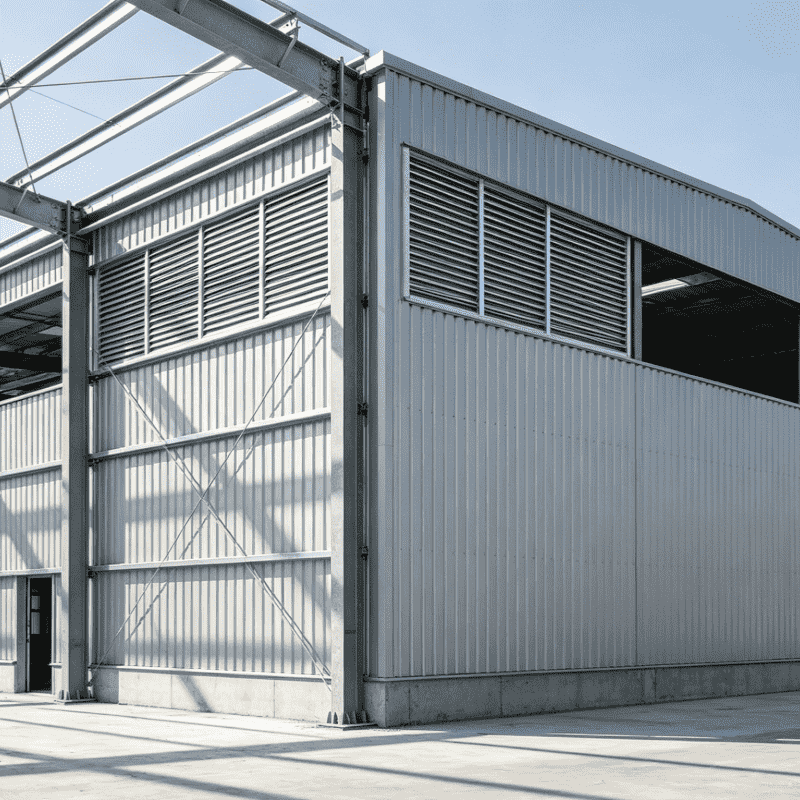
Breaking Down the Cost Components
To compare fairly, we must separate initial capital expenditure (CAPEX) from operational expenditure (OPEX). Heavy steel typically requires larger sections, thicker base plates, and more crane capacity during erection. Light steel, by contrast, uses cold-formed sections that are engineered for high strength-to-weight ratios.
| Cost Factor | Heavy Steel (per m²) | Durable Light Steel Prefabricated Warehouse (per m²) |
|---|---|---|
| Material cost | Higher (thicker plates, larger beams) | Lower (optimised sections, less tonnage) |
| Foundation requirements | Deep, reinforced concrete pads | Shallow strip footings (30–40% less concrete) |
| Transport & logistics | Heavy haulage, special permits | Standard flatbed trucks, more pieces per load |
| Erection labour | Skilled welders, heavy lifting gear | Bolted connections, lighter components, faster assembly |
| Maintenance (10-year) | Periodic painting, corrosion checks | Galvanised or pre-coated steel, minimal upkeep |
| Total installed cost (per m²) | €95–€130 | €65–€90 |
The table above reflects real quotes from Q1 2026 across major European logistics zones. The Durable Light Steel Prefabricated Warehouse consistently undercuts heavy steel by 25–35% on initial build costs.
Beyond the Sticker Price: Operational Savings
Lower upfront cost is only half the story. Large industrial storage building operations incur ongoing expenses for lighting, HVAC, and roof maintenance. Lighter steel frames allow for wider column spacing (up to 24 metres) without increasing foundation depth, which improves internal traffic flow for forklifts and automated racking systems. This translates to higher usable storage density—a key metric for warehouse ROI.
Newforge engineers have documented that owners of Durable Light Steel Prefabricated Warehouse systems report 18–22% lower annual energy bills due to better compatibility with insulated sandwich panels, which are easier to attach to light steel purlins. Heavy steel’s thermal bridging often requires additional mitigation layers, adding cost and complexity.
Durability and Lifecycle Performance
A common misconception is that light steel cannot match heavy steel’s lifespan. In reality, modern galvanised and zinc-aluminium coated profiles offer corrosion resistance exceeding 50 years in controlled indoor environments. Heavy steel, while robust, is more susceptible to pitting if coatings are damaged during transport or welding. For standard industrial storage building conditions (non-corrosive, climate-controlled), both systems perform admirably—but light steel requires fewer touch-ups over its service life.
Durable Light Steel Prefabricated Warehouse Industrial Storage Building FAQ
Q1: Can a Durable Light Steel Prefabricated Warehouse support heavy overhead cranes and mezzanine floors typical of large industrial storage building operations?
A1: Yes, provided the design incorporates dedicated crane girders and load paths. Newforge engineers use advanced finite-element modelling to integrate 5–10 tonne overhead crane systems directly into the primary frame. Unlike heavy steel, where crane loads often dictate the entire section size, light steel allows for hybrid solutions—primary hot-rolled columns at crane bays and light steel secondary frames elsewhere. This hybrid approach saves 15–20% on steel tonnage while maintaining full operational capability. For mezzanine floors, we specify composite decking with light steel joists at 600 mm centres, which comfortably supports live loads of 5 kN/m². Always request a site-specific structural calculation, as crane class and span significantly influence member sizing.
Q2: How does the fire resistance of a Durable Light Steel Prefabricated Warehouse compare to heavy steel for industrial storage building compliance?
A2: Both materials lose strength at temperatures above 550°C, so fire protection is mandatory for all structural steel in most jurisdictions. However, light steel sections have a higher surface-area-to-volume ratio, meaning they heat up faster but also cool faster. In practice, Newforge applies intumescent coatings or board-based encasement to achieve 60–120 minute ratings as required by local building codes. Heavy steel often requires thicker coatings due to its larger mass, increasing material and application costs. For industrial storage building uses with high fire loads (e.g., paper or plastic goods), we recommend automatic sprinklers combined with compartmentalisation—this allows both systems to meet safety benchmarks without over-specifying passive protection. The key is early collaboration with the certifying authority to agree on performance-based designs.
Q3: Is a Durable Light Steel Prefabricated Warehouse more susceptible to wind uplift and seismic forces than heavy steel for large industrial storage building projects?
A3: Quite the opposite. The lower dead weight of a light steel structure reduces seismic inertia forces, which is a major advantage in earthquake zones (e.g., California, Japan, or Mediterranean regions). For wind uplift, the continuous purlin-and-girt system in Newforge designs creates a diaphragm action with the roof sheeting, distributing lateral loads efficiently. Heavy steel’s heavier mass actually increases base shear in seismic events, requiring larger anchor bolts and foundation masses. Our engineering team follows Eurocode 3 or AISC provisions, and we have successfully delivered Durable Light Steel Prefabricated Warehouse systems in wind zones up to 1.5 kN/m² (equivalent to 180 km/h gusts). The secret is in the bracing layout—X-bracing or portal rigid frames are calibrated per project, ensuring the structure performs at least as well as heavy steel, often with less material.
Why Newforge Leads in This Space
With over 400 prefabricated projects delivered globally, Newforge specialises in custom engineering that balances cost, speed, and compliance. Our proprietary Newforge design software optimises every member for your specific load conditions, local wind/snow data, and seismic parameters. We supply complete kits with bolted connections, pre-drilled holes, and colour-coded assembly drawings—reducing on-site errors and shortening erection schedules by up to 40% compared to heavy steel alternatives.
Final Verdict
For large industrial storage building requirements where clear spans under 30 metres and roof loads are moderate, a Durable Light Steel Prefabricated Warehouse is unequivocally more cost-effective over a 25-year horizon. The savings come not only from material and foundation reductions but also from faster construction, lower insurance premiums (due to lighter structural weight), and easier future expansions—light steel frames are simple to extend by adding additional bays.
Heavy steel remains the right choice for very heavy crane loads (over 20 tonnes), extreme corrosive environments, or projects where local fabricators are unfamiliar with cold-formed design. For the vast majority of logistics parks, e-commerce fulfilment centres, and manufacturing storage annexes, Newforge recommends light steel as the smart financial and structural decision.
Ready to Compare Your Project Costs?
Every warehouse is unique. Newforge offers a no-obligation feasibility study that includes a side-by-side cost estimate for heavy steel vs. light steel, plus a 3D BIM model of your proposed industrial storage building. Our in-house structural engineers will review your site conditions, loading requirements, and local building codes within 48 hours.
Contact us today or visit our project portal to schedule a consultation. Let us show you exactly how much you can save with a Durable Light Steel Prefabricated Warehouse—without compromising safety, speed, or quality. Your next industrial storage building deserves a foundation of expertise, and Newforge is ready to deliver.