

What Are the Common Failure Modes of API OH1 Horizontal Centrifugal Pumps in Crude Oil Flow Service
2026-08-21
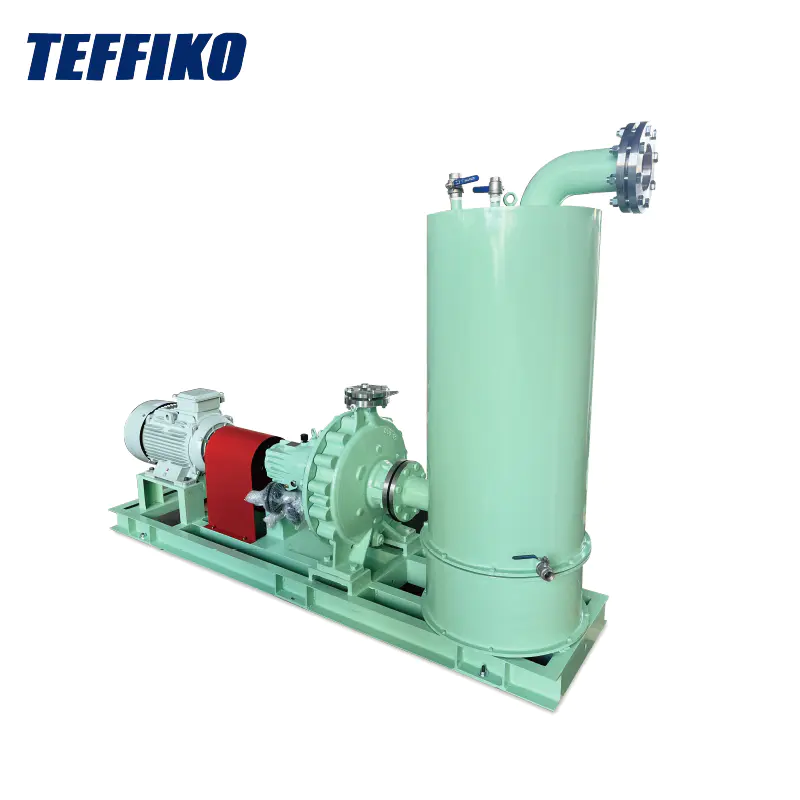
Crude oil transfer is one of the most demanding applications for rotating equipment, and API OH1 Horizontal Centrifugal Pumps For Oil And Chemical Flow are frequently specified for their rugged overhung design and compliance with API 610 standards. At TEFFIKO, we have witnessed firsthand how these pumps perform under varying crude grades, temperatures, and suction conditions. While the OH1 configuration offers a compact footprint and ease of maintenance, its single-bearing housing and overhung impeller make it susceptible to specific failure patterns that operations teams must proactively manage.
Mechanical Seal Failures
The mechanical seal remains the most vulnerable component in API OH1 Horizontal Centrifugal Pumps For Oil And Chemical Flow when handling crude oil. Crude contains abrasive particulates (sand, scale, and iron sulfides) that erode seal faces, while light-end fractions can cause rapid vaporization at the seal chamber. Typical indicators include visible leakage, increased seal chamber pressure, or fluctuating stuffing-box temperatures.
| Failure Indicator | Primary Root Cause | Recommended Action |
|---|---|---|
| External leakage at stuffing box | Abrasive wear or thermal distortion of seal faces | Upgrade to silicon carbide vs. tungsten carbide faces; verify flush plan |
| Rapid seal replacement intervals (<6 months) | Incompatible elastomers for crude's aromatic content | Switch to FKM or perfluoroelastomer O-rings |
| Seal chamber vapor locking | Insufficient subcooling at low-flow conditions | Increase bypass flow or install a cooling jacket |
Bearing Overheating and Premature Spalling
Because the OH1 design relies on a single bearing housing supporting the entire rotor assembly, any misalignment, imbalance, or lubrication degradation directly impacts bearing life. In crude oil service, high ambient temperatures and viscous fluid drag amplify radial loads. TEFFIKO’s field data shows that over 40% of unplanned outages trace back to bearing temperature excursions exceeding 200°F (93°C). Regular oil analysis for water ingress and viscosity loss is non-negotiable.
Impeller Erosion and Unbalance
Crude oil from mature fields often carries produced sand and corrosion byproducts. These solids accelerate erosion on the impeller vane tips and volute casing, gradually altering the pump’s hydraulic balance. As the impeller loses mass unevenly, residual unbalance increases, causing vibration that triggers trip setpoints. This failure mode is insidious because it develops over thousands of operating hours, and early detection requires periodic vibration spectrum analysis rather than simple overall amplitude monitoring.
Cavitation-Induced Damage
Although crude oil has lower vapor pressure than water, light hydrocarbon components can flash at the impeller eye if NPSH available falls below NPSH required. The resulting implosions produce pitting on the impeller inlet and casing wall, reducing efficiency and eventually leading to blade fracture. This is particularly common during winter startup when crude viscosity spikes, or when upstream separators operate at reduced pressure.
API OH1 Horizontal Centrifugal Pumps For Oil And Chemical Flow – FAQ
Q1: How can I distinguish between cavitation and recirculation damage in my API OH1 Horizontal Centrifugal Pump handling crude oil?
A: Cavitation typically produces a random, high-frequency noise resembling gravel passing through the casing, and damage is concentrated on the impeller inlet (suction side) near the vane leading edges. Recirculation, by contrast, generates a lower-frequency throbbing or growling sound, with damage appearing on the impeller discharge side and the volute tongue. For a definitive diagnosis, compare vibration spectra: cavitation shows broadband energy above 1× rotational speed, while recirculation displays strong sub-synchronous components. TEFFIKO recommends installing dual accelerometers (radial and axial) and trending the FFT data weekly.
Q2: What is the maximum allowable radial load that an API OH1 Horizontal Centrifugal Pump can sustain in heavy crude service without compromising bearing life?
A: Per API 610 (12th edition), the radial load at the pump flange must not exceed 50% of the bearing’s dynamic equivalent load rating for continuous operation. For a typical OH1 frame size (e.g., 2×3×10), this translates to approximately 1,800–2,200 N (400–500 lbf) at the discharge nozzle. However, in viscous crude (above 300 cP), the hydraulic radial thrust increases by up to 30% due to the higher pressure gradient across the volute. TEFFIKO advises operators to perform a thrust calculation using the pump’s performance curve at the actual operating flow rate—never at shutoff—and to install a pressure gauge on both suction and discharge to monitor differential pressure in real time.
Q3: Are there specific metallurgical upgrades recommended for API OH1 Horizontal Centrifugal Pumps when processing sour crude with H₂S content above 5%?
A: Yes. For sour service (NACE MR0175/ISO 15156 compliance), the wetted parts—casing, impeller, and shaft—must be manufactured from martensitic stainless steel (e.g., AISI 410 or CA-6NM) with hardness limited to ≤22 HRC to prevent sulfide stress cracking. The fastener and seal gland materials should be Alloy 625 or Alloy 718. Additionally, TEFFIKO strongly recommends upgrading the bearing housing breather to a desiccant-type system to exclude moisture, because H₂S combined with water forms corrosive sulfuric acid that attacks even stainless grades at elevated temperatures. Always verify that your repair vendor provides MTRs (Material Test Reports) and hardness verification for every replacement part.
Proactive Condition Monitoring Strategy
To maximize uptime, successful operators combine daily visual inspections (seal weepage, oil level, temperature guns) with weekly data collection: vibration velocity (mm/s rms), bearing housing temperature, and motor current draw. Monthly oil sampling for particle count and water content provides early warning of seal degradation. TEFFIKO offers a turnable monitoring kit that integrates these parameters into a single dashboard, enabling predictive maintenance rather than reactive repairs.
Final Thought and Contact
The reliability of API OH1 Horizontal Centrifugal Pumps For Oil And Chemical Flow in crude service does not depend solely on the pump’s original design—it hinges on vigilant failure-mode recognition, proper material selection, and disciplined maintenance protocols. Ignoring early warning signs leads to catastrophic rotor damage, costly downtime, and environmental risks.
Contact TEFFIKO today for a comprehensive pump health assessment or to discuss retrofit solutions tailored to your crude oil composition. Our engineering team provides onsite vibration analysis, seal selection consultations, and bearing upgrade packages that extend MTBF by up to 60%. Reach us through our website or call your regional TEFFIKO representative—we are ready to keep your crude transfer operations running safely and efficiently.