

What Are the Main Failure Modes of an Aramid Conveyor Belt in Mining Operations
2026-08-21
In modern mining, the Aramid Conveyor Belt has become a preferred choice for high-tension, long-distance material transport due to its exceptional strength-to-weight ratio and inherent resistance to impact and heat. However, even the most advanced Aramid Conveyor Belt systems are not immune to operational failures. Understanding these failure modes is critical for mine operators seeking to maximize uptime and minimize total cost of ownership. At QMH, we have spent decades analyzing field data from underground and open-pit mines worldwide to identify the most common failure patterns and, more importantly, how to prevent them.
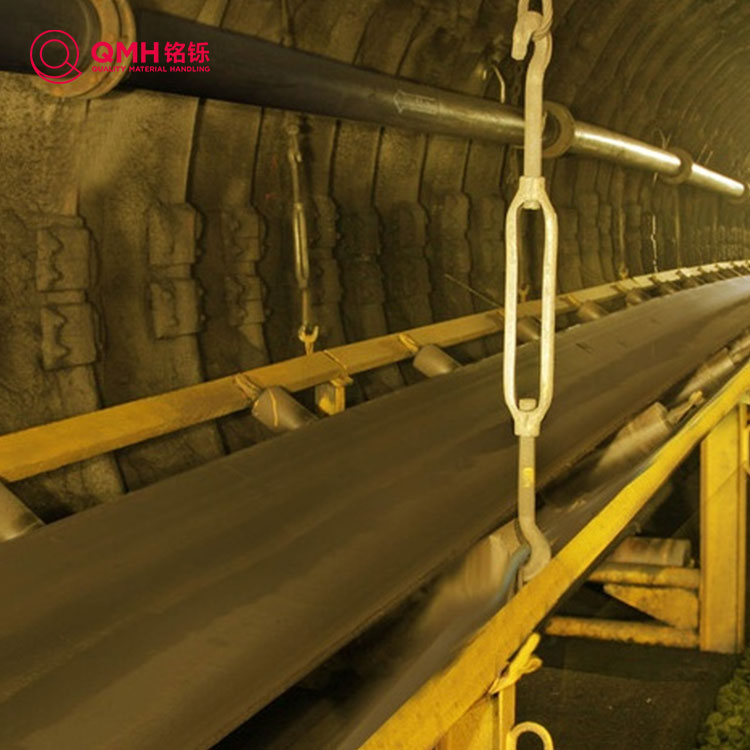
Primary Failure Modes of Aramid Conveyor Belts in Mining
Based on rigorous field inspections and forensic analysis of failed belts, the following five failure categories account for over 85% of premature replacements in mining environments. Each mode is distinct in its root cause, progression, and remedial strategy.
| Failure Mode | Primary Cause | Typical Location | Detection Method | Prevention Strategy |
|---|---|---|---|---|
| Carcass Fatigue Cracking | Cyclic bending over small pulleys | Pulley transition zones | Visual inspection of cover cracks; dynamic stiffness testing | Increase pulley diameter; reduce belt speed fluctuations |
| Impact Damage & Rupture | Large ore lumps falling from height | Loading / feed points | Impact sensor arrays; periodic cover thickness measurement | Install impact beds; adjust chute design; use QMH-engineered impact bars |
| Splice Joint Separation | Improper vulcanization or inadequate finger overlap | Splice joints (mechanical or vulcanized) | Daily splice elongation monitoring; ultrasonic splice scanning | Follow QMH’s strict vulcanization protocols; use OEM-approved adhesives |
| Abrasive Wear of Cover Rubber | High silica content in ore; sliding contact with idlers | Top cover (carry side) and bottom cover (return side) | Laser profilometry for cover loss; weight-per-meter tracking | Apply ceramic-lined idlers; select high-abrasion-resistant cover grades |
| Edge Degradation & Fraying | Belt mistracking against structural supports | Belt edges (both sides) | Edge alignment sensors; visual edge inspection | Install self-aligning idlers; implement real-time tracking control via QMH’s smart monitoring system |
Root Cause Analysis: Why These Failures Occur
The mining environment presents a unique combination of high dynamic loads, abrasive dust, moisture, and temperature extremes. For an Aramid Conveyor Belt, the aramid fiber carcass provides outstanding tensile strength—often 5–7 times that of steel cord per unit weight—but it is relatively sensitive to compressive stress and sharp flexural fatigue. When an Aramid Conveyor Belt is operated on undersized pulleys (below the manufacturer’s minimum recommended diameter), the carcass undergoes repeated compression buckling, leading to microscopic fibrillation. Over time, these micro-cracks coalesce into transverse ruptures that can propagate across the entire belt width.
At loading points, falling rocks with sharp edges can sever individual aramid yarns. Unlike steel-cord belts, which may show gradual wire breakage, Aramid Conveyor Belt impact damage often appears as localized “pockets” of weakness that are not visible from the surface until the cover rubber is peeled back. This is why QMH strongly recommends installing impact energy-absorbing beds and using high-density rubber buffers at every transfer point.
3 Essential FAQ About Aramid Conveyor Belt Failure Prevention
Q1: How can I visually identify early-stage carcass fatigue in an Aramid Conveyor Belt before a catastrophic failure occurs?
A1: Early-stage carcass fatigue in an Aramid Conveyor Belt typically manifests as fine, hairline transverse cracks on the top cover surface directly above the pulley contact area. These cracks are often less than 1 mm deep initially and appear in a regular pattern every 10–20 cm along the belt length. More importantly, you may notice a slight “stiffening” of the belt section when bending it manually—healthy aramid carcasses remain highly flexible, while fatigued areas feel board-like. QMH recommends performing a dynamic bend test on belt samples taken during scheduled maintenance; if the sample fails to withstand 5,000 bend cycles without developing visible surface ripples, the belt should be scheduled for replacement or section repair. Additionally, using QMH’s portable ultrasonic thickness gauge can detect internal delamination that precedes visible cracking by 200–300 operating hours.
Q2: What is the maximum allowable splice elongation for an Aramid Conveyor Belt, and when should I intervene?
A2: For a properly vulcanized splice on an Aramid Conveyor Belt, the maximum allowable permanent elongation at the splice joint should not exceed 0.5% of the original splice length under full rated tension. In practical terms, if your splice measures 1,200 mm immediately after vulcanization, a permanent stretch beyond 6 mm (0.5%) indicates that the finger-joint adhesive bond is deteriorating or that the aramid cords are slipping within the splice matrix. QMH’s field data shows that once elongation reaches 0.8%, the splice has lost over 40% of its rated breaking strength. Intervention steps include: (a) reducing belt tension immediately, (b) conducting a non-destructive ultrasonic inspection of the splice, and (c) planning a re-splice within 48 hours of operation. Do not wait for visual separation—by then, the splice is already in a high-risk failure zone. QMH offers a splice elongation tracking logbook as part of our standard maintenance kit for all mining clients.
Q3: Does an Aramid Conveyor Belt fail more frequently in wet or dry mining conditions, and why?
A3: An Aramid Conveyor Belt actually fails more frequently in wet conditions—not because aramid fibers degrade in moisture (they are inherently hydrophobic), but because water acts as a lubricant that reduces friction between the belt cover and drive pulleys, causing micro-slippage. This micro-slippage generates localized heat spikes of up to 80–100°C at the pulley surface, which accelerates cover rubber softening and promotes splice adhesive hydrolysis. Furthermore, wet ore tends to stick to the carry-side cover, increasing belt weight and dynamic tension fluctuations, which exacerbate fatigue cycles. In contrast, dry conditions primarily cause abrasive wear rather than structural fatigue. QMH advises mine operators in high-rainfall regions to install belt scrapers with carbide tips, use dewatering screens before the feed chute, and apply QMH’s anti-slip pulley lagging to maintain consistent traction. Our case studies show that these measures reduce wet-condition failure rates by nearly 60%.
Proactive Maintenance: The QMH Approach
Rather than reacting to failures, QMH advocates a condition-based monitoring strategy that combines daily visual inspections, weekly elongation tracking, and monthly ultrasonic imaging of all splices and high-stress zones. Our proprietary QMH Belt Analytics Platform uses IoT sensors to record belt speed, tension fluctuations, and idler bearing temperatures in real time, enabling predictive alerts before any failure mode reaches a critical stage. This approach has helped our clients achieve mean time between failures (MTBF) exceeding 18 months—well above the industry average of 10–12 months for comparable aramid-based systems.
Conclusion
Understanding the five primary failure modes—carcass fatigue, impact damage, splice separation, abrasive wear, and edge fraying—is the first step toward extending the service life of your Aramid Conveyor Belt. However, knowledge alone is not enough; you need reliable inspection tools, disciplined maintenance schedules, and expert support to translate that knowledge into operational savings. QMH has been engineering conveyor solutions for over two decades, and our team of field specialists is ready to conduct a free on-site belt health assessment for your mining operation.
Contact us today at QMH to schedule your personalized belt audit. Whether you need splice training, impact bed design, or a full conveyor system upgrade, our engineers are just one call away. Visit our website or reach out to our regional service center—we will respond within 24 hours with a tailored proposal that fits your production targets and budget. Let QMH help you turn belt reliability into your competitive advantage.