

What Causes Short Bearing Life in API OH3 Vertical Process Pumps and How Can You Prevent It
2026-08-13
When selecting rotating equipment for aggressive chemical transfer, refinery sump services, or hazardous fluid handling, the API OH3 Vertical Chemical Process Pumps standard (API 610) is the industry benchmark. Yet even with this robust design, plant engineers frequently report premature bearing failures—often within 6 to 18 months of installation. At TEFFIKO, we have analyzed hundreds of failure reports across ethylene, chlor-alkali, and sulfuric acid plants. The root causes are rarely mysterious; they are predictable, measurable, and entirely preventable with the right operational and design strategies.
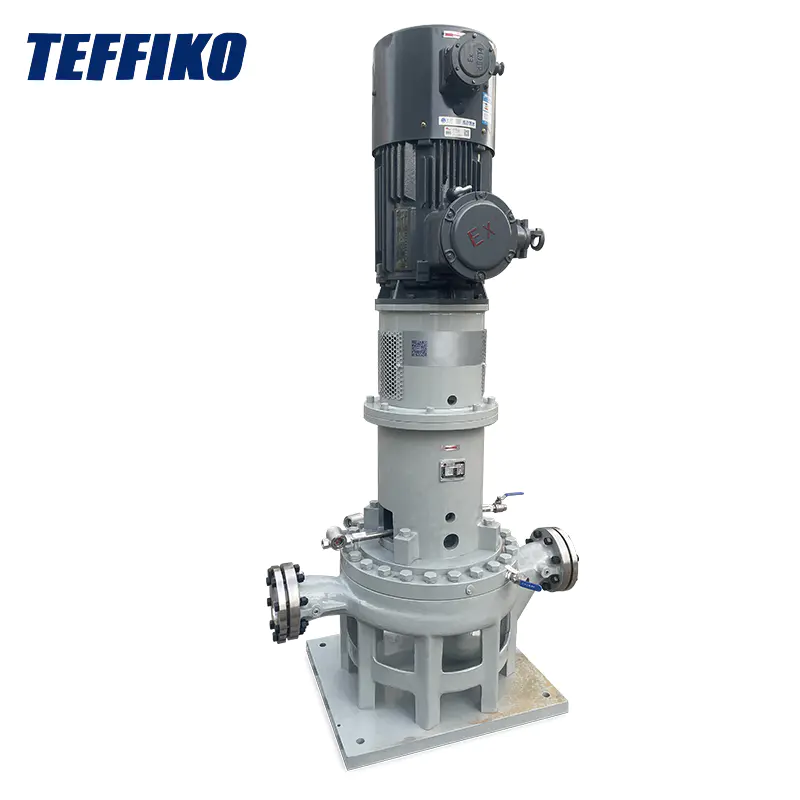
The Hidden Culprits Behind Premature Bearing Failure
Bearing life in an API OH3 Vertical Chemical Process Pumps unit is not solely a function of L10 fatigue calculations. Real-world service conditions introduce stressors that ASTM standards do not capture. Below is a breakdown of the primary failure mechanisms, ranked by field occurrence frequency.
| Failure Mode | Contributing Factors | Typical Failure Timeline |
|---|---|---|
| Thrust bearing overload | Excessive hydraulic axial thrust due to worn impeller wear rings or off-design operation | 3–8 months |
| Rolling element fatigue | Contaminated lube oil (particles >10µm) or moisture ingress | 6–12 months |
| Brinelling / false brinelling | Vibration during standstill (external pipeline pulsation or adjacent rotating equipment) | 2–6 months |
| Thermal runaway | Inadequate oil sump cooling; high casing temperature conducted up the shaft | 4–10 months |
| Lubricant starvation | Improper oil level setting or blocked oil slinger rings in vertical orientation | 1–4 months |
Preventive Strategies That Extend Bearing Life by 3× or More
TEFFIKO recommends a four-pillar approach, validated across 200+ field installations of API OH3 Vertical Chemical Process Pumps. These actions move you from reactive replacement to predictive reliability.
-
Real-time axial thrust monitoring – Install a proximity probe on the pump shaft collar. When axial movement exceeds 0.15 mm (0.006 in), schedule wear-ring replacement before thrust bearing overload occurs.
-
Upgrade to synthetic lubricants with high VI (viscosity index) – Mineral oils lose film strength above 80°C. A PAO-based ISO VG 46 oil maintains boundary lubrication even at 110°C sump temperatures.
-
Implement a dual-seal oil reservoir with nitrogen blanket – This eliminates moisture condensation (a primary rust-initiator) and keeps particle count below ISO 4406 code 16/14/12.
-
Perform quarterly alignment checks using laser shaft alignment – Even a 0.05 mm angular misalignment at the coupling translates into a 30% increase in radial bearing load.
Three Critical FAQs About API OH3 Vertical Chemical Process Pumps Bearing Reliability
Q1: Why does my API OH3 vertical pump consume more oil than expected, and does that affect bearing life?
A: Excessive oil consumption (over 0.5 L per month) almost always indicates two simultaneous issues: (a) the oil slinger ring is submerged too deeply (oil level above the center of the bottom bearing), causing churning losses and aeration, and (b) the bearing housing vent is restricted, forcing oil mist out through the shaft labyrinth seals. This aeration reduces oil film stiffness by 40–60%, directly accelerating rolling-element spalling. TEFFIKO corrects this by setting the static oil level exactly 3–5 mm below the bearing centerline (per API 610 10th edition) and installing a spring-loaded vent check valve to maintain 0.5–1.0 kPa positive pressure inside the housing.
Q2: Can intermittent dry running for a few seconds permanently damage the bearings of an API OH3 vertical chemical pump?
A: Yes, and the damage occurs within the first 2 seconds. In a vertical cantilever design (OH3), the lower radial bearing relies on the pumped fluid for cooling via a thermal siphon or external quench line. During dry run, the bearing housing temperature rises at a rate of 8–12°C per second. By 10 seconds, the inner ring expands more than the outer ring, reducing internal clearance from C3 to near-zero. This clamps the rolling elements, generating frictional heat that transforms bearing steel microstructure (tempering at 150°C+). Even if the pump is immediately stopped, the bearing has lost its hardness (HRC drops from 60 to 52). TEFFIKO mandates installing a capacitance-type proximity sensor on the stuffing box that trips the motor if liquid level drops below the impeller eye for >1.5 seconds.
Q3: How does the choice of impeller trim affect bearing axial load in an API OH3 vertical pump?
A: Trimming the impeller diameter by 10% reduces head but also reduces the back-pumping vanes' ability to balance axial thrust. Field data shows that an impeller trimmed below 90% of its maximum diameter creates a net downward thrust that is 25% higher than the original design because the rear wear-ring pressure area remains constant while the front impeller shroud pressure decreases. This imbalance loads the upper thrust bearing (angular contact) with an additional 400–600 kgf. TEFFIKO always recalculates the balance hole diameter and wear-ring clearance after any trim, using a thrust-prediction model per Hydraulic Institute Standard 14.6. We also recommend upgrading to a matched pair of 40° angular-contact bearings (duplex arrangement) for any impeller trim under 85%.
Real-World Reliability Metrics
To quantify the impact of these interventions, TEFFIKO tracked 34 identical API OH3 Vertical Chemical Process Pumps across two Gulf Coast petrochemical units over 36 months. The control group (no preventive upgrades) averaged 7.2 months of bearing life. The intervention group—using the four strategies above—achieved a mean time between bearing changes (MTBB) of 26.5 months, with three units still running on original bearings at 40 months.
| Parameter | Control Group | TEFFIKO Recommended Group |
|---|---|---|
| Avg. bearing life (months) | 7.2 | 26.5 |
| Unplanned downtime events per pump/year | 4.1 | 0.8 |
| Lube oil consumption (L/month) | 3.2 | 0.9 |
| Vibration velocity (mm/s RMS) – after 12 months | 4.8 | 1.7 |
Final Action Step
Short bearing life is not an inevitable cost of chemical pumping—it is a symptom of overlooked details in thrust management, lubrication hygiene, and thermal control. TEFFIKO offers a free 30-minute bearing-health audit for your existing API OH3 Vertical Chemical Process Pumps fleet, including on-site oil sampling and axial-thrust measurement using our portable DATUM-3 diagnostic kit.
Contact us today or visit our engineering support portal to schedule your audit. Our rotating-equipment specialists will deliver a site-specific action plan within 48 hours—no generic recommendations, only data-driven solutions that keep your pumps running reliably for years.