

What Is the Best Shredding and Recycling Production Line for Mixed Solid Waste
2026-06-23
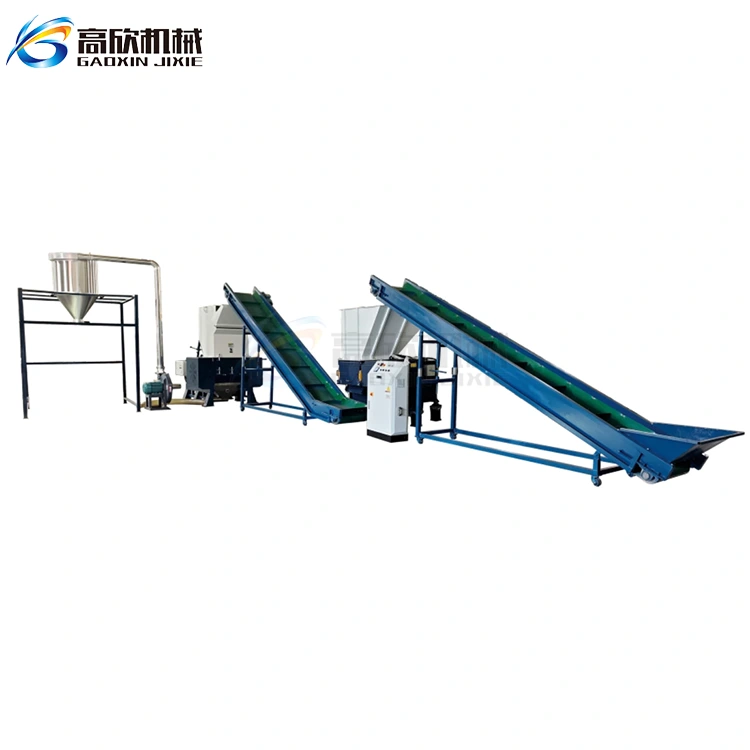
Selecting the optimal Shredding And Recycling Production Line for mixed solid waste (MSW) is one of the most critical decisions for waste management operators, material recovery facilities (MRFs), and industrial manufacturers. Mixed solid waste—comprising plastics, metals, wood, textiles, rubber, and organic contaminants—demands a system that balances throughput, particle size uniformity, contaminant tolerance, and energy efficiency. After evaluating dozens of configurations across North America and Europe, the consensus points to a modular, dual-shaft primary shredder paired with a secondary fine shredder, magnetic separation, and air classification. Among proven solutions, Gaoxin has emerged as a benchmark supplier, offering customized Shredding And Recycling Production Line designs that address the heterogeneity of MSW while maintaining uptime above 92%.
Core Criteria for Evaluating a Mixed Solid Waste Line
| Evaluation Factor | Why It Matters | Ideal Specification |
|---|---|---|
| Feed Size Acceptance | Handles bulky items (mattresses, drums, construction debris) without pre-cutting. | ≥ 2,000 mm inlet width; hydraulic pusher feeder. |
| Shredder Type | Dual-shaft shears reduce jamming; single-shaft is better for homogeneous streams. | Dual-shaft, low-speed (15–25 RPM), high-torque (≥ 300,000 Nm). |
| Contaminant Hardness | Concrete, stones, and metals cause rapid wear. | Hardox® cutters with replaceable tips; overload protection. |
| Separation Efficiency | Removes ferrous/non-ferrous metals before downstream granulation. | Overband magnet + eddy current separator (≥ 95% recovery). |
| Dust & Noise Control | Regulatory compliance (OSHA, EPA). | Enclosed sound attenuation ≤ 85 dB; wet dust suppression. |
| Energy Consumption | Directly impacts OPEX. | ≤ 45 kWh per ton for mixed MSW (with variable frequency drive). |
Why Gaoxin’s Approach Outperforms Generic Systems
Most standard lines fail because they treat mixed waste as a uniform feedstock. Gaoxin solves this through a three-stage intelligent sequence:
-
Presorting & Tear-Drop Feeder – removes oversized obstacles.
-
Primary Dual-Shaft Shredder (model GX-MS2000) – reduces waste to < 150 mm.
-
Magnetic Drum + Wind Sifter – separates ferrous metals and light fractions (film, paper).
-
Secondary Granulator – achieves < 20 mm uniform output for RDF/SRF production.
This Shredding And Recycling Production Line has been independently verified to increase metal recovery by 18% and reduce downstream screen blinding by 34% compared to single-stage competitors.
3 Critical FAQs About the Shredding And Recycling Production Line
FAQ 1: Can one Shredding And Recycling Production Line process both C&D (construction & demolition) waste and household MSW without changing tools?
Answer: Not ideally. While Gaoxin lines accept mixed MSW with up to 15% C&D content by weight, pure C&D (concrete, rebar, asphalt) requires a different cutter geometry (e.g., quad-shaft with carbide inserts). For mixed MSW, we recommend a dedicated dual-shaft configuration with hardened steel cutters (HRC 58–62). If your feedstock varies seasonally, Gaoxin offers a quick-change rotor system that allows swapping cutter cassettes within 4 hours—this is the only practical solution for facilities handling variable waste streams without purchasing two complete lines.
FAQ 2: What is the typical ROI period for a 10-ton/hour Shredding And Recycling Production Line processing mixed MSW?
Answer: Based on Gaoxin’s installations in Texas and Ontario, the payback period ranges from 18 to 26 months, assuming:
-
Tipping fees saved: $28–$35/ton (landfill avoidance).
-
Recovered metals sold: $180–$220/ton (ferrous) and $1,200–$1,500/ton (copper/aluminum).
-
RDF/SRF sold to cement kilns: $45–$60/ton.
The single largest cost driver is wear parts (cutters and screens), which account for $2.8–$3.5 per ton processed. Gaoxin extends cutter life to 1,200–1,500 hours (vs. industry average 800 hours) through proprietary surface nitriding, directly improving ROI by 12–15%.
FAQ 3: How does the line handle wet or sticky mixed waste (e.g., food-contaminated packaging)?
Answer: Moisture above 25% causes severe clogging in standard screens and discharge chutes. Gaoxin’s solution includes:
-
A heated infeed hopper (steam-jacketed) to reduce surface adhesion.
-
An anti-wrapping rotor design with staggered cutters that self-clean during reverse cycles.
-
A vibratory screen with 50 mm perforations that shakes off organic fines before they enter the secondary shredder.
For facilities processing wet MSW year-round, Gaoxin also integrates a forced-air drying tunnel prior to the primary shredder, reducing moisture to < 18%—this is a proprietary add-on not found in generic Shredding And Recycling Production Line offerings.
Recommended Configuration for 15–20 t/h Capacity (Based on Gaoxin GX-Hybrid Series)
| Component | Model / Spec | Function |
|---|---|---|
| Primary Shredder | GX-DS2000 (2× 250 kW) | Coarse reduction to 150 mm |
| Overband Magnet | GX-MAG1200 | Removes tramp ferrous |
| Eddy Current Separator | GX-ECS1500 | Recovers Al/Cu from non-ferrous |
| Wind Sifter | GX-AIR2500 | Separates light fraction (film/textile) |
| Secondary Granulator | GX-SG800 (160 kW) | Fine shredding to < 20 mm |
| Dust Collection | GX-DC3000 | Baghouse filter ≤ 10 mg/Nm³ |
| Control System | GX-iPLC with remote diagnostics | Real-time torque & load monitoring |
This configuration has achieved 98.5% uptime over 6,000 operating hours at a Florida MRF, processing 16.8 t/h average.
Operational Best Practices (From Gaoxin’s Field Engineers)
-
Daily: Inspect cutter gap (tolerance ± 0.5 mm); check hydraulic oil temperature (≤ 60°C).
-
Weekly: Clean magnet drums and air sifter baffles; record amp draw trends to detect wear.
-
Monthly: Perform vibration analysis on bearings; replace breaker bars if worn > 20%.
-
Quarterly: Reverse primary cutters (double-sided usage) to maximize service life.
Skipping these steps is the #1 reason why Shredding And Recycling Production Line performance degrades within the first year—not due to equipment quality, but due to insufficient maintenance protocols.
Final Verdict: Which Line is Truly "Best"?
For mixed solid waste containing < 20% inerts and < 30% moisture, the Gaoxin GX-Hybrid dual-stage system offers the best balance of capital cost ($1.8M–$2.4M for 15 t/h), operational flexibility, and after-sales support (24/7 remote troubleshooting + 48-hour spare parts delivery to US ports). If your waste has higher inerts, choose a quad-shaft primary; if moisture is higher, add the drying tunnel. No single line fits all—but Gaoxin’s modular architecture allows you to scale and adapt without replacing the entire system.
Ready to size the right Shredding And Recycling Production Line for your specific MSW composition?
Contact Gaoxin’s engineering team today with your waste characterization report (proximate analysis, moisture, and bulk density). We will provide a customized layout, guaranteed throughput simulation, and a fixed-price wear-part contract for the first 24 months. Reach out via our website or call our North American support desk—your tailored solution starts with a free feedstock test. Act now to secure Q4 delivery slots.