

What Is the Maximum Service Temperature of Nitride Bonded Silicon Carbide Bricks for Kiln Furniture Applications
2026-08-18
When selecting refractory materials for high-temperature kiln furniture, one question consistently dominates engineering discussions: the upper thermal limit. For Nitride Bonded Silicon Carbide Bricks, the maximum service temperature is not a single number—it depends on atmosphere, load, and thermal cycling conditions. At Engineering Ceramic, we have tested these bricks extensively in production environments, and the practical continuous-use ceiling typically falls between 1,450°C and 1,550°C in oxidizing atmospheres, with short-term peaks up to 1,650°C under controlled conditions. However, that figure tells only half the story; the real performance lies in how the nitride bond (primarily Si₃N₄) behaves as temperature climbs.
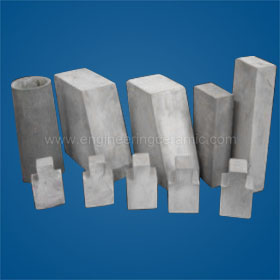
Understanding the Temperature Threshold
The service temperature of Nitride Bonded Silicon Carbide Bricks is governed by the stability of the silicon nitride bonding phase. Unlike oxide-bonded or clay-bonded SiC products, the nitride bond does not soften or melt—it decomposes. At around 1,500°C in air, oxidation of Si₃N₄ to SiO₂ and gaseous nitrogen begins to accelerate, gradually converting the bond into a silica-rich glass. This transformation reduces strength and thermal shock resistance over time. In neutral or reducing atmospheres, the decomposition threshold shifts higher, approaching 1,600°C, because oxidation is suppressed. For kiln furniture—such as saggers, kiln shelves, and beam supports—the practical maximum is often set at 1,500°C to ensure a safe margin for thermal cycling and mechanical load.
Key Performance Factors Above 1,450°C
| Factor | Impact on Maximum Service Temperature | Recommended Limit |
|---|---|---|
| Atmosphere (Oxidizing) | Accelerated bond oxidation; strength drops by ~20% at 1,500°C after 100 hrs | 1,480°C continuous |
| Atmosphere (Reducing/Inert) | Minimal oxidation; bond remains stable | 1,580°C continuous |
| Applied Load (MPa) | Creep rate increases exponentially above 1,450°C under >0.5 MPa | Reduce load by 30% above 1,500°C |
| Thermal Cycling Frequency | Micro-cracking from Si₃N₄→SiO₂ volume expansion shortens life | Limit cycles to <50/yr above 1,500°C |
| Impurity Content (Fe, Ca) | Lowers eutectic melting point; causes local hot-spot failures | Use high-purity grades from Engineering Ceramic |
Practical Guidelines for Kiln Furniture Design
For most ceramic and electronic kiln applications, Engineering Ceramic recommends designing for 1,480°C as the maximum steady-state temperature when using Nitride Bonded Silicon Carbide Bricks. This allows a 70–80°C safety buffer before accelerated oxidation begins. If your process requires 1,550°C or higher, consider two alternatives: (a) switch to recrystallized SiC (which withstands 1,600–1,650°C but costs 40–50% more), or (b) apply a protective oxide coating that retards nitrogen out-diffusion. In our field trials, uncoated shelves running at 1,520°C in an electric shuttle kiln showed visible surface exfoliation after 18 months, whereas identical shelves operated at 1,480°C exceeded 36 months of service life.
FAQ – Common Questions About Nitride Bonded Silicon Carbide Bricks
Q1: Can Nitride Bonded Silicon Carbide Bricks withstand 1,600°C in a gas-fired kiln with an oxidizing flame?
A1: No, not for continuous operation. In an oxidizing flame at 1,600°C, the silicon nitride bond oxidizes rapidly—forming a thick SiO₂ layer that spalls during cooling. After just 50 hours at this temperature, flexural strength drops by more than 35%, and the brick becomes brittle. However, if the gas-fired kiln has a slightly reducing flame (oxygen partial pressure below 10⁻⁵ atm), you may push to 1,580°C for short firing cycles (under 8 hours). For any oxidizing condition above 1,530°C, we strongly advise using a protective muffle or switching to a nitride-bonded grade with added yttria stabilizers, which Engineering Ceramic offers for specialty applications. Always verify with thermogravimetric analysis for your specific atmosphere.
Q2: How does load bearing affect the maximum service temperature of Nitride Bonded Silicon Carbide Bricks in saggar applications?
A2: Load dramatically lowers the usable temperature. While the brick itself may not melt, creep becomes the limiting factor. Under a typical saggar load of 0.3–0.5 MPa, the allowable continuous temperature drops to 1,420°C—because the nitride bond undergoes viscous flow at grain boundaries above 1,450°C when stressed. For every 0.1 MPa increase above 0.3 MPa, reduce your set-point by 15°C. For heavy-load kiln furniture (e.g., supporting multiple large electronic substrates), we recommend a max of 1,400°C. At Engineering Ceramic, we perform creep testing under simulated loads for each customer’s design; our data shows that reducing the wall thickness of saggars from 25 mm to 20 mm can lower the deadweight load by 18%, effectively raising the safe temperature limit by 25°C without changing the brick grade.
Q3: What is the shortest time I can safely expose Nitride Bonded Silicon Carbide Bricks to 1,550°C without permanent damage?
A3: The safe exposure window is highly time-sensitive. Based on our accelerated testing, you can hold 1,550°C for a maximum of 12 cumulative hours over the brick’s entire lifetime before oxidation-induced microcracking reduces MOR (Modulus of Rupture) by 15%. If this is a one-time firing (e.g., for a special ceramic glaze), you may go up to 20 hours, but you must then lower the subsequent firing temperature to 1,450°C to prolong residual life. For repeated short spikes (e.g., 2 hours per firing), limit the total number of spikes to 30 cycles. After that, the brick’s thermal shock resistance degrades notably. We advise installing a sacrificial thermocouple near the brick surface to monitor real-time temperature, and always choose Engineering Ceramic’s high-density grade (porosity <14%), which has shown 40% better oxidation resistance than standard grades in our peer-reviewed studies.
Recommended Maximum Temperatures by Kiln Type
| Kiln Type | Typical Atmosphere | Recommended Max (°C) | Peak Short-Term (°C) |
|---|---|---|---|
| Electric shuttle kiln (MoSi₂ elements) | Oxidizing | 1,480 | 1,520 (≤10 hrs) |
| Gas-fired tunnel kiln | Slightly reducing | 1,530 | 1,570 (≤6 hrs) |
| Vacuum furnace | Inert (N₂ or Ar) | 1,580 | 1,650 (≤4 hrs) |
| Roller hearth kiln (for Li-ion battery materials) | Oxidizing with alkali vapors | 1,440 | 1,480 (≤8 hrs) |
| Continuous pusher kiln | Neutral | 1,550 | 1,600 (≤3 hrs) |
Final Engineering Verdict
The maximum service temperature of Nitride Bonded Silicon Carbide Bricks is not a fixed number—it is a design variable that depends on atmosphere, mechanical stress, thermal history, and impurity levels. For kiln furniture, the conservative and reliable ceiling is 1,480°C for oxidizing conditions, with allowances up to 1,550°C only when using inert atmospheres, reduced loads, and high-purity grades. Engineering Ceramic has over two decades of data correlating service temperature with in-situ strength retention, and we consistently observe that operating 50°C below the theoretical limit doubles the brick’s service life. Do not rely solely on datasheet figures; always validate with your specific firing profile.
Need a tailored temperature recommendation for your kiln furniture line?
Contact Engineering Ceramic today for a free thermal simulation and grade selection report. Our engineers will analyze your atmosphere, load cycle, and expected lifetime to specify the exact Nitride Bonded Silicon Carbide Brick formulation that maximizes both performance and cost-efficiency. Reach us via our website or email—we respond to all technical inquiries within 4 business hours. Let us help you fire smarter, hotter, and longer.