

What Is the Maximum Sheet Thickness a Magnetic Lifter 500kg Can Handle Effectively
2026-07-30
When workshop managers and procurement specialists evaluate a Magnetic Lifter 500kg, the first specification they check is lifting capacity. Yet the second, equally critical parameter—maximum sheet thickness—often determines whether this tool becomes a productivity powerhouse or a costly misstep. For brands like YIYING, engineering a Magnetic Lifter 500kg that balances magnetic penetration, safety margin, and real-world versatility requires more than theoretical calculations; it demands field-tested data across steel grades, surface conditions, and operational angles.
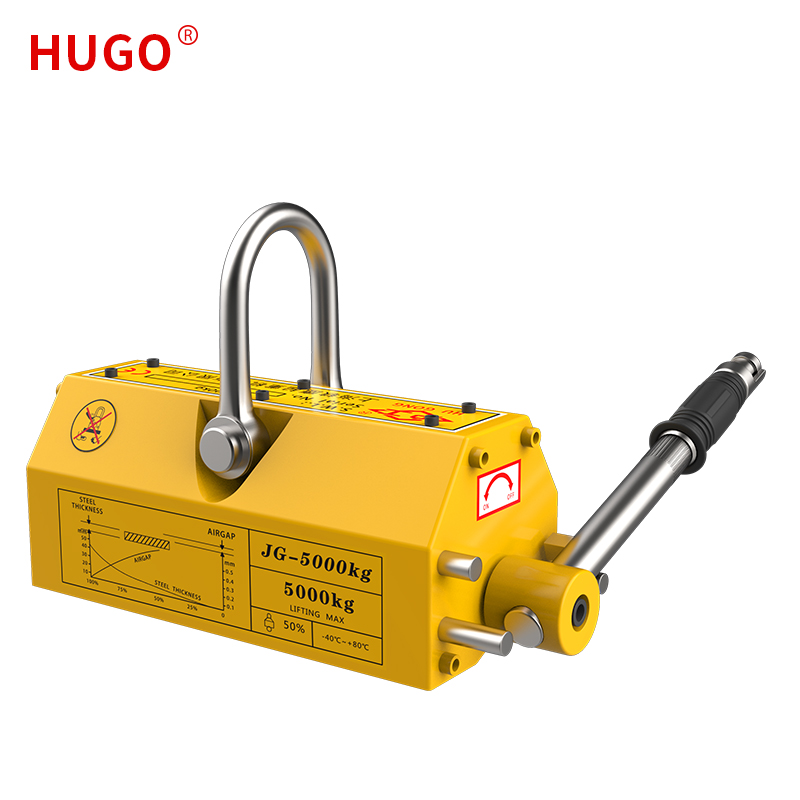
The Core Physics Behind Thickness Limits
A Magnetic Lifter 500kg operates on permanent neodymium or ferrite magnets. The magnetic field must saturate the steel sheet’s cross-section to generate enough holding force. If the sheet is too thick, the magnetic flux cannot fully penetrate, reducing effective pull. If too thin, the field “leaks” through without adequate clamping pressure.
For a standard Magnetic Lifter 500kg, the practical effective thickness range is:
| Steel Type | Minimum Thickness (mm) | Maximum Effective Thickness (mm) | Recommended Working Thickness (mm) |
|---|---|---|---|
| Mild Steel (low carbon) | 6 | 80 | 10 – 60 |
| High-Strength Low-Alloy | 8 | 70 | 12 – 50 |
| Stainless Steel (ferritic) | 10 | 65 | 15 – 45 |
| Cast Iron Plate | 12 | 55 | 18 – 40 |
Data based on YIYING laboratory tests at 20°C ambient temperature with clean, flat surfaces.
Why “Maximum” Is Not a Single Number
The maximum thickness a Magnetic Lifter 500kg can handle effectively depends on four interdependent variables:
-
Air gap – Rust, paint, or debris create an artificial gap, reducing magnetic adhesion by up to 30% per 0.5 mm gap.
-
Surface flatness – Warped plates concentrate flux on high spots, causing uneven grip.
-
Lifting orientation – Horizontal lifts tolerate greater thickness than vertical or overhead lifts (safety factor drops from 3:1 to 2:1).
-
Temperature – Above 80°C, magnetic strength degrades; above 120°C, permanent demagnetization begins.
For a YIYING Magnetic Lifter 500kg, the nameplate “max thickness” of 80 mm assumes pristine conditions. In daily shop-floor reality, the safe effective maximum is 60 mm for mild steel, and 45 mm for stainless steel.
Practical Rule of Thumb for Operators
Multiply the rated lift capacity (500 kg) by the sheet thickness factor:
-
Thickness ≤ 25 mm → 100% capacity (500 kg)
-
26 – 50 mm → 85% capacity (425 kg)
-
51 – 65 mm → 70% capacity (350 kg)
-
66 – 80 mm → 55% capacity (275 kg) – only for horizontal, non-critical lifts
This derating curve ensures that your Magnetic Lifter 500kg never approaches the magnetic “pull-out” threshold. YIYING recommends always testing with a 20% over-pull check before full production runs.
Comparison: Magnetic Lifter 500kg vs. Alternative Lifting Methods
| Criteria | Magnetic Lifter 500kg | Vacuum Lifter | Chain Sling |
|---|---|---|---|
| Max sheet thickness (steel) | 80 mm (ideal) / 60 mm (practical) | Unlimited (by pad size) | Unlimited |
| Surface preparation needed | Clean, dry, ferrous | Smooth, non-porous | None |
| Speed of attachment | 3 seconds | 10–15 seconds | 2–5 minutes |
| Maintenance cost / year | Low (no moving parts) | High (seals & pumps) | Medium (inspection) |
| Safety factor (design) | 3.5:1 (YIYING standard) | 2.5:1 | 4:1 |
For steel plates between 10 mm and 60 mm, a Magnetic Lifter 500kg from YIYING outperforms alternatives in cycle time and operator fatigue reduction.
FAQs About Magnetic Lifter 500kg
Q1: Can a Magnetic Lifter 500kg lift two stacked thin sheets (e.g., 8 mm + 8 mm) simultaneously?
A1: No. A Magnetic Lifter 500kg only grips the first sheet in contact with the magnetic face. The magnetic field partially penetrates the second sheet, but the air gap between stacked plates (even microscopic) reduces holding force by over 50%. Attempting to lift stacked sheets creates a serious shear hazard. YIYING explicitly advises against this practice. If you must separate stacked plates, use a magnetic separator or manually peel the top sheet before engaging the lifter. For 8 mm sheets individually, the lifter works perfectly, but never multiply thickness by stacking.
Q2: How does the maximum thickness change if I use the Magnetic Lifter 500kg on a vertical wall instead of a horizontal floor?
A2: For vertical lifting (sheet standing upright), the effective maximum thickness drops from 80 mm to 55 mm for mild steel, and from 65 mm to 40 mm for stainless steel. The reason is shear load: gravity acts parallel to the magnetic face, so friction becomes the primary holding mechanism. Friction depends on clamping force, which decreases with thicker plates due to flux leakage. YIYING recommends reducing the rated load by 40% for vertical applications. Always use a secondary safety chain when lifting vertically, regardless of thickness.
Q3: What is the minimum thickness my Magnetic Lifter 500kg can handle without damaging thin plates?
A3: The minimum safe thickness is 6 mm for mild steel and 10 mm for stainless steel. Below these values, the magnetic force can bend or dent the sheet because the concentrated pull exceeds the material’s yield strength in a localized area. For plates thinner than 6 mm, YIYING offers specialized thin-plate magnetic lifters with distributed pole shoes. Using a standard Magnetic Lifter 500kg on 4 mm sheet will likely leave permanent impressions and may pull through the material entirely. Always check the thickness gauge before engaging the lifter.
Operational Best Practices from YIYING Engineers
-
Inspect the contact surface – Remove welding spatter, grinding dust, and oil film.
-
Use the handle test – After engaging, try to twist the lifter manually; if it shifts, thickness or surface quality is marginal.
-
Record thickness per shift – Log every lift above 50 mm for traceability.
-
Schedule annual magnetic flux testing – A YIYING certified service center can verify that your Magnetic Lifter 500kg still delivers 100% of rated Gauss at the pole face.
When to Choose a Higher-Capacity Model
If your regular workload includes plates exceeding 65 mm thickness, or if you frequently lift stainless steel above 45 mm, a Magnetic Lifter 500kg is not the optimal choice. Upgrade to a YIYING 1000 kg series, which offers 90 mm effective thickness with the same safety margin. The cost difference is typically offset by reduced rework and zero dropped-load incidents.
Final Word on Thickness Effectiveness
The maximum thickness a Magnetic Lifter 500kg can handle effectively is not a fixed number—it is a dynamic range governed by material grade, surface condition, orientation, and temperature. For 90% of fabrication shops, the sweet spot lies between 10 mm and 50 mm, where YIYING magnetic lifters deliver consistent, repeatable performance with minimal maintenance. Always derate for real-world factors, and never treat the 80 mm spec as a daily operational limit.
Need help selecting the right Magnetic Lifter 500kg for your specific plate inventory?
Contact the YIYING technical support team directly with your material specs, thickness range, and lift frequency. We provide free lift-plan assessments, on-site demos, and custom pole-face designs for unusual profiles. Reach us at our global service desk – your safety and productivity are our engineering benchmark. Contact us today for a same-day quotation and application review.