

A 12 Ton Industrial Air Cooled Process Chiller can provide reliable temperature control for manufacturing equipment and industrial processes when its cooling capacity, operating temperatures, fluid flow, and installation conditions are correctly matched to the application. This guide explains how the system works, where it can be used, how to evaluate its cooling performance, and what buyers should check before purchasing. It also covers energy consumption, maintenance, common selection mistakes, and practical questions to discuss with a chiller supplier.
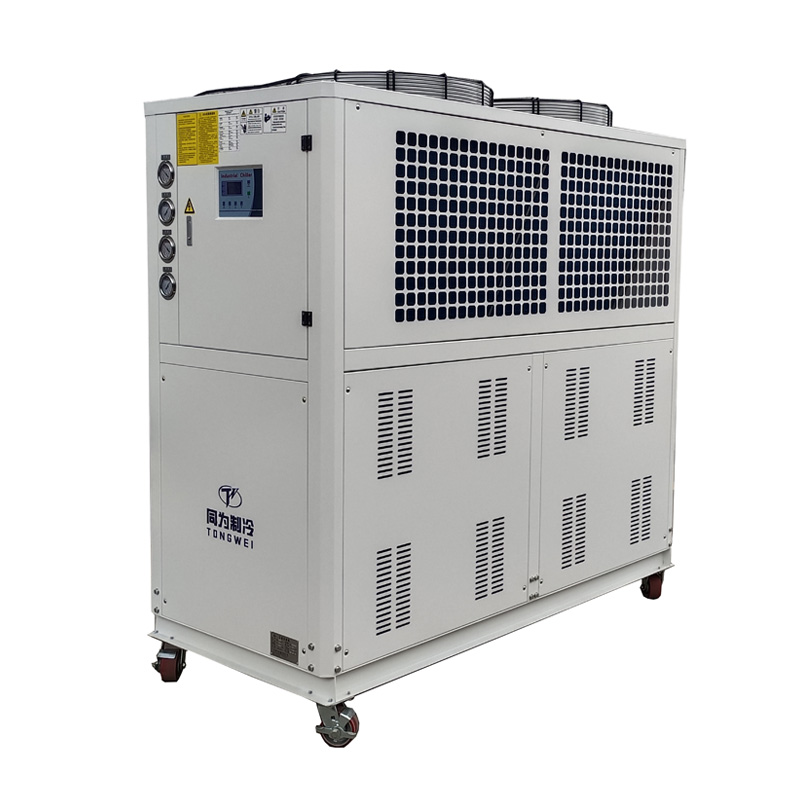
1. Understanding a 12 Ton Industrial Air Cooled Process Chiller
Temperature stability is essential in many manufacturing environments. When production machinery generates heat faster than it can dissipate it, equipment temperatures may rise, product quality can become inconsistent, and production cycles may be interrupted. A properly selected process chiller helps control these conditions by continuously removing unwanted heat.
A 12 Ton Industrial Air Cooled Process Chiller is a mechanical cooling system designed to remove heat from a circulating fluid and release that heat into the surrounding air. The cooled fluid is then delivered to production equipment, molds, tanks, heat exchangers, or other process loads.
In refrigeration terminology, one ton of cooling capacity equals approximately 3.517 kW. Therefore, 12 refrigeration tons represent approximately 42.2 kW of nominal cooling capacity, equivalent to 144,000 BTU/h.
Unlike comfort air conditioning, which primarily regulates indoor air temperature, a process chiller is selected according to the heat generated by a particular process and the required temperature of its circulating fluid. This makes accurate engineering data essential when comparing models.
2. How the Chiller Works
An air-cooled process chiller typically uses a vapor-compression refrigeration cycle. Its main components include a compressor, condenser, expansion device, and evaporator. A circulating pump may also be included in the package, depending on the configuration.
- Heat absorption: Warm process fluid passes through the evaporator, where heat transfers to the refrigerant.
- Refrigerant compression: The compressor raises the refrigerant's pressure and temperature.
- Heat rejection: The condenser transfers heat from the refrigerant to outdoor air, usually with the assistance of condenser fans.
- Pressure reduction: The expansion device lowers the refrigerant pressure before it returns to the evaporator.
- Continuous circulation: The cooled process fluid returns to the equipment, allowing the cycle to repeat.
Because heat is rejected directly to the air, an air-cooled chiller generally does not require a separate cooling tower. This can simplify installation and reduce the need for cooling-tower water treatment and related maintenance.
For production managers, the practical objective is to maintain the required process temperature while delivering sufficient flow and avoiding unnecessary compressor cycling. The control system, pump arrangement, and overall piping design all contribute to this result.
3. Industrial Applications and Production Benefits
A 12-ton process chiller may suit small or medium-sized production systems, individual machines, or a group of compatible loads. Its suitability must be verified against the actual heat load rather than determined by the application name alone.
Plastic Injection Molding and Extrusion
Molding and extrusion equipment release heat during production. Controlled cooling can help stabilize mold temperatures, support consistent cycle times, and reduce temperature-related quality variation. The required capacity depends on the machine, mold design, material, production rate, and cooling-water conditions.
Laser and Machine Tool Cooling
Laser systems, CNC equipment, and certain machining processes require controlled temperatures for heat-sensitive components, cutting tools, or hydraulic systems. A dedicated chiller can help limit thermal drift, provided that its temperature accuracy and flow characteristics meet the equipment manufacturer's requirements.
Industrial Processing and Manufacturing
Process chillers can also serve heat exchangers, mixing systems, industrial tanks, printing equipment, and selected chemical or food-processing operations. Applications involving hygiene requirements, corrosive fluids, or specialized process media may require additional materials and system-design considerations.
| Application | Cooling Objective | Key Selection Consideration |
|---|---|---|
| Injection molding | Manage mold and process temperatures | Peak heat load and flow requirements |
| Laser equipment | Maintain stable equipment temperature | Temperature accuracy and fluid quality |
| CNC machining | Remove heat from selected machine systems | Coolant compatibility and operating pressure |
| Industrial tanks | Control process-fluid temperature | Tank volume, heat input, and cooling time |
| Printing equipment | Reduce heat-related process variation | Continuous duty and operating schedule |
These examples are potential applications, not a guarantee that one standard chiller configuration will fit every machine. Process conditions should always be confirmed before purchase.
4. Cooling Capacity and Technical Specifications
Cooling capacity is one of the first specifications buyers should examine. However, tonnage alone cannot establish whether a chiller will deliver the required performance. A useful technical review should also cover fluid temperatures, flow rate, electrical requirements, and site conditions.
| Parameter | Reference or Requirement | Why It Matters |
|---|---|---|
| Nominal capacity | 12 RT ≈ 42.2 kW | Provides the starting point for capacity evaluation |
| Heat removal rate | 144,000 BTU/h nominal equivalent | Allows comparison across common capacity units |
| Leaving fluid temperature | Based on the process requirement | Affects refrigeration performance and fluid selection |
| Fluid flow rate | Calculated from load and temperature difference | Ensures sufficient heat transfer |
| Ambient temperature | Based on the site's design maximum | Influences condenser performance and available capacity |
| Electrical supply | Confirmed with the supplier | Ensures compatibility with local power standards |
| Pump and connections | Matched to system flow and pressure drop | Supports reliable circulation through the process loop |
The values above are capacity conversions and selection criteria, not a verified product datasheet. Operating temperatures, refrigerant, dimensions, noise level, input power, pump specifications, and electrical ratings must be obtained from the selected manufacturer's technical documentation.
5. How to Select the Right Chiller
Choosing a chiller based only on a requested tonnage can lead to inadequate cooling, unnecessary energy consumption, or compatibility problems. A more reliable approach starts with the production process and works backward to the equipment specification.
5.1 Calculate the Actual Cooling Load
The cooling load represents the amount of heat the system must remove over a given period. For a water-based process, a preliminary estimate can be calculated using the fluid flow rate and temperature difference.
Q (kW) ≈ Flow rate (L/min) × Specific heat (kJ/kg·°C) × Temperature difference (°C) ÷ 60
For water, using a density close to 1 kg/L and a specific heat of approximately 4.18 kJ/kg·°C:
Q (kW) ≈ Flow rate (L/min) × Temperature difference (°C) × 4.18 ÷ 60For example, suppose a water loop circulates 120 L/min and experiences a temperature difference of 5°C. The estimated heat transfer is:
120 × 5 × 4.18 ÷ 60 = 41.8 kW
This is close to the nominal equivalent of 12 refrigeration tons. However, it does not establish that a nominal 12-ton chiller will be sufficient. The actual selection must account for operating conditions, fluid properties, peak loads, and the manufacturer's performance data.
When possible, use measured full-production data or equipment-manufacturer heat-load figures. A safety margin may be appropriate when the load is uncertain, but excessive oversizing should be avoided.
5.2 Check Temperature and Fluid Requirements
The required supply temperature affects the refrigeration cycle and the achievable cooling capacity. A process requiring relatively warm cooling water may operate under different conditions from one requiring low-temperature fluid.
- Confirm the required leaving-fluid temperature and allowable temperature variation.
- Record the returning-fluid temperature and expected temperature difference.
- Identify whether the system uses water, a water-glycol mixture, or another compatible fluid.
- Verify the required flow rate, operating pressure, and pressure drop.
- Ask the manufacturer to confirm capacity at the specified operating conditions.
Glycol mixtures can reduce heat-transfer performance and increase viscosity compared with water. If freeze protection is required, the supplier should account for the selected concentration and minimum operating temperature.
5.3 Evaluate Installation Conditions
Air-cooled chillers rely on unobstructed airflow to reject heat. A unit installed in a confined area or exposed to recirculated hot air may operate at higher condensing temperatures and deliver less cooling than expected.
- Ambient conditions: Use the expected maximum site temperature rather than the annual average.
- Ventilation: Follow the manufacturer's clearance requirements around air inlets and outlets.
- Installation location: Consider rain exposure, dust, corrosive atmospheres, and service access.
- Electrical compatibility: Confirm voltage, frequency, phase, protection, and local electrical requirements.
- Hydraulic layout: Check pipe sizing, pump head, valves, filters, and any required buffer tank.
For facilities in hot climates, the supplier should verify the chiller's capacity and operating limits at the site's actual design ambient temperature. A standard rating may not represent performance during the hottest part of the year.
6. Air-Cooled vs. Water-Cooled Process Chillers
Both air-cooled and water-cooled chillers can support industrial process cooling, but their installation requirements and operating considerations differ. The best choice depends on the facility's infrastructure, heat load, climate, and long-term operating priorities.
| Comparison Factor | Air-Cooled Chiller | Water-Cooled Chiller |
|---|---|---|
| Heat rejection | Transfers heat directly to air | Transfers heat to a water circuit |
| Cooling tower | Generally not required | Often required in conventional systems |
| Installation | Usually simpler where airflow is available | Requires suitable water-side infrastructure |
| Water consumption | No cooling-tower evaporation in the refrigeration heat-rejection system | May require makeup water for cooling-tower operation |
| Maintenance focus | Condenser coils, fans, airflow, and refrigerant circuit | Condenser-water quality and associated heat-rejection equipment |
| Selection priority | Convenient installation and independent operation | Potential efficiency advantages in suitable larger installations |
An air-cooled system is often attractive when a factory wants to avoid cooling-tower infrastructure and simplify installation. A water-cooled system may be worth evaluating where water-side facilities already exist and the expected energy savings justify the additional equipment and maintenance.
Actual efficiency depends on the complete system design and operating conditions. Neither configuration should be assumed to be universally more efficient.
7. How to Improve Energy Efficiency
Electricity is an important part of the total cost of owning an industrial chiller. Although the initial purchase price matters, buyers should also consider the energy required to maintain process temperatures over the equipment's expected operating life.
Match Capacity to the Real Load
An undersized chiller may struggle to maintain the set point during peak production. An oversized unit may cycle too frequently when its controls and compressor arrangement cannot match lower loads efficiently. Proper sizing and suitable capacity control help avoid both problems.
Keep the Condenser Clean
Dust, fibers, oil mist, and other airborne contaminants can restrict airflow and reduce heat transfer. Regular inspection and cleaning help the condenser reject heat effectively, especially in demanding factory environments.
Optimize Water Flow and Temperature Settings
Operate within the process equipment's permitted temperature range rather than selecting an unnecessarily low set point. Confirm that the pump delivers the required flow without excessive pressure or avoidable throttling losses.
Review Energy Performance Data
Ask for rated cooling capacity and electrical input under clearly stated conditions. A useful comparison also considers part-load performance, compressor control, pump power, and the number of hours the equipment operates annually.
8. Maintenance and Troubleshooting
Preventive maintenance reduces the risk of unplanned shutdowns and helps maintain stable cooling performance. The exact service schedule should follow the manufacturer's instructions and reflect the dust level, operating hours, and environmental conditions at the site.
Recommended Maintenance Checklist
- Inspect condenser coils for dust, debris, and restricted airflow.
- Check condenser fan operation and listen for unusual vibration or noise.
- Monitor fluid supply and return temperatures during normal production.
- Inspect the circulating pump, piping, valves, and visible connections for leaks.
- Check filters and strainers for blockage according to the service schedule.
- Review alarms, operating pressures, and electrical indicators using approved procedures.
- Inspect fluid condition and concentration where glycol or process additives are used.
- Arrange qualified inspection of the refrigerant circuit when performance declines.
Common Problems and Possible Causes
| Observed Problem | Possible Cause | Recommended Action |
|---|---|---|
| Fluid temperature remains too high | Excessive heat load, poor airflow, insufficient flow, or incorrect sizing | Verify the load and operating conditions; arrange technical diagnosis |
| Frequent high-pressure alarms | Blocked condenser, hot-air recirculation, or fan malfunction | Check airflow and obtain qualified service if the alarm persists |
| Low or unstable fluid flow | Blocked filter, air in the circuit, or pump-related problems | Inspect the hydraulic system using the approved procedure |
| Unexpectedly high energy use | Dirty coils, unsuitable set points, high ambient temperature, or inefficient operation | Review operating data and compare it with rated performance |
| Unusual noise or vibration | Loose components, fan issues, or mechanical wear | Arrange inspection by qualified maintenance personnel |
Do not bypass safety protections or open a pressurized refrigerant circuit without the appropriate qualifications. Electrical, refrigerant, and compressor-related work should be performed by trained service personnel.
9. Common Purchasing Mistakes
Even experienced industrial buyers can overlook details when comparing quotations. The following mistakes can create avoidable installation costs or performance problems.
Choosing Only by Nominal Tonnage
A 12-ton rating is a starting point, not a complete performance specification. Always confirm the available capacity at the required fluid and ambient temperatures.
Ignoring Peak Production Conditions
Average heat load may be lower than the load during startup, peak production, or simultaneous operation of multiple machines. The selected unit must meet the actual design requirement.
Overlooking the Pump and Piping
A chiller cannot deliver its expected performance if the process loop does not provide sufficient flow. Pump head, pipe resistance, elevation, valves, and filters should be considered together.
Comparing Prices Without Comparing Scope
One quotation may include a pump, tank, controller, and flow protection, while another may cover only the basic chiller unit. Buyers should compare the complete supply scope, warranty, spare parts, commissioning support, and delivery terms.
Failing to Confirm Local Conditions
Electrical standards, ambient temperatures, installation space, and service availability vary by market. Confirming these requirements before ordering can prevent delays and costly modifications.
10. Buyer Checklist Before Ordering
Preparing a concise technical brief makes it easier for a supplier to recommend a suitable configuration and provide a meaningful quotation. Buyers can use the following checklist when requesting information about a 12-ton industrial chiller.
- Identify the equipment or process requiring cooling.
- Provide the estimated or measured cooling load.
- Specify required supply and return fluid temperatures.
- Confirm the required flow rate and system pressure drop.
- Identify the circulating fluid and any freeze-protection requirements.
- Provide the site's maximum ambient temperature and installation environment.
- Confirm voltage, frequency, phase, and electrical standards.
- State the required operating schedule and temperature stability.
- Ask whether a pump, tank, controller, or other accessories are included.
- Request rated performance data, overall dimensions, and service clearances.
- Review warranty coverage, delivery arrangements, and after-sales support.
For OEM projects, distributors, and equipment manufacturers, it is also useful to discuss enclosure requirements, control interfaces, connection positions, labeling, and other project-specific configuration needs before production begins.
11. Frequently Asked Questions
1. What does a 12-ton industrial chiller mean?
It refers to a nominal refrigeration capacity of 12 tons, equivalent to approximately 42.2 kW or 144,000 BTU/h. The actual delivered capacity depends on the operating conditions specified by the manufacturer.
2. Is a 12 Ton Industrial Air Cooled Process Chiller suitable for my factory?
It may be suitable if the required cooling load falls within the unit's available capacity under your design conditions. You should also verify fluid temperature, flow rate, ambient temperature, operating hours, and equipment compatibility before selecting a model.
3. How much electricity does a 12-ton process chiller consume?
Electricity consumption varies by compressor technology, ambient temperature, fluid temperatures, part-load operation, and auxiliary equipment. Cooling capacity is not the same as electrical input. Request the rated power and performance data for the exact model, then estimate energy use from its actual operating profile.
4. Does an air-cooled process chiller need a cooling tower?
Generally, no. An air-cooled chiller rejects heat directly into the surrounding air through a condenser and fans. It still requires suitable ventilation, installation clearances, and regular condenser maintenance.
5. Can a 12-ton chiller operate in a hot climate?
Yes, provided the selected model is designed for the site's ambient conditions. High outdoor temperatures can reduce available cooling capacity, so the supplier should confirm performance at the expected maximum temperature rather than relying only on nominal ratings.
6. Can a process chiller use glycol instead of plain water?
Many systems can use an appropriate water-glycol mixture, but compatibility must be confirmed. Glycol concentration changes heat-transfer characteristics, viscosity, flow requirements, and available cooling capacity. The chiller should be selected for the actual fluid.
7. How often should an industrial air-cooled chiller be maintained?
Maintenance frequency depends on the manufacturer's recommendations, operating hours, and site cleanliness. Condenser condition, fan operation, fluid flow, filters, alarms, and visible leaks should be checked regularly. Dusty environments may require more frequent cleaning.
8. What information should I send when requesting a quotation?
Provide the process heat load, required fluid temperatures, flow rate, fluid type, maximum ambient temperature, electrical supply, installation environment, and preferred configuration. If the load is uncertain, send the available equipment data so the supplier can help assess the requirement.
9. Can a process chiller be customized for a specific application?
Depending on the manufacturer's capabilities, customization may cover control functions, pumps, tanks, fluid connections, electrical standards, and other configuration details. Confirm the available options, technical limitations, and any minimum order requirements before placing an order.
10. How can I compare two industrial chiller quotations fairly?
Compare cooling capacity under identical rating conditions, electrical input, fluid requirements, included accessories, dimensions, warranty, delivery time, and service support. A lower initial price does not necessarily mean a lower total cost of ownership.
12. Final Considerations
A 12 Ton Industrial Air Cooled Process Chiller can be an effective solution for manufacturing operations that require reliable, controlled cooling without a separate cooling tower. Its real value depends on how well the equipment matches the process heat load, temperature requirements, circulation system, and installation environment.
Before making a purchasing decision, verify the actual cooling requirement, request performance data for the intended operating conditions, and evaluate the complete system rather than the nominal tonnage alone. Proper selection, installation, and preventive maintenance can help support stable production and more predictable operating costs.
For businesses evaluating industrial cooling equipment, Guangdong Tongwei Machinery Co., Ltd. can be included in the supplier inquiry process to discuss project requirements, configuration options, and technical information relevant to the intended application. Confirm the specific model specifications, customization capabilities, and available support directly with the company before making a final selection.
Looking for the Right Industrial Cooling Solution?
Every production process has different cooling requirements. Share your heat load, target temperatures, flow rate, and installation conditions to help identify a suitable chiller configuration.
Contact Guangdong Tongwei Machinery Co., Ltd. to discuss your industrial cooling requirements, request detailed technical specifications, and explore the configuration options available for your project.