

Which Bolted or Welded Design Works Better for a Rain Resistant Prefab Steel Frame Warehouse
2026-08-26
Selecting the optimal connection method for a Rain Resistant Prefab Steel Frame Warehouse is a critical engineering decision that directly impacts structural integrity, construction timelines, and long-term durability. For Newforge, a leader in prefabricated steel solutions, the choice between bolted and welded designs is not merely about preference—it is about delivering predictable performance in demanding environments where moisture and weather exposure are constant factors.
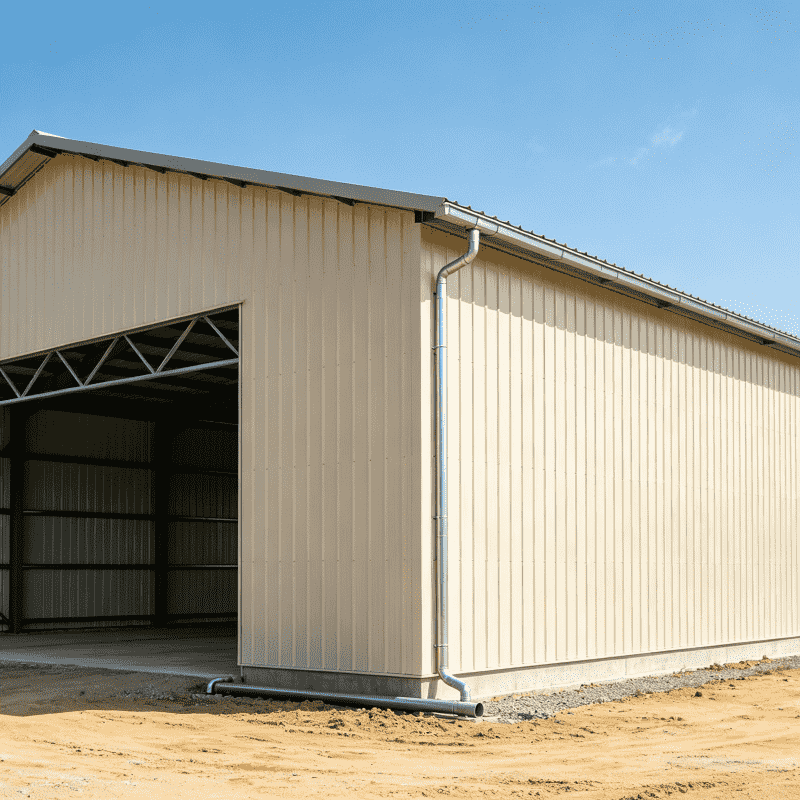
The Critical Role of Connection Design in Moisture-Prone Environments
A Rain Resistant Prefab Steel Frame Warehouse faces unique challenges. Rain, humidity, and temperature fluctuations test every joint and seam. The connection method determines how effectively the structure resists moisture ingress and maintains coating integrity over decades of service.
Bolted connections have gained significant traction in the prefabricated steel industry, particularly for export and weather-exposed projects. Industry data indicates that bolted systems can reduce on-site erection time by 30 to 40 percent compared to welded joints, translating to two to three weeks saved on a typical 50,000-square-foot warehouse project.
Welded connections, while offering superior rigidity and load distribution, introduce complexities that can compromise a building's rain-resistant properties when executed in the field. The quality of a welded joint is inherently tied to site conditions, which are far less controllable than a factory environment.
Bolted vs. Welded: A Professional Comparison
| Feature | Bolted Design | Welded Design |
|---|---|---|
| Installation Speed | Faster—pre-drilled components assemble quickly with basic tools and minimal supervision. | Slower—requires skilled labor, specialized equipment, and favorable weather conditions. |
| Labor Requirements | Semi-skilled labor sufficient; work continues regardless of light rain or wind. | Certified welders essential; welding operations must stop in rainy or high-wind conditions. |
| Quality Assurance | Easily verifiable through torque checks and visual inspection of fasteners. | Requires non-destructive testing methods such as ultrasonic or radiographic examination to detect hidden defects. |
| Corrosion Resistance | Factory-applied coatings remain intact; fasteners are separately galvanized or coated. | Field welds destroy the protective coating at the joint, exposing bare steel to oxidation. |
| Maintenance & Repair | Fully disassemblable; individual damaged components can be replaced without cutting. | Permanent structure; repairs require on-site cutting, grinding, and re-welding. |
| Seismic Performance | Preferred for ductility and energy dissipation under cyclic loading. | High rigidity can lead to brittle failure modes in seismic events. |
| Shipping & Logistics | Compact packing into standard shipping containers; parts are interchangeable. | Often requires shipping larger welded sub-assemblies, increasing freight costs and complexity. |
Why Bolted Systems Excel for Rain Resistant Warehouses
For a Rain Resistant Prefab Steel Frame Warehouse, the bolted approach offers distinct advantages that align with Newforge's commitment to quality and performance.
Precision manufacturing is the foundation of a bolted system. At Newforge fabrication facilities, components are produced using computer-controlled machinery, ensuring millimeter-level accuracy. This factory-controlled environment eliminates the variables that plague on-site welding, such as inconsistent electrode heating, atmospheric contamination, and weather-induced defects. Every hole is precisely aligned, every member is cut to exact specifications, and every coating is applied under optimal conditions.
The corrosion resistance of a bolted structure depends on the integrity of its protective layers. While bolted connections can create small crevices, Newforge addresses this by using hot-dip galvanized or high-performance coated fasteners, combined with proper installation techniques that minimize coating damage at bearing surfaces. Field welds, by contrast, inherently destroy the factory coating around the joint area. This requires immediate and meticulous site recoating, a process that is notoriously difficult to execute with the same quality and consistency as factory application. In a rainy climate, any delay or deficiency in this recoating process creates a direct pathway for oxidation.
Predictability is paramount for project success. A bolted Rain Resistant Prefab Steel Frame Warehouse from Newforge offers a stable construction schedule unaffected by weather delays, reduced labor uncertainty, and straightforward quality management throughout the erection process. Project managers can plan with confidence, knowing that the assembly sequence will proceed without interruption from afternoon showers or seasonal humidity.
Frequently Asked Questions
Q: Is a welded frame inherently stronger than a bolted frame for a rain resistant warehouse?
A: While a properly executed welded joint creates a continuous connection that can achieve higher ultimate strength in certain static load scenarios, the practical strength of a welded structure is heavily dependent on the skill of the onsite welder and the environmental conditions during welding. Welding defects, including porosity, incomplete penetration, and slag inclusion, account for a significant portion of structural issues in field-erected steel buildings. For a Rain Resistant Prefab Steel Frame Warehouse, a properly engineered bolted connection using high-strength friction-grip bolts provides more than adequate strength for all standard industrial applications, including heavy overhead crane loads and high wind pressures. Furthermore, the ductility of bolted connections is consistently preferred in seismic regions, offering energy dissipation characteristics that rigid welded joints often cannot match. Newforge engineers all bolted connections to meet or exceed applicable international structural standards, ensuring long-term reliability under diverse loading conditions.
Q: Which design provides better long-term protection against corrosion in a rainy climate?
A: The corrosion resistance of any steel structure is ultimately determined by the effectiveness of its protective coating system rather than the connection type alone. However, the connection method plays a decisive role in how well that coating system performs over time. Factory-based fabrication for bolted systems allows for the application of uniform, high-quality industrial coatings in a controlled environment with proper surface preparation, temperature regulation, and curing conditions. Field welds, on the other hand, destroy the factory coating at the joint location, leaving raw, unprotected steel exposed to moisture and oxygen. Protecting a field weld requires an immediate on-site recoating process, which involves surface preparation, primer application, and topcoat curing—all performed under ambient weather conditions that are rarely ideal. In a Rain Resistant Prefab Steel Frame Warehouse, preserving coating integrity at every connection point is essential for preventing early oxidation. Newforge leverages factory-applied corrosion protection systems to ensure that every bolted connection maintains its defensive barrier against moisture ingress, significantly reducing the risk of premature deterioration and extending the structure's service life by years or even decades.
Q: How does the choice between bolted and welded designs affect maintenance requirements and future building modifications?
A: Maintenance and adaptability represent some of the most compelling differentiators between the two systems. A bolted design offers exceptional long-term value because it is inherently modular and reversible. If a structural member becomes damaged—whether during shipping, installation, or later during the warehouse's operational life—it can be unbolted and replaced with an identical component, requiring no cutting, welding, or complex site fabrication. This modularity also simplifies future expansions, as new structural bays can be securely bolted onto the existing frame without disrupting ongoing warehouse operations. In contrast, a welded structure is permanent by nature. Any modification, whether for repair, reinforcement, or expansion, involves costly and time-consuming on-site cutting and re-welding, which disrupts daily activities, introduces new quality risks, and requires the same skilled labor and weather-dependent conditions as the original installation. For a Rain Resistant Prefab Steel Frame Warehouse, this modularity translates directly to lower total cost of ownership, reduced downtime during maintenance activities, and greater flexibility to adapt to evolving business requirements over the building's lifespan.
The Newforge Commitment
At Newforge, every Rain Resistant Prefab Steel Frame Warehouse is engineered with the bolted design philosophy as the standard. This approach ensures superior quality control through factory-based fabrication, faster and more predictable project completion, and a final structure that is simpler to maintain, repair, and expand over its operational life. We prioritize solutions that provide our clients with certainty, transparency, and peace of mind—especially when facing the challenges of humid climates and frequent rainfall.
For a detailed assessment of how a bolted Rain Resistant Prefab Steel Frame Warehouse from Newforge can address your specific storage, logistics, or manufacturing requirements, reach out to our engineering team today. We offer comprehensive consultations, site-specific design recommendations, and transparent project estimates. Contact us now to begin planning a warehouse solution that delivers lasting durability, predictable performance, and exceptional value for your investment.