

Which Cartridge Dust Collectors Deliver Efficient Industrial Dust Control?
2026-09-30
In modern manufacturing environments, controlling airborne dust is essential for maintaining cleaner production areas, protecting equipment, improving working conditions, and supporting stable production. Cartridge Dust Collectors are widely used for applications involving fine and dry particulate because their pleated filter cartridges provide a large filtration surface within a relatively compact structure. Depending on the filter media, airflow, dust characteristics, and cleaning method, cartridge systems can be applied to welding fumes, grinding dust, laser and plasma cutting, powder handling, chemical processing, woodworking, and other industrial processes.
For industrial buyers, however, selecting a dust collector is not simply about choosing the largest airflow capacity. Filter area, dust loading, pressure drop, pulse cleaning, filter media, maintenance requirements, and operating conditions all influence long-term performance. Jiangsu Jiangteng Environmental Protection Engineering Technology Co., Ltd. focuses on industrial environmental protection engineering and can provide equipment solutions designed around specific dust-control requirements.
What Are Cartridge Dust Collectors?
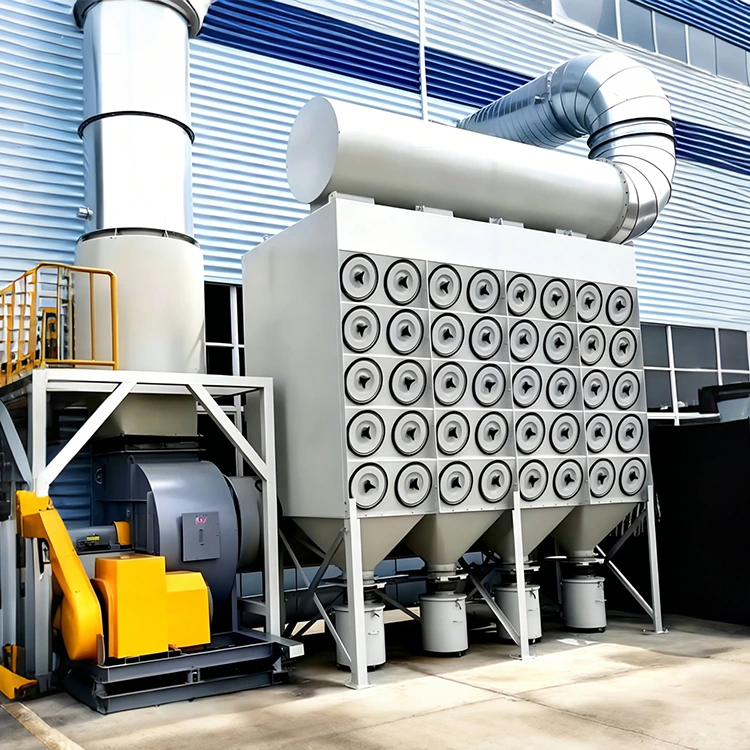
A cartridge dust collector is an industrial filtration system that uses cylindrical, pleated filter cartridges to capture airborne particulate. Compared with conventional filter bags, the pleated structure can provide substantial filtration area in a relatively compact housing, making this type of collector attractive where installation space is limited.
The basic filtration process can be summarized as:
- Dust-laden air enters through an inlet or connected duct.
- Air passes through the filter cartridges, while dust particles are retained on the filter surface.
- Clean air moves into the clean-air chamber and exits through the outlet.
- Accumulated dust is removed through a pulse-jet cleaning system.
- Released dust falls into a hopper or collection container for subsequent disposal.
Many industrial cartridge systems use compressed-air pulse cleaning to remove accumulated dust without requiring frequent manual filter cleaning.
How Does Pulse-Jet Cleaning Improve Performance?
As dust accumulates on the cartridge surface, filtration resistance can increase. A pulse-jet system sends a short burst of compressed air through the cartridge in the reverse direction of normal airflow. This pulse dislodges the accumulated dust cake, allowing it to fall into the collection hopper.
The effectiveness of this process depends on several factors, including compressed-air conditions, pulse frequency, nozzle design, filter media, dust characteristics, and pressure-drop control. Research has also shown that pulse-cleaning parameters can significantly affect residual pressure drop and dust emissions.
A properly designed cleaning system can help achieve:
- More stable airflow
- Controlled pressure drop
- Longer cartridge service intervals
- Reduced manual maintenance
- More consistent filtration performance
- Less production interruption
For this reason, pulse cleaning should be considered as an integral part of the entire dust collection system rather than simply an accessory.
Why Is Cartridge Filtration Important for Industrial Production?
Industrial dust can affect both the production environment and the equipment itself. Fine particulate may accumulate around machinery, enter ventilation systems, interfere with production processes, or create additional housekeeping requirements.
An appropriately designed cartridge dust collector can help capture airborne particulate at or near the source before it spreads throughout the workplace.
The main functions include:
| Function | Practical Effect |
|---|---|
| Fine-particle filtration | Helps capture airborne dust and fumes |
| Source dust control | Limits the spread of particulate |
| Continuous pulse cleaning | Helps maintain stable filter performance |
| Compact filtration | Saves installation space |
| Dust collection | Makes captured material easier to handle |
| Equipment protection | Reduces particulate accumulation around machinery |
The actual filtration efficiency depends on the selected media and operating conditions, so system specifications should always be matched to the application rather than assumed from the collector type alone.
Where Can Cartridge Dust Collectors Be Used?
The versatility of cartridge filtration makes it suitable for numerous industrial processes. Common applications include:
- Welding and metal fabrication: capture of welding fumes and fine metal particles
- Laser and plasma cutting: collection of smoke and fine cutting dust
- Grinding and polishing: removal of airborne abrasive particles
- Powder handling: filtration of dry powders during processing and transfer
- Woodworking: collection of fine wood dust
- Chemical production: dust control for suitable dry chemical powders
- Food processing: filtration of compatible dry food powders
- Abrasive blasting: collection of fine particulate generated during surface treatment
Industrial cartridge collectors are commonly used across metalworking, material handling, woodworking, chemical, food, and other manufacturing applications.
However, not every dust stream should automatically use a cartridge collector. Moisture, oil, sticky particles, high temperature, abrasive loading, sparks, and combustible-dust characteristics can affect filter selection and system design.
What Determines the Effect of a Cartridge Dust Collector?
A high-quality dust collector is more than a housing containing several filter cartridges. Its actual performance depends on how the entire system is engineered.
1. Airflow Capacity
The collector needs sufficient airflow to capture dust effectively at the source. Undersized airflow may allow particulate to escape into the working environment, while unnecessarily high airflow can increase energy consumption.
2. Filter Area
Pleated cartridges provide a large filtration area in a compact space. Correctly matching filtration area with required airflow can help control filtration velocity and pressure drop.
3. Filter Media
Different applications may require different media or surface treatments. Factors such as particle size, moisture, oil, static electricity, temperature, and dust-release characteristics should be considered when choosing cartridges.
4. Dust Loading
Heavy dust loads can cause rapid filter loading. An appropriate inlet arrangement or pre-separation design may help reduce direct dust impact on the cartridges.
5. Cleaning System
Pulse frequency, compressed-air quality, pressure, valve performance, and control strategy all affect cartridge cleaning.
6. Maintenance Design
Easy access to filter cartridges can simplify replacement and reduce maintenance downtime. Cartridge systems are often valued for their relatively straightforward filter-change process.
Cartridge Dust Collectors vs. Traditional Baghouse Systems
Cartridge and baghouse collectors can both provide industrial particulate filtration, but their structures and application characteristics differ.
| Feature | Cartridge Dust Collectors | Baghouse Dust Collectors |
|---|---|---|
| Filter element | Pleated cartridge | Fabric filter bag |
| Equipment footprint | Generally compact | Often larger |
| Filter area | High area within compact elements | Large filtration capacity |
| Fine-dust applications | Commonly suitable | Also widely used |
| Maintenance | Cartridge replacement can be convenient | Bag replacement varies by design |
| Space requirements | Advantageous for limited space | May require more installation space |
| Application flexibility | Strong for many fine, dry dust streams | Strong for many heavy-duty applications |
The appropriate choice depends on dust properties, airflow requirements, temperature, installation conditions, maintenance expectations, and overall process design rather than on one technology being universally suitable.
How Can Businesses Improve Dust Collection Results?
For a reliable industrial dust-control system, buyers should evaluate the complete application before selecting equipment.
A practical evaluation checklist includes:
- Identify the dust source and generation rate.
- Determine required airflow.
- Analyze particle size and dust characteristics.
- Check moisture and oil content.
- Consider temperature and abrasive properties.
- Evaluate spark or combustible-dust risks where applicable.
- Select suitable filter media.
- Match filter area to airflow.
- Configure an effective pulse-cleaning system.
- Plan convenient dust discharge and maintenance.
- Consider future production expansion.
This application-based approach can help prevent common problems such as excessive pressure drop, frequent cartridge replacement, insufficient dust capture, or unnecessary energy consumption.
How Does Jiangsu Jiangteng Environmental Protection Engineering Technology Co., Ltd. Support Industrial Dust Control?
Jiangsu Jiangteng Environmental Protection Engineering Technology Co., Ltd. can position Cartridge Dust Collectors as part of a broader industrial environmental protection solution rather than treating the dust collector as an isolated piece of equipment.
For manufacturers, the value of a suitable system lies in matching filtration performance with actual production conditions. From dust characteristics and airflow requirements to filter configuration, cleaning method, collection capacity, and installation environment, every component can influence the final operating result.
A properly engineered solution can help create a cleaner production environment, improve dust-control stability, simplify maintenance, and support more efficient industrial operations.
When your production process generates fine dust, fumes, or other airborne particulate, choosing the right filtration configuration is an important step toward reliable environmental management. Jiangsu Jiangteng Environmental Protection Engineering Technology Co., Ltd. can work with industrial customers to evaluate application requirements and develop suitable dust collection solutions.
Looking for a suitable industrial dust collection solution? Contact us to discuss your application, dust characteristics, airflow requirements, and equipment needs.