

Article Summary: Bulk metal garage cabinets are expected to do much more than keep tools behind closed doors. For distributors, garage-equipment suppliers, workshop contractors, and project buyers, the real concerns are structural strength, dimensional consistency, clean assembly, surface durability, packaging efficiency, and dependable production at volume. Laser cutting can play an important role in achieving accurate panels, openings, mounting holes, and repeated cabinet components, but the cutting process is only one part of a successful cabinet. This guide explains the practical factors that determine whether a bulk order of laser cut metal garage cabinets will perform well after installation and throughout daily use.
What Bulk Metal Garage Cabinets Need to Deliver
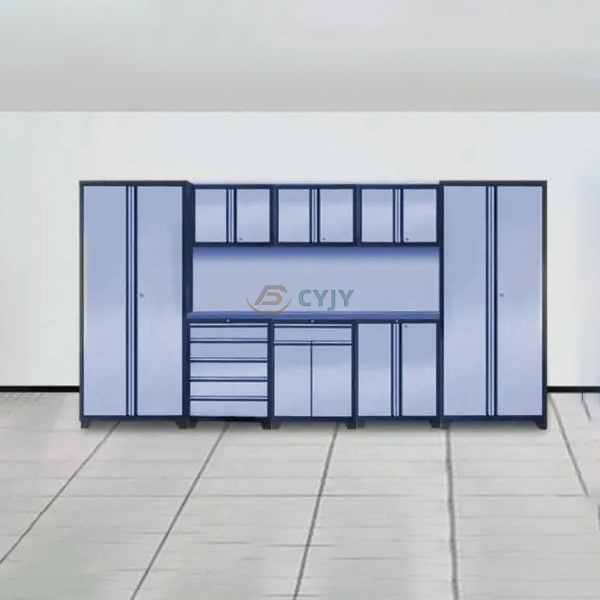
A garage cabinet may look straightforward from the outside: several steel panels, doors, shelves, hinges, handles, and a locking system. In a real workshop, however, every part has a job. Doors need to remain aligned, shelves need to support their intended loads, panels need enough rigidity to avoid unwanted movement, and the finished surface needs to withstand repeated handling.
The challenge becomes more demanding when the requirement is for a bulk order. A cabinet that works perfectly as a single prototype is not automatically suitable for hundreds or thousands of units. Production consistency becomes just as important as the original design. A small dimensional difference repeated across a large shipment can lead to difficult assembly, uneven doors, incompatible components, or increased after-sales work.
For this reason, a bulk cabinet purchase should be viewed as a complete manufacturing project rather than simply a product purchase.
Why Laser Cutting Matters in Cabinet Production
Laser cutting is particularly useful when a cabinet contains repeated holes, slots, mounting openings, ventilation patterns, brackets, door components, or customized panel geometries. Instead of relying entirely on conventional cutting methods, a digital cutting file can control the shape and location of numerous features on a sheet.
This becomes valuable for bulk production because the same approved design can be repeated across a large production run. When the design has been properly prepared, the process helps reduce variation between batches and makes customized cabinet layouts easier to reproduce.
Accuracy Is More Than a Clean Cut
A smooth laser-cut edge is useful, but cabinet performance depends on more than the appearance of the cut. Hole position, panel dimensions, bending allowances, corner geometry, and the relationship between adjacent components all affect final assembly.
For example, if mounting holes are slightly misplaced, a shelf bracket may become difficult to install. If door mounting points do not match the cabinet frame, the final gap can become uneven. A reliable manufacturing process therefore connects laser cutting with bending, welding, assembly, and inspection rather than treating cutting as an isolated operation.
Material Selection and Structural Design
Steel remains a practical material for garage storage because it combines rigidity, durability, and suitability for formed sheet-metal construction. The correct material thickness, however, depends on cabinet size, shelf loading, door construction, reinforcement, transportation requirements, and the intended environment.
Choosing the thickest possible sheet is not always the most efficient solution. Additional material can increase cabinet weight, freight cost, handling requirements, and manufacturing expense. A better approach is to match the sheet specification to the actual structural requirements of the cabinet.
| Design Area | What Buyers Should Consider | Why It Matters |
|---|---|---|
| Cabinet Panels | Steel grade, thickness, panel size and reinforcement | Influences rigidity, weight and long-term stability |
| Shelves | Thickness, reinforcement and support spacing | Helps reduce bending when storing heavier items |
| Doors | Panel construction, hinges, frame and locking points | Affects alignment and daily operating feel |
| Frame | Folded edges, reinforcements and joining method | Contributes to overall cabinet rigidity |
| Hardware | Handles, locks, hinges and shelf supports | Determines usability and replacement requirements |
A useful specification should therefore describe the cabinet as a complete structure instead of focusing only on the steel sheet thickness.
Dimensions, Shelves and Internal Layout
Garage storage requirements vary considerably. Automotive workshops may need space for power tools and replacement parts, while home garages may require compartments for gardening equipment, sports goods, cleaning supplies, and seasonal items.
Internal organization often determines whether a cabinet is genuinely useful. Adjustable shelves can make one cabinet suitable for different storage requirements, while fixed shelves can provide a more rigid arrangement when the contents are predictable.
Think About the Items Before Finalizing the Cabinet
- Measure the largest item that must fit inside.
- Allow practical clearance around frequently removed tools.
- Consider whether shelves need to be adjustable.
- Check whether doors require additional clearance when opened.
- Leave enough space for handles and locking mechanisms.
- Confirm whether cabinets will be installed individually or as a continuous storage system.
- Consider floor conditions and whether leveling feet are required.
These details are particularly important for distributors because the cabinet may eventually be installed in many different customer environments. A flexible interior can make a standard cabinet easier to sell across multiple applications.
From Sheet Metal to Finished Cabinet
A dependable bulk production process usually involves several connected stages. Each stage influences the next one, so problems should be identified before they reach final assembly.
For large orders, process stability is especially important. The objective is not merely to produce one excellent cabinet but to maintain the same basic performance throughout the production quantity.
Surface Treatment and Everyday Protection
Garage cabinets can encounter dust, moisture, fingerprints, workshop debris, occasional oil contact, and repeated handling. A suitable surface finish therefore contributes to both appearance and service life.
Powder coating is widely used on steel storage products because it creates a uniform finished surface when the preparation and curing process are properly controlled. The final result depends on more than the powder itself. Cleaning, pretreatment, coating coverage, curing conditions, and handling after coating all influence the finished surface.
Look Beyond Color
When specifying a cabinet, buyers often focus heavily on black, grey, white, or a custom RAL color. Color is important for brand consistency, but surface performance should also be considered.
- Confirm the requested coating type.
- Specify the required color reference rather than relying only on a verbal description.
- Discuss surface texture, especially when appearance is important.
- Confirm how exposed edges and folded areas are treated.
- Ask how coating consistency is checked during production.
For customers selling under their own brand, consistency in finish can be just as important as dimensional consistency because repeated orders should maintain a recognizable product appearance.
Quality Checks That Matter in Bulk Orders
Quality control should be connected to the problems buyers actually experience after delivery. A cabinet can look attractive in a product photograph while still creating difficulties during installation if the holes, bends, shelves, or hardware are inconsistent.
| Inspection Point | Typical Concern | Buyer Benefit |
|---|---|---|
| Sheet Material | Incorrect or inconsistent material specification | More predictable structural performance |
| Cutting | Incorrect dimensions, openings or hole positions | Better component fit |
| Bending | Inconsistent angles or dimensions | More stable assembly |
| Welding | Weak joints, distortion or poor appearance | Improved structural integrity |
| Coating | Uneven coverage, scratches or poor adhesion | More consistent appearance and protection |
| Assembly | Door, shelf or lock alignment problems | Reduced installation and service issues |
| Packaging | Corner damage or panel deformation during transport | Fewer delivery-related claims |
Before placing a major order, it is useful to request a sample or pre-production unit. This gives the buyer an opportunity to verify dimensions, assembly, hardware, finish, packaging, and general usability before the complete quantity is manufactured.
Packaging, Shipping and Installation
International transportation creates another layer of risk. Metal cabinets can be strong enough for workshop use but still vulnerable to dents, scratches, bent corners, or damaged hardware if packaging is not designed around the product.
Bulk buyers should review packaging before production rather than treating it as an afterthought. The best packaging arrangement depends on whether the cabinets ship assembled or knocked down, the shipping route, container loading method, and the expected handling conditions.
Questions Worth Asking About Packaging
- Are cabinets shipped fully assembled or in knock-down form?
- How are painted surfaces separated from one another?
- Are cabinet corners protected against impact?
- Are shelves and hardware packed securely?
- Is an assembly instruction included where required?
- Can packaging be customized for retail or distributor requirements?
- Has the loading arrangement been reviewed for container efficiency?
Knock-down construction can be useful for international distribution because it can reduce shipping volume and simplify handling. However, the joints and hardware still need to provide a stable final cabinet after assembly.
What Buyers Should Confirm Before Ordering
A clear purchasing specification reduces misunderstandings between the buyer and manufacturer. Instead of sending only a product photo and estimated quantity, provide the information that determines how the cabinet should actually be made.
- Overall cabinet width, depth and height
- Steel material and thickness requirements
- Door configuration
- Number and type of shelves
- Target shelf loading requirements
- Lock and handle requirements
- Color and surface finish
- Logo or branding requirements
- Assembly method
- Packaging configuration
- Quantity and expected production schedule
- Inspection and sample approval requirements
If the cabinet is being developed from an existing product, photographs and samples can help. For a new design, CAD drawings, dimensioned sketches, or a detailed bill of materials can reduce interpretation errors during quotation and production.
For OEM and private-label projects, it is also worth discussing which components are standardized and which parts can be customized. Keeping commonly used hardware or structural components standardized can simplify future replacement orders while still allowing visible panels, dimensions, colors, and layouts to reflect the buyer's market.
Where Bulk Metal Garage Cabinets Fit Best
The same cabinet platform can serve different markets when its dimensions, internal arrangement, and hardware are configured appropriately.
| Application | Common Storage Requirements | Useful Cabinet Features |
|---|---|---|
| Automotive Workshops | Hand tools, spare parts, maintenance supplies | Strong shelves, secure doors, easy-access organization |
| Home Garages | Tools, gardening equipment, sports goods | Flexible shelving and compact footprint |
| Industrial Workshops | Production tools, components and maintenance items | Durable construction and high storage efficiency |
| Warehouses | Small parts, tools and maintenance stock | Clear internal organization and lockable storage |
| Distributors | Standardized products for different customers | Repeatable specifications, packaging and branding options |
| Commercial Projects | Large quantities across multiple locations | Consistent dimensions, finish and batch performance |
For distributors and project contractors, the ability to repeat the same cabinet specification can be particularly valuable. Once a model has been approved, future orders can follow the established design instead of starting the specification process again from the beginning.
Frequently Asked Questions
Are laser cut metal garage cabinets suitable for bulk orders?
Yes. Laser cutting is well suited to repeat production because digital cutting files can be reused after the design has been approved. For bulk orders, the cutting process should be integrated with bending, joining, finishing, assembly, and inspection to maintain consistent results.
Can the dimensions of metal garage cabinets be customized?
In many manufacturing projects, cabinet width, depth, height, shelf arrangement, door configuration, hole patterns, and other structural details can be customized. The available range depends on the manufacturer's equipment and production process.
What information should be provided for a custom cabinet quotation?
Provide cabinet dimensions, material requirements, sheet thickness, door and shelf configuration, hardware, surface finish, quantity, packaging expectations, and any drawings or reference samples. The more complete the specification, the easier it is to prepare a meaningful quotation.
Can metal garage cabinets be produced with a private-label design?
OEM and private-label projects may include customized colors, logos, dimensions, hardware, packaging, and internal layouts. These requirements should be confirmed during the quotation and sample-development stage.
How should shelf capacity be specified?
Shelf capacity should be discussed according to the intended load and how that load is distributed. The shelf material, reinforcement, support spacing, cabinet width, and mounting structure all influence actual performance, so a manufacturer should confirm the appropriate design rather than relying on a single thickness figure.
Is powder coating suitable for garage storage cabinets?
Powder coating is commonly used for steel storage products because it can provide a durable finished surface. Proper metal preparation, coating application, curing, and handling are important for achieving consistent results.
Should bulk buyers request a sample before production?
A pre-production sample is strongly useful for confirming the details that are difficult to judge from drawings alone, including door alignment, shelf installation, hardware operation, surface appearance, assembly method, and packaging.
Can garage cabinets be supplied in knock-down form?
Yes, knock-down construction is commonly considered for products that need efficient international transportation. The design should be checked carefully so that flat-pack shipping does not compromise final rigidity, assembly convenience, or hardware reliability.
Building a Better Bulk Cabinet Specification
The right laser cut bulk metal garage cabinet is not determined by one specification alone. Material, cabinet geometry, cutting accuracy, bending, reinforcement, hardware, coating, packaging, and inspection all contribute to the finished product.
For buyers, the most useful approach is to define the real working conditions first. What will the cabinet store? How much space is available? How often will the doors be opened? What kind of loads will the shelves carry? Will the cabinets be sold individually or installed as part of a larger workshop system? Will they need private labeling or customized packaging?
Once these questions are clear, the manufacturing specification becomes much easier to build. It also gives the supplier a better basis for recommending suitable materials, structural details, production methods, and packaging.
Qingdao Chrecary International Trade Co., Ltd. can work with buyers on metal garage cabinet requirements covering product configuration, customization, bulk production, and export-oriented supply. A detailed drawing, reference image, sample, or basic dimensional requirement can provide a starting point for discussing the project.
Need Laser Cut Bulk Metal Garage Cabinets?
Whether you are sourcing garage storage cabinets for distribution, workshop projects, commercial facilities, or private-label sales, a clear specification can make the entire purchasing process more efficient.
Share your required dimensions, quantity, material preference, cabinet layout, finish, packaging requirements, or existing drawings with Qingdao Chrecary International Trade Co., Ltd. The team can review your requirements and discuss a practical configuration for your market.
Have a cabinet project in mind? Contact us with your requirements and start a conversation about your bulk metal garage cabinet order.
Contact Us