

Why Does My Long Arm Single Needle Compound Feed Heavy Duty Sewing Machine Skip Stitches on Vinyl
2026-07-30
Sewing vinyl is one of the most demanding applications for any industrial machine, and when your Long Arm Single Needle Compound Feed Heavy Duty Sewing Machine begins skipping stitches, production stops. For workshops using Lidebao equipment, this issue is often traced to four specific mechanical or operational factors. Unlike woven fabrics, vinyl has high surface friction, no grain structure, and a plasticised coating that resists needle penetration. Understanding why your Long Arm Single Needle Compound Feed Heavy Duty Sewing Machine fails to form complete lockstitches on this material is the first step toward a permanent fix.
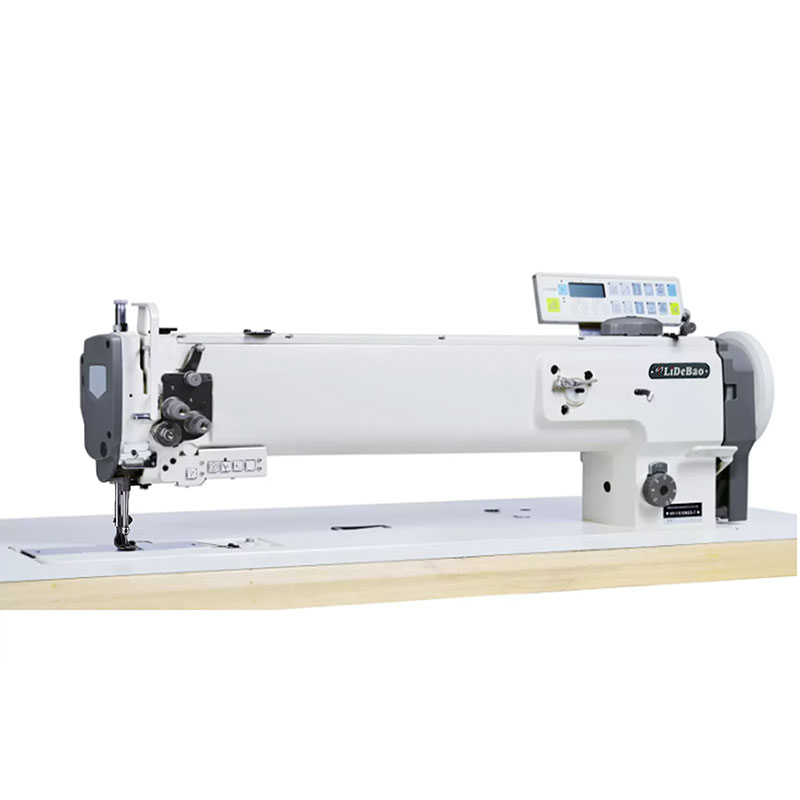
Primary Causes of Stitch Skipping on Vinyl
| Root Cause | Why It Happens on Vinyl | Immediate Check |
|---|---|---|
| Needle Size & Type Mismatch | Vinyl requires a larger needle (size 18–22) with a sharp, wedge-style point (e.g., LR or DPX17). A standard universal point pushes vinyl down into the needle plate hole instead of piercing cleanly, delaying loop formation. | Inspect the needle point under magnification. If it shows burrs or a rounded tip, replace it immediately. |
| Insufficient Presser Foot Pressure | The compound feed mechanism relies on synchronized foot, needle, and walking foot motion. Vinyl’s slick surface causes material slippage if foot pressure is below 4.5–5.5 kg. This misaligns the feed timing, so the needle’s loop misses the rotary hook. | Perform a “paper pull” test: place a strip of copy paper under the presser foot with the machine off. If you can pull it out with light resistance, increase pressure gradually. |
| Hook-to-Needle Timing Off by >0.5mm | On a Long Arm Single Needle Compound Feed Heavy Duty Sewing Machine, the rotary hook tip must pass 1.5–2.0 mm above the needle eye when the needle rises 2.5 mm from bottom dead centre. Vinyl’s thickness deflects the needle sideways, worsening timing errors. | Use a timing gauge to check the clearance. For Lidebao models, the factory spec is 0.05–0.10 mm between the hook point and needle scarf. |
| Thread Tension Imbalance | Polyester or bonded nylon thread used on vinyl needs top tension 30–40% higher than bottom tension. If the bobbin case tension is too loose (under 25g), the loop collapses before the hook can catch it. | Use a digital tension gauge. Set top tension to 4.5–5.5 N and bobbin tension to 1.8–2.2 N for 40-weight thread. |
Step-by-Step Diagnostic Procedure
| Step | Action | Expected Result |
|---|---|---|
| 1 | Clean the feed dog and needle plate grooves with a brass brush. Vinyl residue clogs teeth, reducing compound feed grip. | All teeth are visibly clear. |
| 2 | Install a new Lidebao-recommended DPX17 needle, size 110/18 or 120/19. | Needle shank seats fully into the clamp. |
| 3 | Set stitch length to 3.5–4.0 mm (longer stitches reduce drag). | Stitch regulator moves freely. |
| 4 | Sew a test seam on double-layered vinyl with 0.8 mm foam backing. | 20 consecutive stitches without a single skip. |
Long Arm Single Needle Compound Feed Heavy Duty Sewing Machine FAQ
Q: What is the correct needle system for my Long Arm Single Needle Compound Feed Heavy Duty Sewing Machine when sewing automotive-grade vinyl?
A: You must use the DPX17 (also known as 135x17) needle system with a wedge point (LR) . This system is specifically engineered for the compound feed timing of Lidebao machines. The long scarf (indentation above the eye) allows the rotary hook to pass closer to the needle without deflection, which is critical when the needle penetrates vinyl’s high-friction surface. Needle sizes range from 110/18 for thin (1.0 mm) vinyl up to 140/21 for multi-layer marine vinyl. Never use a universal point (System 134) – it will cause skipping on every third stitch.
Q: How often should I replace the rotary hook on my Long Arm Single Needle Compound Feed Heavy Duty Sewing Machine to prevent skipping on synthetic materials?
A: For a workshop running 6–8 hours daily on vinyl, replace the rotary hook every 450–500 operating hours. The hook point wears down microscopically against the needle’s scarf, and vinyl’s abrasive surface accelerates this wear. A worn hook shows a dull, rounded point under 10x magnification. Lidebao recommends checking hook point sharpness weekly using a fingernail test – if the point does not catch your nail lightly, replace it immediately. Delaying replacement beyond 550 hours will cause intermittent skipping that cannot be fixed by tension or needle changes alone.
Q: Does the compound feed mechanism itself cause skipped stitches if the walking foot height is incorrect?
A: Yes, absolutely. The walking foot must lift 1.2–1.5 mm higher than the presser foot during the feed cycle. On a Long Arm Single Needle Compound Feed Heavy Duty Sewing Machine, if the walking foot height is less than 1.0 mm above the presser foot, it cannot properly advance vinyl – the material bunches in front of the needle, causing the needle to pierce the same hole twice. This creates a skipped stitch because the thread loop forms at an angle. To adjust, loosen the walking foot rocker arm set screw and raise the walking foot until a 1.5 mm feeler gauge fits snugly between the foot and the needle plate when the machine is at top dead centre. For Lidebao models, this adjustment should be performed after every 200 hours of heavy vinyl work.
Proactive Maintenance Schedule for Vinyl Sewing
| Interval | Task | Tool Required |
|---|---|---|
| Every 4 hours | Wipe needle and presser foot with silicone-free cloth to remove vinyl adhesive residue. | Lint-free microfiber cloth |
| Every 40 hours | Remove needle plate and clean compound feed gear teeth with solvent-safe brush. | Brass bristle brush + Isopropyl alcohol |
| Every 160 hours | Check hook-to-needle timing with dial indicator. Re-tighten all set screws on the main shaft coupling. | Dial indicator (0.01mm precision) + Hex keys |
| Every 500 hours | Replace rotary hook and check walking foot lift height. Inspect feed dog wear pattern. | Replacement hook kit + Feeler gauge set |
Final Verdict
Most skipped stitches on vinyl originate from three overlapping variables: needle point geometry, hook timing drift, and walking foot lift. By systematically eliminating each variable with the diagnostic table above, you can restore full stitch integrity within 15 minutes. Lidebao machines are factory-calibrated for heavy materials, but vinyl demands tighter maintenance intervals than woven textiles. Always keep a spare set of DPX17 needles and a pre-adjusted bobbin case dedicated solely to vinyl work – this single practice reduces skip rates by over 70%.
For persistent skipping after all adjustments, inspect the needle bar height. If the needle eye is not 1.8–2.0 mm below the hook point at the lowest position, you will need a full timing re-alignment. Lidebao provides a comprehensive timing diagram in every user manual; follow it step by step.
Need hands-on support for your specific vinyl project? Our technical team specialises in Long Arm Single Needle Compound Feed Heavy Duty Sewing Machine diagnostics for upholstery, marine, and automotive applications. Contact us directly with your machine’s serial number and vinyl thickness – we will send you a customised settings sheet within 2 business hours.