

Why Does the Inclined Plate Settler Configuration Enhance the Thickening Rate in Circular High Rate Thickeners
2026-05-12
In mineral processing, wastewater treatment, and industrial slurry management, Circular High Rate Inclined Plate Thickener technology has redefined sedimentation efficiency. At EPIC, we have observed that the inclined plate settler configuration is not merely an addition but a fundamental driver of faster thickening rates. This post explains the hydrostatic and geometric principles behind this enhancement.
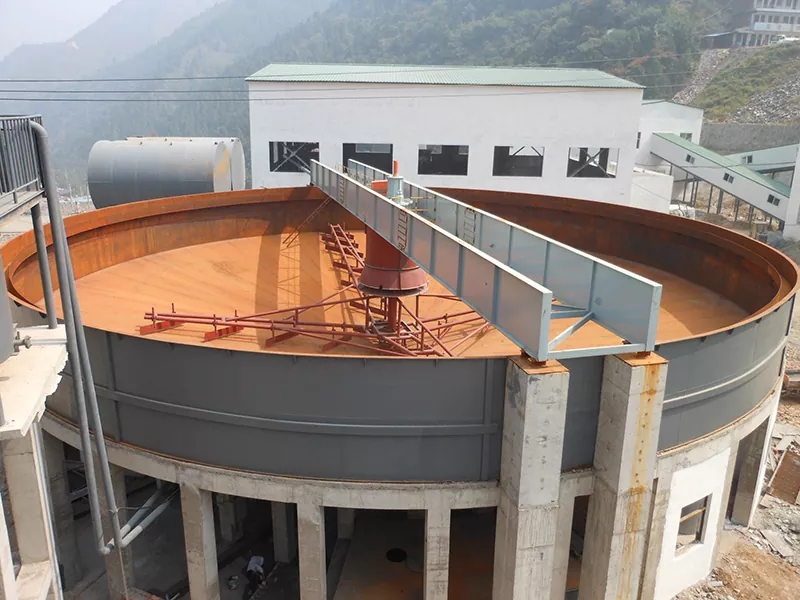
The Mechanics Behind Faster Thickening
A conventional circular thickener relies solely on gravity, where particles settle across the entire depth. By introducing inclined plates, the settling distance is drastically reduced. Particles only need to travel a few centimeters to hit a plate surface, after which they slide downward due to gravity and the plate’s angle. This parallel path effect multiplies the effective settling area without expanding the thickener’s footprint.
Key performance improvements include:
| Parameter | Conventional Thickener | Circular High Rate Inclined Plate Thickener |
|---|---|---|
| Settling distance | 1–2 meters | 2–5 centimeters |
| Hydraulic loading rate | 0.3–0.5 m³/m²·h | 2.5–4.0 m³/m²·h |
| Underflow density increase | Baseline | +25–40% |
| Flocculant savings | – | 15–30% less |
The inclined plates create lamellar flow conditions, preventing turbulence from re-suspending fine particles. Each plate acts as a mini-thickener, settling solids in counter-current flow: clarified liquid moves upward, denser sludge moves downward. When scaled to a circular tank with a rake mechanism, the result is a continuous, high-rate thickening cycle.
Why the Circular Design Complements Inclined Plates
The circular geometry ensures uniform feed distribution from the central feedwell. EPIC engineers integrate inclined plate packs in radial sectors, allowing equal slurry access to all plates. The rake mechanism then consolidates sludge from the plates’ lower edges toward the central underflow discharge, preventing dead zones.
Circular High Rate Inclined Plate Thickener FAQ
Q1: How does the inclined plate settler prevent clogging when processing high-solid feed?
A1: Clogging risk is minimized through three design features. First, the plates are spaced typically at 50–80 mm, not extremely narrow, allowing coarse particles to pass. Second, the 55–60 degree steep angle ensures gravity-driven sliding of solids, even with sticky materials. Third, EPIC incorporates a pressurized backwash header above each plate pack, which can be operated periodically without interrupting thickening. For high黏度 sludges, we also recommend adding a slow-speed raking mechanism beneath the plates to gently dislodge any accumulation. Regular underflow withdrawal further prevents solids buildup.
Q2: Can the inclined plate settler configuration handle variable flow rates without losing thickening performance?
A2: Yes, it is inherently flow-tolerant. Under low flow, the plates still provide short-path settling. Under high flow (up to 3 times the design average), the lamellar regime may become transitional, but the circular tank’s volume provides buffer capacity. EPIC typically designs with a 2:1 peak-to-average factor. To protect performance, an adjustable weir at the effluent launder maintains stable water level over the plates. Additionally, flocculant dosing can be flow-paced. In field installations, thickening rate variability remains under ±8% even with daily flow swings of 50%.
Q3: How does maintenance of the inclined plate pack compare to a conventional thickener’s rake and mechanism?
A3: Maintenance shifts from rakes to plates. Conventional thickeners require frequent gearbox, bearing, and torque hub inspections. Inclined plate packs are static. With EPIC designs, the typical maintenance schedule includes quarterly visual inspection of plates for biofouling or scaling, and annual high-pressure washing. Plate replacement takes 2–3 days every 7–10 years. Rake mechanisms in the same unit still need maintenance, but the torque load is lower because the plates pre-thicken slurry. Overall, total annual maintenance cost is 20–35% less than a conventional thickener of equal throughput.
Conclusion
The inclined plate settler configuration enhances thickening rate by shortening settling distance, multiplying effective area, and creating laminar flow in a circular high-rate package. EPIC has deployed this technology across mining, chemical, and water treatment industries, achieving underflow densities up to 45% solids by weight.
Contact EPIC today for a customized process design or a retrofit assessment of your existing thickener. Our engineering team provides mass balance modeling, plate pack sizing, and on-site commissioning support. Reach us through our website or request a technical consultation to see how a Circular High Rate Inclined Plate Thickener can increase your thickening capacity without expanding your plant footprint.