

Why Is a lost foam casting production line Becoming the Smarter Choice for Modern Foundries?
2026-03-20
When I look at the pressure many foundries face today, I see the same pattern again and again: customers want better dimensional consistency, cleaner surfaces, lower labor dependence, and a production method that does not create unnecessary complexity on the shop floor. That is exactly where Qingdao Kaijie Heavy Industry Machinery Co., Ltd. gradually comes into the picture for buyers who are evaluating a more practical and scalable lost foam casting production line. Instead of treating casting equipment as a simple collection of machines, I prefer to look at the full production logic behind it, because real value comes from how each stage works together to improve output, reduce rework, and support stable long-term production.
If I am choosing a production solution for cast components, I do not only care about whether it can run. I care about whether it can help me solve familiar operational problems, including pattern consistency, coating quality, sand handling efficiency, production flexibility, and the hidden cost of scrap. A well-designed lost foam casting production line gives me a stronger answer to those issues because it supports pattern forming, coating treatment, vibration compaction, pouring, cooling, and sand recycling as a connected manufacturing process rather than isolated tasks.
What Problems Usually Push Foundries to Rethink Their Existing Casting Setup?
I often find that many production managers are not actively looking for change until the same problems start hurting delivery and profit at the same time. In many conventional casting environments, these issues appear gradually and then become difficult to ignore.
- I may struggle with inconsistent casting dimensions across batches
- I may spend too much time on finishing because the casting surface quality is unstable
- I may face rising labor costs due to process steps that depend too heavily on manual experience
- I may lose production time because sand handling and mold preparation are not well coordinated
- I may see avoidable defects caused by weak pattern protection or unstable mold conditions
- I may need a process that can handle both simple parts and more complex structures with better repeatability
When these problems start to overlap, replacing individual machines is usually not enough. I need a system-level upgrade, and that is why a properly planned lost foam casting production line becomes attractive. It offers a more integrated path for improving product quality and production control.
How Does a lost foam casting production line Actually Work in Real Production?
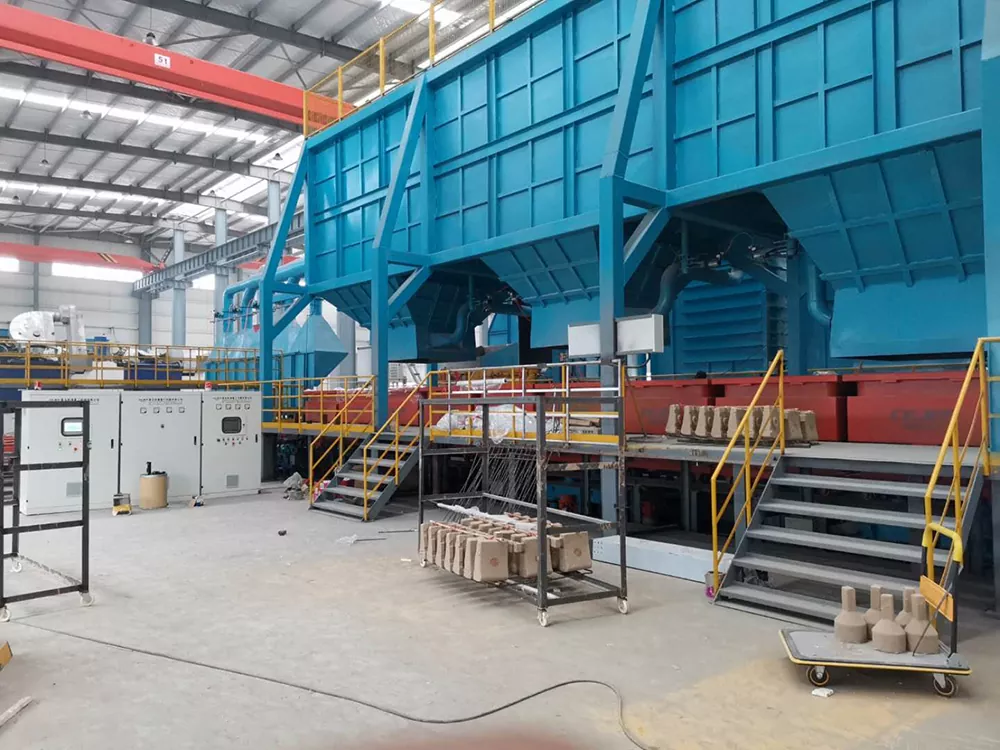
I like this process because it is easier to understand when I divide it into practical workshop stages. First, foam patterns are produced and assembled to match the required casting geometry. Then the patterns are coated and dried so the surface can stay protected during sand filling and pouring. After that, the coated pattern cluster is placed into a flask and packed with dry sand through vibration. When molten metal is poured in, the foam pattern is replaced by metal, and the final casting takes shape. Once solidification is complete, the casting is removed and the dry sand can be processed for reuse.
This production logic matters because it is not just about making castings. It is about making castings with a process structure that helps me reduce unnecessary variation. On the product page, the manufacturer describes the line through distinct working sections for foam pattern preparation, coated pattern processing, and final casting formation, which reflects a more organized workflow for foundry use. It also highlights dry sand handling and reuse, along with solution options ranging from simple to semi-automatic and automatic configurations. :contentReference[oaicite:0]{index=0}
Why Does Process Integration Matter More Than Buying Standalone Equipment?
I have seen many buyers focus too much on one machine and too little on the full workflow. That usually leads to a line that looks complete on paper but creates bottlenecks in daily production. If the foam area, coating area, molding area, and sand handling area are not matched correctly, the entire workshop feels slower than it should.
What I want from a production line is coordination. I want the upstream pattern process to feed the downstream casting process without unnecessary waiting. I want coating and drying to support pattern stability. I want vibration compaction to improve mold integrity. I want sand recycling to support cleaner and more cost-conscious production. A complete lost foam casting production line is valuable because it connects these needs into one operating structure.
| Production Concern | Common Workshop Risk | How an Integrated Line Helps |
|---|---|---|
| Pattern consistency | Dimensional variation between batches | More standardized foam pattern production and assembly workflow |
| Surface protection | Rough finish or damaged pattern surfaces | Coating and drying stages support pattern integrity before pouring |
| Mold stability | Collapse, deformation, or unstable cavities | Dry sand filling and vibration compaction improve support conditions |
| Production efficiency | Disconnected operations and unnecessary downtime | Linked process design improves workflow continuity |
| Sand cost control | Waste and poor reuse management | Sand processing supports recycling and reuse of dry sand |
| Scalability | Equipment that cannot adapt to changing order volume | Simple, semi-automatic, and automatic layouts allow more flexible planning |
What Advantages Make This Process More Competitive for Foundries Under Cost Pressure?
From my perspective, the biggest advantage is that this process helps me pursue better quality and efficiency at the same time. That combination matters because many foundries are under pressure from labor costs, shorter lead times, and stricter customer expectations.
- I can support more accurate shape replication for complex parts
- I can improve surface appearance and reduce excessive finishing work
- I can build a cleaner and more organized production flow around dry sand handling
- I can choose a line structure that better matches my current scale and future expansion plan
- I can reduce hidden losses caused by unstable process coordination
- I can create a stronger base for long-term production standardization
For many buyers, that last point is especially important. I do not want equipment that only works when my most experienced workers are present. I want a production setup that helps the factory become more controllable, more teachable, and easier to optimize over time. That is one of the strongest reasons to invest in a lost foam casting production line rather than continuing with fragmented upgrades.
Which Type of Buyer Benefits Most from This Kind of Production Line?
I would say this solution is especially relevant if I fall into one of the following groups.
- I run a foundry that wants to move from a basic setup toward a more organized and repeatable production model
- I handle castings with shapes that demand better detail reproduction
- I need a line that can be adjusted to different order sizes and production targets
- I want to reduce dependence on inefficient manual coordination between process stages
- I am planning long-term equipment investment and care about installation, commissioning, and after-sales support as part of the decision
The official product information also shows that the manufacturer provides multiple configuration levels, including simple, semi-automatic, vacuum casting, and automatic options, which is useful for buyers who want to compare investment levels against production needs. :contentReference[oaicite:1]{index=1}
How Should I Evaluate a Supplier Before I Decide?
I never judge a supplier by a product photo alone. A serious project needs more than a catalog description. When I assess a supplier for a lost foam casting production line, I focus on whether they can support the entire production logic from design to implementation.
| Evaluation Point | What I Look For | Why It Matters |
|---|---|---|
| Process understanding | Knowledge of foam pattern, coating, pouring, and sand recovery stages | A supplier should understand the line as a system, not just sell equipment |
| Customization ability | Willingness to adapt layout and configuration to production needs | Different foundries require different levels of automation and output |
| Installation and commissioning | Practical support after equipment delivery | Line performance depends heavily on proper setup and coordination |
| Service continuity | Reliable communication and post-sale response | Production lines need long-term support, not one-time shipment only |
| Industry experience | Real project background in foundry machinery | Experience helps reduce design mistakes and implementation risk |
On its product page, the company presents itself as a manufacturer involved in design, manufacturing, installation, commissioning, and service for foundry machinery, with experience in lost foam casting solutions and different production line layouts. That kind of end-to-end positioning is relevant for buyers who do not want to coordinate multiple suppliers on their own. :contentReference[oaicite:2]{index=2}
Why Does Customization Matter So Much in Foundry Equipment Decisions?
I do not believe in one-size-fits-all production planning. A smaller foundry with unstable orders may need a simpler line with room for future upgrades, while a larger operation may prioritize automation, throughput, and tighter process control from the beginning. If the supplier cannot adjust the solution to actual production goals, the project can become expensive without being efficient.
This is why I pay attention to whether the supplier can match equipment structure with my casting type, workshop space, labor condition, and investment plan. A good lost foam casting production line should not force me into an oversized system or leave me with a layout that cannot grow as my business expands.
Can a Better Line Really Help Me Improve Product Quality and Business Stability?
Yes, and I say that carefully. No production line removes every foundry challenge overnight, but a well-planned system gives me a much stronger foundation. When pattern preparation, coating, molding, pouring, and sand treatment are connected properly, I gain more than equipment efficiency. I gain process consistency. That consistency supports better part quality, more predictable delivery, and a stronger reputation with customers who expect repeatable results.
For me, this is where investment decisions become strategic. I am not only buying machinery. I am improving the way my factory produces value. A more coordinated lost foam casting production line can help me reduce avoidable waste, manage production more effectively, and position my foundry for more demanding projects in the future.
What Should I Do If I Am Comparing Solutions Right Now?
If you are currently reviewing foundry equipment options, I would strongly recommend that you compare more than just machine price. Look at the full process design, the flexibility of the configuration, the supplier’s practical support capacity, and the long-term production value the line can bring to your workshop. If you want a more dependable way to improve casting consistency, workflow coordination, and scalable production planning, Qingdao Kaijie Heavy Industry Machinery Co., Ltd. is worth evaluating in more detail. If you are ready to discuss your casting requirements, workshop conditions, or target capacity, please contact us and send your inquiry today. A suitable lost foam casting production line starts with the right conversation.